
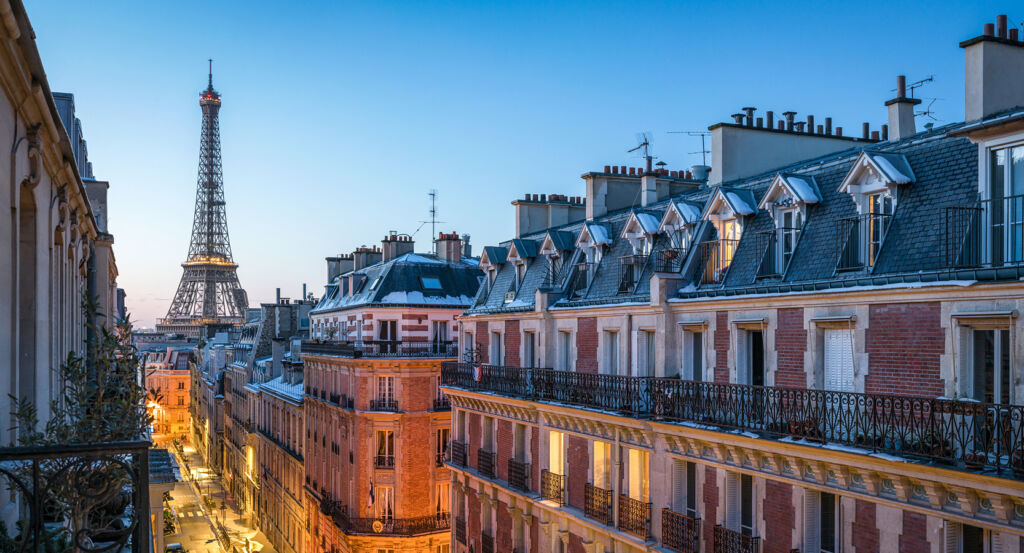
Why 8th Arrondissement matters.
8th Arrondissement is an imposing enclave where the ceremonial western axis of Paris meets a district of formal gardens, grand avenues, private mansions and commercial streets shaped by royal planning, nineteenth-century expansion and the rise of French luxury.
Positioned between 1st Arrondissement, 9th Arrondissement, and 16th Arrondissement, the neighborhood occupies a broad Right Bank territory extending from the gardens near Place de la Concorde through the Champs-Élysées corridor to the approaches of the Arc de Triomphe and north toward Monceau. Long axial avenues establish an expansive physical scale, yet streets around Madeleine, Faubourg Saint-Honoré and Europe introduce denser sequences of stone apartment houses, courtyards and former private residences behind restrained facades. Avenue des Champs-Élysées establishes the primary encounter through the westward perspective originating at the Tuileries, with planted gardens and broad promenades gradually giving way to an intensely built metropolitan avenue. Avenue Montaigne and Rue du Faubourg Saint-Honoré deepen that character through two distinct concentrations of fashion houses, galleries and historic residences whose comparatively narrow frontages pull the district back toward the scale of individual addresses. Northern streets change the rhythm again around Europe and Monceau, where rail infrastructure, curving avenues and planted squares interrupt the dominant east-west geometry. The result is an Arrondissement whose imposing scale contains several distinct urban worlds, preparing a history that begins with woods and cultivated ground before royal landscape design redirected the expansion of western Paris.
What you should know 8th Arrondissement.
8th Arrondissement is best known for containing the western ceremonial axis whose development began when Louis XIV ordered a route beyond the Tuileries in 1667 and André Le Nôtre extended the garden's central perspective toward the heights of Chaillot. Le Nôtre transformed the route into the Grand Cours by 1670, lining the avenue with elms across territory still dominated by fields, market gardens and sparse buildings. The axis initially terminated around the present Rond-Point des Champs-Élysées before continuing toward the Butte de l'Étoile, with the Allée des Veuves and Avenue d'Antin branching south toward the Cours-la-Reine. Duc d'Antin renewed the plantings during the early eighteenth century, and Abel Poisson, marquis de Marigny, carried further improvements into territory increasingly used for public promenade. Ange-Jacques Gabriel supplied another decisive intervention after his design for Place Louis XV was accepted in 1755, establishing an immense royal square between the Tuileries and the developing western avenue. The Revolution radically changed its political meaning when the square, renamed Place de la Révolution, became the execution site of Louis XVI in January 1793 and Marie-Antoinette that October. Nineteenth-century Paris subsequently absorbed the former peripheral territory into a much denser western district, but the seventeenth and eighteenth-century geometry endured as the organizing structure connecting Central Paris with the Étoile.
Fashion supplied a separate mechanism for consolidating the Arrondissement's international significance during the twentieth century. The western fashion district was still heavily residential in 1909 when Paul Poiret left Rue Pasquier for a private mansion near the Champs-Élysées, entering an area of aristocratic houses and broad avenues increasingly associated with fashionable public display. Construction of the Plaza Athénée and Théâtre des Champs-Élysées strengthened Avenue Montaigne's cultural position as antiquarians, tailors and perfumers accumulated around the surrounding streets. Madeleine Vionnet moved her house to 50 Avenue Montaigne during the 1920s, joining the shift of couture away from older concentrations closer to the Opéra. Christian Dior opened at 30 Avenue Montaigne in 1946 and presented his first collection there in February 1947, binding a single address to the postwar revival of Paris couture. Successive creative directors including Yves Saint Laurent, Marc Bohan, Gianfranco Ferré, John Galliano, Raf Simons and Maria Grazia Chiuri extended that association across subsequent generations. Avenue Montaigne consequently developed from an aristocratic residential corridor into a concentrated fashion district whose twentieth-century history placed the 8th Arrondissement at the center of Parisian haute couture.
How 8th Arrondissement fits.
8th Arrondissement works as the anchor for an afternoon tracing aristocratic landscape design, Bourbon commemoration and the architectural ambitions of the 1900 Exposition Universelle through three institutions distributed across its western and central districts.
Begin at Parc Monceau, where Louis-Philippe-Joseph d'Orléans, then duc de Chartres, assembled land around a pleasure pavilion and commissioned Louis Carrogis, known as Carmontelle, to create an Anglo-Chinese garden between 1773 and 1778. Carmontelle organized the property as a sequence of seventeen encounters encompassing structures inspired by disparate periods and places, including a pyramid, obelisk, naumachia, Turkish tents and an antique temple; Claude-Nicolas Ledoux added the rotunda of the Barrière de Chartres in 1787 when the Farmers-General wall reached the park, and Jean-Charles Alphand recast the diminished estate as a public promenade in 1860. Continue to Chapelle Expiatoire, built between 1815 and 1826 on the former Madeleine Cemetery where Louis XVI and Marie-Antoinette had been buried following their executions. Louis XVIII initiated the project after the Bourbon Restoration and transferred their remains to Saint-Denis, leaving Pierre Fontaine to design a commemorative complex drawing on antique architecture, French classicism and Italian medieval and Renaissance precedents; its foundation stone was laid on January 21, 1815, the anniversary of Louis XVI's death, and sculptural groups by François Joseph Bosio and Jean-Pierre Cortot gave the interior a dynastic program centered on the executed monarchs. Conclude at Petit Palais, where Charles Girault won the architectural commission in 1896 and spent four years creating one of the permanent buildings planned for the Exposition Universelle of 1900. Girault, Prix de Rome in 1880 and a former student of Honoré Daumet, combined classical references, Art Nouveau decoration and reinforced concrete within a building conceived for a future life as the municipal fine-arts museum; the institution opened in that role in 1902, when the Dutuit brothers' bequest brought a major body of older art into collections previously formed through municipal commissions and acquisitions, and decorative work by artists including Albert Besnard and Maurice Denis continued into the following decades. The progression moves from Carmontelle and Ledoux turning an aristocratic estate into an architectural journey through Fontaine converting Revolutionary burial ground into Bourbon remembrance into Girault joining historical reference with new construction for the Exposition Universelle, tracing three successive moments when patrons and architects used the 8th Arrondissement to reshape the public image of Paris.
Where your story begins.
Foresyte Travel reveals places that feel extraordinary long before you arrive.
Experience premium editorial crafted for luxury travelers.
Foresyte Travel may earn a commission when you book through the link on this page.














































































































