
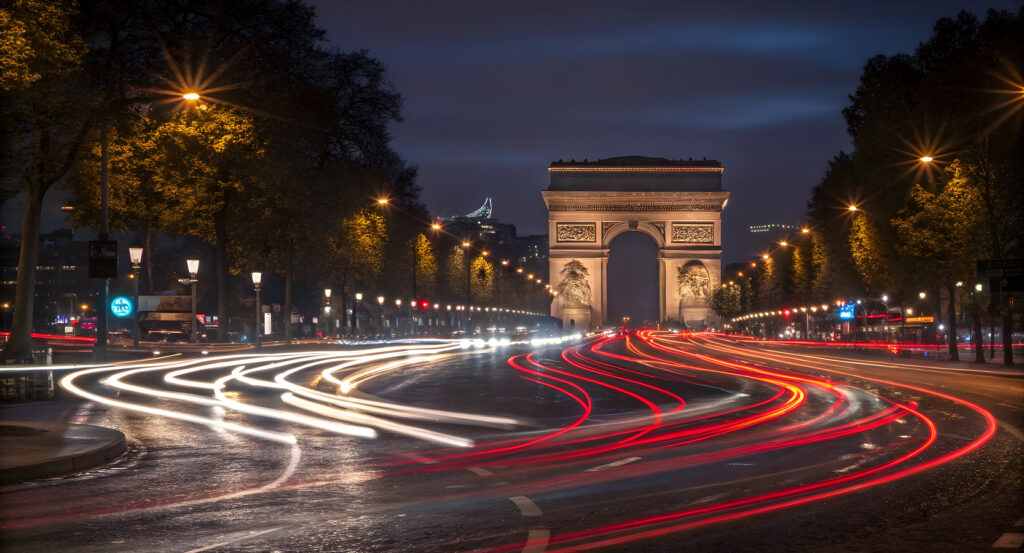
Why Champs-Élysées matters.
Champs-Élysées is a grand ceremonial avenue where the 8th Arrondissement's stately character meets André Le Nôtre's royal perspective, nineteenth-century promenades and the long western axis culminating at the Arc de Triomphe.
Set along Avenue des Champs-Élysées near Avenue Montaigne and just steps from Avenue Franklin D. Roosevelt, the avenue crosses a striking sequence of urban environments where wooded gardens and exhibition palaces at its eastern end give way to continuous stone facades, broad sidewalks and increasingly dense commercial frontage toward the Étoile. The Rond-Point divides the greener lower section from the more intensely built upper avenue, making the shift in scale and enclosure visible along a single sightline. Rows of trees preserve the avenue's origins as a planted promenade as the carriageway rises gradually toward the Arc de Triomphe. Side avenues including George V and Marceau open substantial lateral views through the surrounding blocks, reinforcing the unusually expansive geometry of the district. The result is a vast Parisian promenade whose gardens, architecture and uninterrupted perspective preserve more than three centuries of deliberate development along the city's principal western axis.
What defines Champs-Élysées.
Champs-Élysées is best known for extending the central perspective of the Tuileries westward through an avenue whose form began under Louis XIV and André Le Nôtre. Louis XIV ordered a route toward Saint-Germain-en-Laye in 1667 along the axis of the Tuileries' central allée, and Le Nôtre planted rows of elms beside the new avenue. The Grand Cours reached a star-shaped junction corresponding to the present Rond-Point before the road continued toward the rise at the Étoile and Neuilly. The Champs-Élysées name received official use in 1698, initially referring to the green territory around the lower avenue and drawing its meaning from the Elysian Fields of Greek mythology. Louis-Antoine de Pardaillan de Gondrin, duc d'Antin, renewed planting during the early eighteenth century, and Abel Poisson de Vandières, marquis de Marigny, replanted the gardens in 1765 as elite residences began advancing along the adjoining Faubourg Saint-Honoré territory. Napoleon subsequently selected the western end of the axis for an Arc de Triomphe honoring the Grande Armée, signing the decree on February 18, 1806 after the victory at Austerlitz. Jean-François Thérèse Chalgrin and Jean-Arnaud Raymond prepared the first plans, and the foundation stone was placed on Napoleon's birthday that August. Political regime changes repeatedly interrupted construction before the arch reached completion in 1836, fixing an immense architectural terminus at the Étoile. Champs-Élysées consequently developed from a royal garden extension into a national ceremonial axis through successive interventions that preserved Le Nôtre's original westward perspective even as its political meaning changed.
Jacques-Ignace Hittorff transformed the lower avenue during the July Monarchy by turning its inherited plantations into a coordinated district of gardens, fountains and entertainment architecture. His work began in 1834 alongside his reconstruction of Place de la Concorde, and the garden squares created from 1835 established new public spaces on both sides of the avenue. Hittorff designed fountains including the Grille au coq and Ambassadeurs, built the Pavillon Gabriel in 1841 and completed the present Pavillon Ledoyen in 1842. His Cirque d'Été occupied the Carré Marigny from 1841 until 1900, adding large-scale entertainment to territory previously dominated by planted promenades. Adolphe Alphand took control of another extensive redesign from 1859 under the Second Empire, working with landscape gardener Jean-Pierre Barillet-Deschamps and architect Gabriel Davioud. Curving paths, rolling lawns and flower beds replaced much of the earlier rectilinear garden organization, establishing the landscape composition surviving across the Lower Champs-Élysées. Charles Garnier later created the Théâtre Marigny in 1883 on ground associated with Hittorff's entertainment district, and Albert Ballu added the Pavillon de l'Élysée in 1899. The Exposition Universelle of 1900 brought another architectural concentration to the southern edge through the Grand Palais and Petit Palais, embedding the avenue within a sequence of permanent institutions created for successive forms of Parisian public performance.
How Champs-Élysées fits.
Champs-Élysées works as the anchor for a daytime exploration of the grand western axis using three nearby sites that move from an eighteenth-century royal square through an exhibition palace conceived for the Third Republic into Napoleon's triumphal project completed under the July Monarchy.
Begin at Place de la Concorde, created as Place Louis XV on marshy ground at the western edge of the Tuileries and developed under Ange-Jacques Gabriel before its inauguration in 1772. The Revolution converted the royal square into Place de la Révolution in 1792 after Louis XV's statue was melted down, and the guillotine installed there became the instrument used to execute Louis XVI, Marie-Antoinette, Danton and Robespierre. The Concorde name followed in 1795 as a gesture toward national reconciliation after the Terror. Louis-Philippe later entrusted Jacques-Ignace Hittorff with another reconstruction, producing fountains, rostral columns and sculptural additions around the Luxor Obelisk erected at the center in 1836. Continue to Petit Palais, where Charles Girault won the architectural competition for one of the principal permanent buildings created for the Exposition Universelle of 1900. Girault coordinated a composition organized around a semicircular garden and an immense entrance beneath a gilded wrought-iron gate, balancing exhibition requirements with the building's planned conversion into a municipal fine-arts museum. The Palais des Beaux-Arts de la Ville de Paris opened there in 1902 after the Dutuit brothers' collection substantially expanded the municipal holdings; painted and sculpted decoration continued until 1925, with Albert Besnard and Maurice Denis among the participating artists. Conclude at Arc de Triomphe, where Napoleon's 1806 commission survived the fall of the Empire and a long construction history involving Chalgrin, Louis-Robert Goust and Jean-Nicolas Huyot. Louis XVIII suspended the project before reviving it in 1823 with a changed political dedication, and Charles X subsequently ordered renewed adherence to Chalgrin's conception. Completion in 1836 turned the western end of the Champs-Élysées perspective into an immense architectural memorial capable of absorbing the commemorative programs of successive French regimes. The progression moves from Gabriel and Hittorff's remaking of a royal square through Girault's permanent palace for the 1900 exposition into Chalgrin's Napoleonic arch completed after three decades of political change, developing the ceremonial institutions that transformed the western Parisian axis.
Where your story begins.
Foresyte Travel reveals places that feel extraordinary long before you arrive.
Experience premium editorial crafted for luxury travelers.
Foresyte Travel may earn a commission when you book through the link on this page.














































































































