
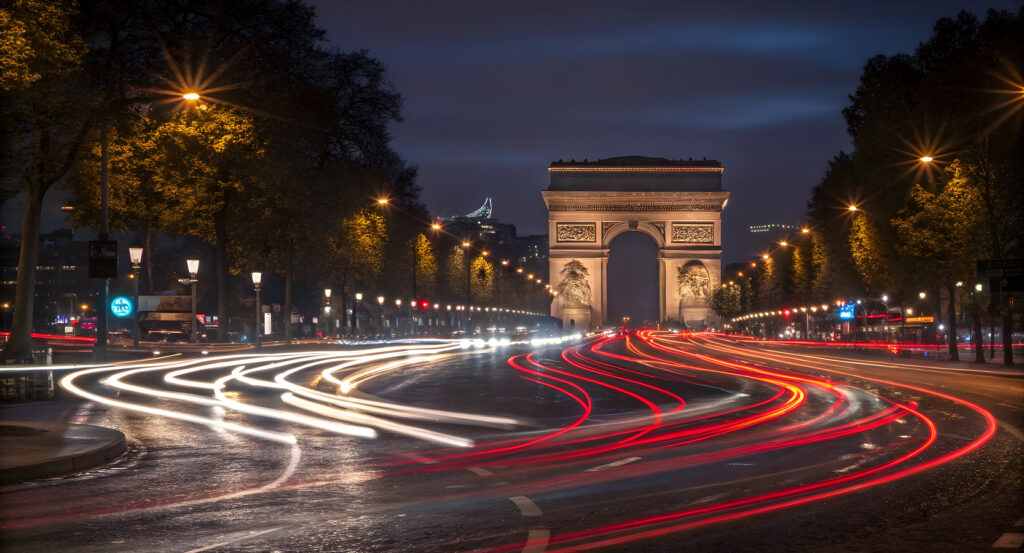
Why Avenue Montaigne matters.
Avenue Montaigne is a polished grand avenue where the Champs-Élysées quarter's cultivated elegance meets nineteenth-century Parisian performance, twentieth-century haute couture and an architectural corridor extending from the Rond-Point des Champs-Élysées toward the Seine.
Set along Avenue Montaigne near Rue François Ier and just steps from Rue Clément Marot, the avenue occupies a 615-meter corridor where limestone apartment buildings, former hôtels particuliers, iron balconies, gated front gardens and closely spaced trees create a measured transition between the Champs-Élysées and Place de l'Alma. Recessed entrances and planted forecourts break the continuity of the facades, giving individual buildings greater separation than the denser commercial streets farther north. Hôtel Plaza Athénée introduces its wrought-iron balconies and projecting window awnings midway along the route as couture houses occupy a succession of historic residential fronts toward both ends. The Seine approaches gradually through the southern sightline as the broader traffic and gardens of the Champs-Élysées remain concentrated beyond the opposite end. The result is a refined Parisian avenue whose unusual combination of domestic architecture, planted setbacks and internationally significant cultural addresses sustains a distinct physical character across its entire length.
What defines Avenue Montaigne.
Avenue Montaigne is best known for evolving from a semi-rural path beyond Central Paris into one of the principal addresses of French haute couture. A 1672 plan places the Allée des Gourdes across land belonging to the Visitation-Sainte-Marie, where gardeners cultivated vegetables before urban development reached the territory. The route later carried the names Allée des Soupirs and Avenue Verte before the Marquis de Marigny ordered rows of elms planted there in 1770, after which the Allée des Veuves designation became established. Entertainment transformed its reputation during the nineteenth century, led by the Bal Mabille, a public dance garden developed by the Mabille family and extensively reconstructed in 1844 with paths, lawns, groves, galleries, a grotto and thousands of gas lights. Hippolyte Triat introduced another form of metropolitan recreation nearby in 1846 through his vast covered gymnasium at number 36. The street received the name Avenue Montaigne in 1850, honoring Michel de Montaigne as development accelerated around the Champs-Élysées quarter. Hector-Martin Lefuel's Palais des Beaux-Arts rose along the avenue for the 1855 Exposition Universelle, reinforcing a shift toward prestigious construction as private residences followed. The Bal Mabille closed in 1875, but the social prominence established during its decades of operation survived through the aristocratic and bourgeois houses that increasingly lined the street. Avenue Montaigne entered the twentieth century with the architectural scale and social associations that later made it particularly attractive to fashion houses.
Christian Dior converted that inherited prestige into a new concentration of couture when he established his house at 30 Avenue Montaigne in 1946 with textile industrialist Marcel Boussac. The company opened there on December 16 with three ateliers and 85 employees inside an hôtel particulier built in 1865 by Count Walewski, a son of Napoleon I. Victor Grandpierre redesigned the interiors in white, pearl gray and other restrained tones, creating presentation salons whose crystal chandeliers, shaded wall lamps and Kentia palms supplied the architectural setting for Dior's work. The first collection appeared in those salons on February 12, 1947, introducing the Corolle and En 8 lines associated with the emergence of the New Look. Christian Dior Parfums followed on March 4 under Serge Heftler-Louiche, and Miss Dior appeared later that year, extending the house from couture into fragrance. Dior rapidly built international commercial connections through branches and production licenses as 30 Montaigne remained its creative center. Other fashion houses subsequently concentrated along Avenue Montaigne and adjoining Rue François Ier, a collective presence formalized in 1971 when Jacques Rouët founded the Comité Montaigne. The organization now brings together close to 80 members across the two streets, institutionalizing a fashion district whose international prominence developed from the postwar couture concentration that Dior had helped establish.
How Avenue Montaigne fits.
Avenue Montaigne works as the anchor for a daytime exploration across the adjoining Seine-side cultural district using three nearby sites that move from a revolutionary 1913 performance venue through a nineteenth-century philanthropic museum into the vast arts complex created for the 1937 international exposition.
Begin at Théâtre des Champs-Élysées, conceived by impresario Gabriel Astruc as a palace devoted to music and dance and constructed by Auguste and Gustave Perret using reinforced concrete. Antoine Bourdelle developed major sculptural decoration, with Maurice Denis, Édouard Vuillard and Jacqueline Marval contributing to an artistic program integrated with the architecture. The theater opened in spring 1913 and entered cultural history almost immediately when Igor Stravinsky's Le Sacre du printemps, choreographed by Vaslav Nijinsky for Sergei Diaghilev's Ballets Russes, received its first performance there on May 29. The score, choreography and audience reaction placed the new building at the center of the artistic ruptures transforming prewar Paris. Continue to Palais Galliera, commissioned by Marie Brignole-Sale, Duchess of Galliera, to house her art collection and designed by Paul-René-Léon Ginain after her 1878 donation initiative. Construction began in May 1879, with a concealed steel structure executed by Gustave Eiffel's company supporting Ginain's Neo-Renaissance stone architecture. A dispute over the intended recipient of the donation led the duchess to leave her collection to Palazzo Rosso in Genoa in 1884, separating the museum from the artworks for which she had financed it. Ginain completed the building in February 1894 after her death, and it opened as the Musée d'Art Industriel in 1895 before the City of Paris dedicated it permanently to fashion in 1977. Giandomenico Facchina's mosaic floors and the building's Palladian references preserve the architectural ambition of the original commission. Conclude at Palais de Tokyo, conceived for the 1937 Exposition internationale des arts et techniques dans la vie moderne as a dual museum complex by Jean-Claude Dondel, André Aubert, Paul Viard and Marcel Dastugue. President Albert Lebrun laid its foundation stone on July 5, 1936, and the building opened on May 24, 1937 with two long wings extending toward the Seine around terraces and a grand central approach. The western wing became the Musée national d'art moderne after the war, then passed through several institutional uses before Nicolas Bourriaud and Jérôme Sans opened the contemporary Palais de Tokyo there in 2002 following intervention by Anne Lacaton and Jean-Philippe Vassal. Their later expansion occupied the full 22,000-square-meter western wing in 2012, exposing the immense concrete structure created for the 1937 exposition. The progression moves from Astruc and the Perret brothers' dramatic performance venue through Ginain and the Duchess of Galliera's museum commission into Dondel, Aubert, Viard and Dastugue's 1937 arts complex, extending Avenue Montaigne through three institutions that chart major changes in Parisian cultural architecture across the twentieth century.
Where your story begins.
Foresyte Travel reveals places that feel extraordinary long before you arrive.
Enjoy editorial crafted for luxury travelers.
Foresyte may earn a commission when you book.














































































































