
Why Chanel matters.
Chanel is a rarefied couture institution where Place Vendôme's luxury character meets Gabrielle Chanel's working world, a mirrored staircase, active Haute Couture ateliers and the Paris address that became inseparable from the house she built.
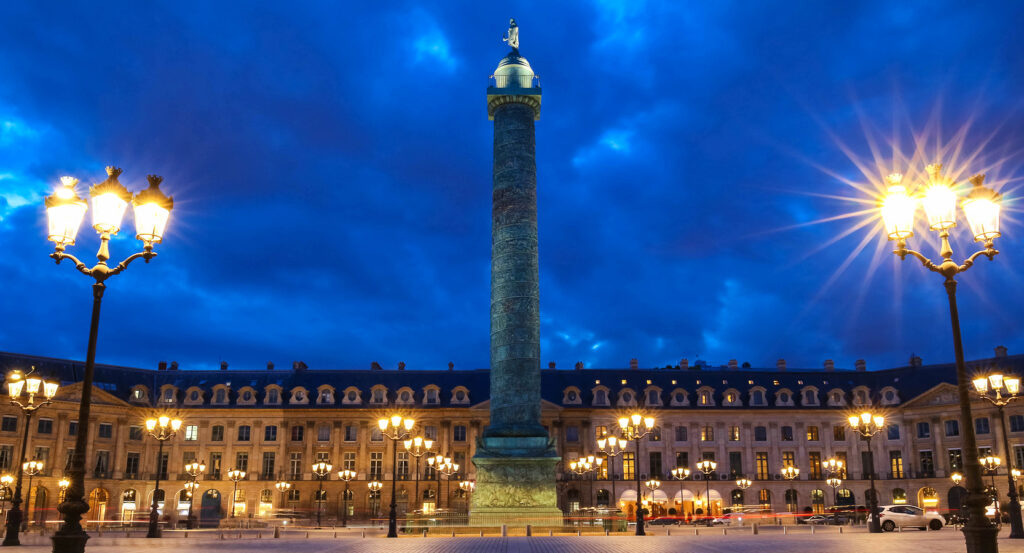
Set along Rue Cambon near Rue Saint-Honoré and just steps from Place Vendôme, the boutique occupies a narrow luxury corridor where pale stone facades, discreet storefronts and tightly aligned nineteenth-century buildings connect the Tuileries side of the 1st Arrondissement with Paris's historic jewelry quarter. The exterior at number 31 gives little indication of the vertically organized world behind it, concentrating boutique, couture salons, Gabrielle Chanel's former apartment, creative studio and workrooms within successive levels of the same building. Rue Cambon's restrained width keeps the facade close to the surrounding urban fabric as nearby Rue Saint-Honoré introduces a denser concentration of fashion houses and Place Vendôme opens into a grander architectural enclosure to the north. The short distance to the Ritz places Chanel's working address beside the hotel that became her principal residence during the later decades of her life. The result is an unusually concentrated Paris fashion address where the physical proximity of couture, private rooms and the surrounding luxury quarter remains central to the character of the house.
What defines the Chanel.
Chanel is best known for the fashion house Gabrielle Chanel developed from a Paris millinery business into a couture operation whose Rue Cambon address became its permanent creative center. She opened Chanel Modes at 21 Rue Cambon in 1910, building her reputation through hats worn by prominent French actresses before extending the business to Deauville in 1912. Jersey sportswear followed there in 1913, using a fabric then strongly associated with men's undergarments for clothing designed around freer movement. Biarritz became the site of her first couture house in 1915, where 300 women worked as Chanel established Haute Couture as the central discipline of the expanding business. She acquired 31 Rue Cambon in 1918 and transferred the Paris couture house into a building organized vertically around its different functions. The ground floor contained the boutique, the first floor the couture salons, the second her private apartment, the third her studio and the upper stories the workrooms. Expansion continued along the street when Chanel purchased number 25 in 1926 and numbers 23 and 27 in 1927, consolidating a larger Rue Cambon domain around the original couture address. The building remained the center of the house after Gabrielle Chanel reopened her couture operation in 1954 at age seventy-one, presenting her return collection there on February 5. Haute Couture continues at 31 Rue Cambon through three tailleur ateliers, two flou ateliers and a specialized galon atelier, preserving the connection between the address and made-to-measure production established during Chanel's lifetime.
The interior architecture at number 31 developed into a working environment whose arrangement linked fashion presentation with Gabrielle Chanel's private collection of art and furnishings. A mirrored staircase connects the couture salon with her second-floor apartment, allowing Chanel to watch presentations below from the stair without placing herself directly among the audience. Four rooms survive in the apartment: entrance, salon, dining room and office, joined by the stairwell and its adjoining circulation spaces. Coromandel lacquer screens stand among gilded objects, crystal, books, sculptural lions and wheat forms, establishing recurring objects that Chanel assembled during decades of collecting. Octagonal forms appear among the mirrors and furnishings, establishing a geometric connection with the profile of Place Vendôme nearby. Chanel used the apartment during the working day and crossed Rue Cambon to the Ritz at night, where she settled permanently in 1954 and remained until her death in 1971. The French Ministry of Culture classified the four apartment rooms and mirrored staircase as a Monument historique on June 19, 2013, protecting the surviving private interior within an active couture house.
How the Chanel fits.
Chanel works as the anchor for a daytime exploration through the western 1st Arrondissement and adjoining Madeleine quarter using three nearby sites that move from Napoleonic state architecture through a Second Empire sporting pavilion into Claude Monet's postwar gift to France.
Begin at Église de la Madeleine, whose construction began under Louis XV before the Revolution halted the project and Napoleon radically changed its purpose. A decree issued from Posen on December 2, 1806 called for a temple dedicated to the Grande Armée, and Napoleon selected Pierre-Alexandre Vignon to develop the project despite another architect winning the competition. Vignon demolished earlier work and conceived the immense Corinthian peristyle as an antique temple before the Restoration returned the unfinished structure to Catholic use. Jacques-Marie Huvé continued the work after Vignon's death in 1828, and the completed church was consecrated during the 1840s, preserving Napoleonic architecture inside a building whose intended political function had disappeared. Continue to Jeu de Paume, constructed after work on Charles Garnier's opera required demolition of an older racquet court in Passage Sandrié. Napoleon III authorized relocation to the northwest corner of the Tuileries, where Melchior Viraut designed the replacement building to correspond architecturally with the neighboring Orangerie. The court opened on January 29, 1862 and retained its sporting purpose before conversion to exhibition use in 1909. That change began a succession of institutional lives extending from racquet sports through museum activity to the center for photography and moving images occupying the building in the twenty-first century. Conclude at Musée de l'Orangerie, where Claude Monet's late Water Lilies transformed a nineteenth-century garden building into one of the defining installations of modern painting. Monet offered paintings to France through Georges Clemenceau immediately after the 1918 Armistice, expanded the proposal through subsequent negotiations and formalized a donation of nineteen panels on April 12, 1922. He retained the works until his death in 1926 as he continued revising them, leaving Clemenceau to press for completion of the installation. Two oval rooms received eight vast compositions according to Monet's conception, and the museum opened them to the public in May 1927 as a permanent environment built around water, willow, reflection and changing light. The progression moves from Vignon's imperial temple recast as a church through Viraut's Second Empire sporting hall converted for art into Monet and Clemenceau's creation of a permanent home for the Water Lilies, developing three successive reinventions of architecture around Rue Cambon and the Tuileries.
Where your story begins.
Foresyte Travel reveals places that feel extraordinary long before you arrive.
Enjoy editorial crafted for luxury travelers.
Foresyte may earn a commission when you book.














































































































