
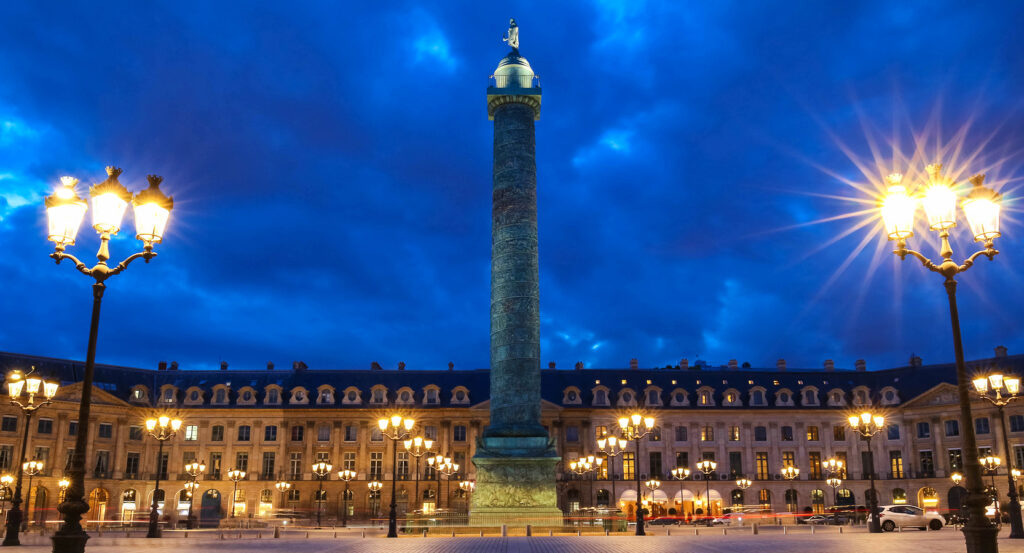
Why Place Vendôme matters.
Place Vendôme is a regal architectural square where the 1st Arrondissement's refined character meets Louis XIV's royal urbanism, Jules Hardouin-Mansart's disciplined classical facades and the soaring Napoleonic column that transformed a royal monument into an enduring Parisian axis.
Set along Rue de la Paix near Rue Saint-Honoré and just steps from Rue de Castiglione, the square occupies an expansive octagonal enclosure where pale stone hôtels particuliers, steep slate roofs, repetitive classical bays and clipped corner fronts create an almost continuous architectural wall between the Tuileries district and the boulevards. Hardouin-Mansart's perimeter maintains a disciplined cornice line above rusticated ground floors and giant pilasters, concentrating visual attention toward the open center. Rue de la Paix extends north toward the Opéra district as Rue de Castiglione continues south toward the Tuileries, creating a long axial opening through an enclosure otherwise defined by narrow entrances and tightly coordinated elevations. The Vendôme Column rises from the center as the square's dominant vertical element, contrasting with the horizontal consistency of the surrounding hôtels and reinforcing the precise geometry established at the close of the seventeenth century. The result is a highly controlled Parisian enclosure where royal planning, aristocratic architecture and Napoleonic commemoration remain fused within one of the capital's most complete classical compositions.
What defines Place Vendôme.
Place Vendôme is best known for Jules Hardouin-Mansart's transformation of former Vendôme family property into a royal square whose uniform architectural perimeter survived the disappearance of the monarchy it was designed to glorify. Louis XIV acquired the Hôtel de Vendôme and adjoining Capuchin property in 1685 as François-Michel Le Tellier de Louvois and Hardouin-Mansart developed an ambitious project devoted to royal institutions and the king's public image. Financial pressure dismantled that first scheme, and the Crown transferred the territory to the City of Paris before Hardouin-Mansart produced the definitive plan approved by Louis XIV on May 12, 1699. Robert de Cotte received responsibility for executing the elevations and architectural decoration, with the revised design tightening the enclosure into the clipped-corner form that survives. François Girardon's bronze equestrian Louis XIV occupied its center, arriving on July 16, 1699 and giving the Place Louis-le-Grand a royal focal point. Private purchasers subsequently developed individual hôtels behind prescribed facades, allowing different architects and patrons to construct independent residences without breaking the visual continuity of the public perimeter. The arrangement created an unusual separation between architectural appearance and private building development: a controlled royal frontage unified parcels whose internal courts, staircases and rooms evolved independently. Political upheaval then repeatedly altered the square's name and centerpiece, and Girardon's Louis XIV was destroyed on August 12, 1792 after the fall of the monarchy. Place Vendôme retained Hardouin-Mansart's architectural order through those reversals, allowing a royal urban project conceived around Louis XIV to survive as a durable piece of Parisian city form.
Napoleon recast the empty center through the Vendôme Column, transferring the square from Bourbon royal commemoration into the grand culture of the First Empire. Construction extended from 1806 to 1810 under a team that included Jean-Baptiste Lepère and Jacques Gondoin, with Vivant Denon directing the wider artistic undertaking. Trajan's Column in Rome supplied the ancient precedent for the shaft, whose spiraling bronze reliefs recount the 1805 campaign culminating at Austerlitz. Seventy-six battle scenes encircle the structure, and the completed monument rises 44 meters from the former pedestal site of Girardon's Louis XIV. Antoine-Denis Chaudet created the original terminal Napoleon as a Roman emperor, introducing an explicitly imperial figure above the classical square. Successive regimes altered the summit before Napoleon III restored a Roman-costumed Napoleon there during the nineteenth century. The Paris Commune brought the most dramatic rupture on May 16, 1871, when the column was pulled down and its disassembled drums fell onto a prepared bed across the piazza. Reconstruction proceeded between 1873 and 1875 under Alfred-Nicolas Normand, returning the column to the architectural center established first for Louis XIV. The monument consequently compresses imperial victory, regime change, revolutionary destruction and republican reconstruction into a single structure whose political history repeatedly rewrote the meaning of Hardouin-Mansart's square.
How Place Vendôme fits.
Place Vendôme works as the anchor for a daytime exploration through the adjoining 1st Arrondissement using three nearby sites that move from a seventeenth-century religious foundation transformed by Polish exile through a major parish assembled by successive royal architects into a princely palace converted into one of pre-Revolutionary Paris's great commercial and political gathering places.
Begin at Église Notre-Dame-de-l'Assomption, created for a community of nuns transferred to Rue Saint-Honoré by Cardinal François de La Rochefoucauld in 1622. The Revolution emptied the convent for military and storage uses and converted the church into a repository for theatrical scenery, severing the complex from its original religious purpose. Worship resumed in 1802, when the building became the parish church of the 1st Arrondissement under the name La Madeleine. Completion of the present Madeleine in 1842 changed its role again, and Archbishop Denis Auguste Affre placed Notre-Dame-de-l'Assomption at the disposal of Polish refugees in 1844 after the failed Warsaw uprising had driven a major émigré community into France. The church became a lasting center of Polish Catholic life in Paris, extending a seventeenth-century convent foundation through Revolution, Napoleonic reorganization and nineteenth-century political exile. Continue to Église Saint-Roch, whose present building began in 1653 from plans by Jacques Lemercier and developed through an exceptional succession of architects. The main body rose through 1690 before Jules Hardouin-Mansart constructed the Chapelle de la Vierge between 1706 and 1710 and Robert de Cotte designed the facade completed during the 1730s. Curé Jean-Baptiste Marduel then assembled an ambitious artistic program between 1750 and 1770, commissioning Étienne-Maurice Falconet, Jean-Baptiste-Marie Pierre, Joseph-Marie Vien and Étienne-Louis Boullée, whose 1754 Chapelle du Calvaire extended the sequence of spaces behind the choir. Revolutionary destruction later dispersed parts of that program, yet Saint-Roch subsequently received paintings and sculpture from suppressed or demolished churches, giving the parish an unusually concentrated collection of seventeenth and eighteenth-century French religious art. Conclude at Palais-Royal, where Cardinal Richelieu acquired the Hôtel de Rambouillet and neighboring parcels in 1624 before Jacques Lemercier developed the Palais-Cardinal. Richelieu bequeathed the residence to Louis XIII, and it passed into royal and Orléans family history before Philippe d'Orléans governed from the palace as Regent between 1715 and 1722. A decisive commercial transformation followed after the property passed to Louis-Philippe Joseph d'Orléans, who commissioned Victor Louis in 1781 to develop rental buildings and arcaded galleries around three sides of the garden. The Valois, Montpensier and Beaujolais wings filled their ground floors with shops, cafés and gathering places, drawing political discussion and printed polemic into the complex during the years preceding the Revolution. The progression moves from a convent reshaped by Revolution and Polish exile through Saint-Roch's accumulation of architecture and art into Victor Louis's conversion of an Orléans residence into a commercial and political forum, developing three institutions that expose the religious, artistic and public worlds surrounding Place Vendôme.
Where your story begins.
Foresyte Travel reveals places that feel extraordinary long before you arrive.
Experience premium editorial crafted for luxury travelers.
Foresyte Travel may earn a commission when you book through the link on this page.














































































































