
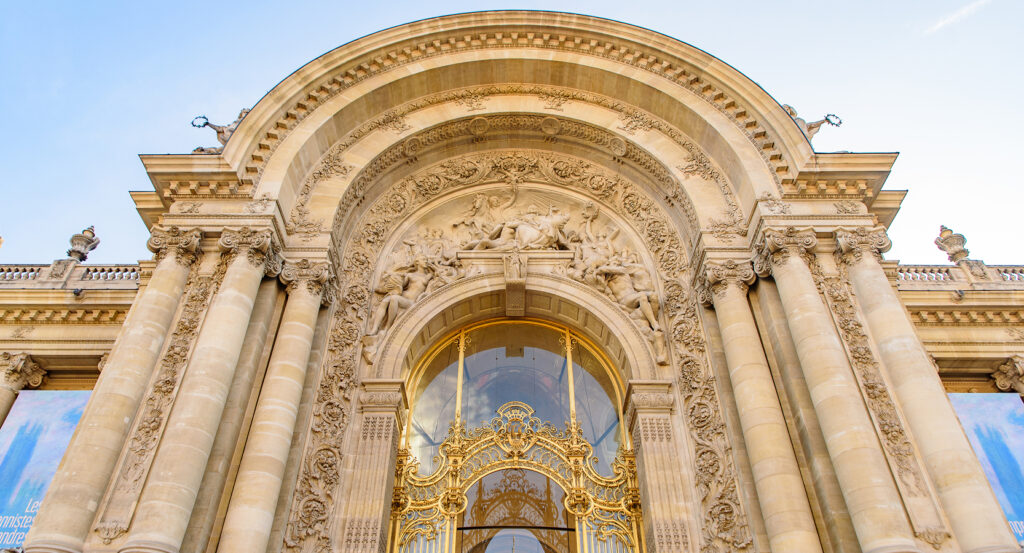
Why Petit Palais matters.
Petit Palais is an opulent Beaux-Arts museum where the Champs-Élysées district's ceremonial grandeur meets Charles Girault's sweeping colonnades, a richly ornamented exhibition palace and an interior garden concealed behind its grand avenue front.
Set along Avenue Winston Churchill near Cours la Reine and just steps from Avenue des Champs-Élysées, the museum occupies a commanding corner of the grand precinct where broad avenues, formal gardens, exhibition architecture and the Seine establish one of western Central Paris's grandest urban settings. A gilded entrance grille opens beneath a projecting dome as paired columns and sculpted stonework extend across the curving principal facade. Galleries wrap around a semicircular garden whose mosaic paving, pools, planted beds and Italianate peristyle create a sheltered interior world behind the imposing exterior. Long sightlines across Avenue Winston Churchill connect the building with the exhibition grounds extending toward Pont Alexandre III and the Invalides axis beyond the river. The result is a richly composed museum whose ceremonial exterior and garden-centered interior compress the architectural ambitions of Belle Époque Paris into a single building.
What defines Petit Palais.
Petit Palais is best known for Charles Girault's design for the Exposition Universelle of 1900, which produced a permanent fine-arts palace conceived from the beginning for a second life as a municipal museum. Girault had trained under Honoré Daumet at the École des Beaux-Arts, won the Prix de Rome in 1880 and achieved an early public success with Louis Pasteur's tomb before winning the Petit Palais competition in 1896. His commission required completion within four years, placing the architect under an exhibition deadline while demanding a permanent building suited to the City of Paris's art collections after the fair closed. Girault developed an arrangement around an internal garden, distributing galleries through varied volumes linked by rotundas and circulation spaces whose iron, masonry, glass and extensive decorative programs joined modern construction with academic composition. The immense gilded entrance grille became one of his most recognizable inventions, and the entrance rotunda received stained-glass oculi executed by the Champigneulle workshop. Albert Besnard spent seven years between 1903 and 1910 creating four Symbolist panels for the entrance vestibule, La Mystique, La Plastique, La Pensée and La Matière. Fernand Cormon developed the Galerie Nord vault through a sequence devoted to Parisian history, extending the building's decorative program into an account of the city itself. Painted and sculpted decoration continued until 1925, a quarter century after the exhibition for which the palace had first been built. Conversion into the Palais des Beaux-Arts de la Ville de Paris in 1902 fulfilled Girault's planned permanent purpose and turned an exposition building into the municipal art museum it remains.
The museum's collection developed through gifts that expanded an initial concentration on nineteenth-century French art into a broad account of European art from Antiquity to the early twentieth century. Municipal acquisitions made at Salons and directly from artists supplied the original foundation, but the 1902 bequest assembled by Eugène and Auguste Dutuit changed the institution's scope immediately after its conversion into a museum. Their holdings introduced ancient art and strengthened numerous European schools, helping establish the Petit Palais as a general fine-arts museum during its first years. Edward Tuck and Julia Stell later developed another major collection encompassing eighteenth-century furniture, tapestries, watches, Sèvres porcelain, Meissen figures, English enamels, paintings and Chinese porcelain. The couple donated their holdings to the City of Paris with reserved usufruct on October 21, 1921 after art dealer Sir Joseph Duveen introduced them to museum director Henry Lapauze. Julia died in 1928, after which Edward surrendered the usufruct and worked with Duveen and architect Guillaume Tronchet on a dedicated gallery fitted with historic light-oak paneling. President Gaston Doumergue attended the gallery's inauguration on November 5, 1930, completing the physical transfer of a private transatlantic collection into the municipal museum. The Dutuit and Tuck gifts established a collecting mechanism that placed private connoisseurship beside municipal acquisition, giving the Petit Palais holdings ranging from Greek vases and Dutch painting to French nineteenth-century art and decorative arts.
How Petit Palais fits.
Petit Palais works as the anchor for a daytime exploration through the western Right Bank using three sites that move from Jean-François Chalgrin's eighteenth-century religious architecture through a Second Empire collector's residence into an early modern theater created through architecture, sculpture, painting and reinforced concrete.
Begin at Église Saint-Philippe-du-Roule, built between 1769 and 1784 from designs by Jean-François Chalgrin. The architect developed an unusually lucid Neoclassical church around a columned nave whose coffered wooden vault hangs from the roof structure, establishing a spatial system distinct from the compartmented churches inherited from earlier Parisian practice. Nineteenth-century alterations introduced new glazing and overhead illumination as the building repeatedly sought more daylight after installation of an organ obscured its large southern opening 1799. Classification as a historic monument followed in 1993, and a four-year campaign completed in 2022 recovered the roof, timber structure, stained glass, interior vault and principal organ. Continue to Musée Jacquemart-André, where banker and collector Édouard André commissioned Henri Parent to build a private mansion on the newly created Boulevard Haussmann between 1869 and 1876. Parent set the residence behind the boulevard alignment and organized its ceremonial interiors around a double-spiral staircase, creating a setting for the collections André assembled with his wife, painter Nélie Jacquemart. Their travels through Italy and the Near East fed an expanding collection, and Jacquemart's 1912 bequest transferred the house to the Institut de France under detailed instructions governing its public presentation. President Raymond Poincaré inaugurated the museum on December 8, 1913, preserving the residence and its collection as a unified private collecting project. Conclude at Théâtre des Champs-Élysées, born from impresario Gabriel Astruc's ambition for a Parisian house devoted to music and dance and inaugurated in 1913. Henry Van de Velde participated in the initial architectural conception before Auguste and Gustave Perret brought reinforced-concrete construction to the project, producing the first Parisian theater built entirely with that structural system. Antoine Bourdelle developed sculptural work, Maurice Denis contributed decoration and the theater rapidly entered modern music history through the premiere of Igor Stravinsky's Le Sacre du printemps with Vaslav Nijinsky's choreography. The progression moves from Chalgrin's late eighteenth-century experiment in Neoclassical church architecture through Parent, André and Jacquemart's integration of collecting with private residence into Astruc, the Perrets, Bourdelle and Denis's collaborative theater, carrying the surrounding district through three successive periods of Parisian artistic patronage.
Where your story begins.
Foresyte Travel reveals places that feel extraordinary long before you arrive.
Experience premium editorial crafted for luxury travelers.
Foresyte Travel may earn a commission when you book through the link on this page.














































































































