
Why Grand Palais matters.
Grand Palais is a soaring exhibition palace where the Champs-Élysées' ceremonial character meets an immense glass-and-steel nave, Beaux-Arts stonework and the architectural ambitions of the 1900 Exposition Universelle.
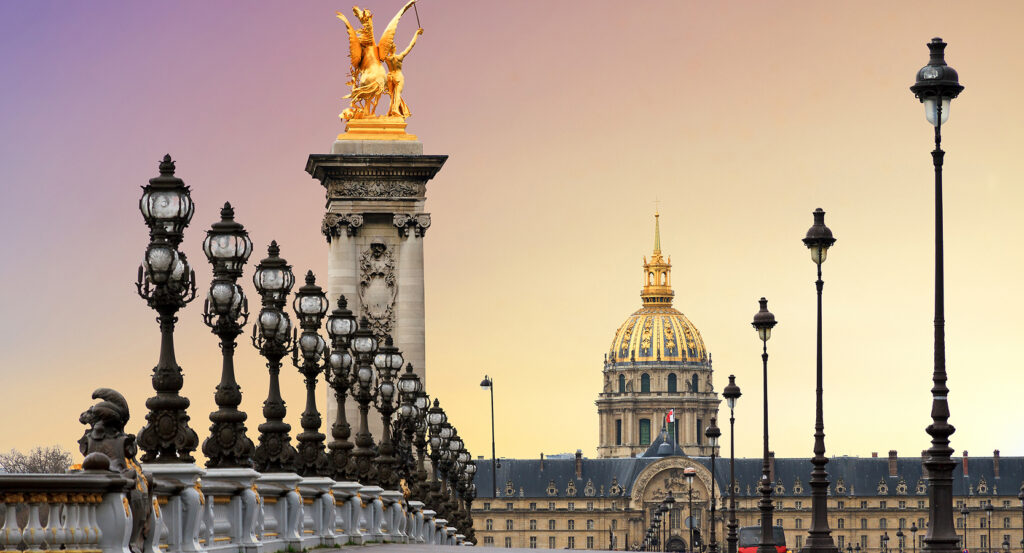
Set along Avenue Winston Churchill near Avenue des Champs-Élysées and just steps from the Seine, the exhibition palace occupies a commanding site where the Jardins des Champs-Élysées, Petit Palais and Pont Alexandre III open the dense Eighth Arrondissement into a sequence of gardens, grand facades and broad river approaches. A vast glazed roof rises behind the stone exterior, allowing the nave's steel structure to define the skyline without diminishing the sculpted classical fronts below. Avenue Winston Churchill establishes a formal open corridor between Grand Palais and Petit Palais before continuing directly toward the gilded pylons of Pont Alexandre III and the Invalides beyond the Seine. Georges Récipon's immense copper quadrigas crown the outer corners, extending the building's silhouette above trees that soften its northern and southern edges. The result is a grand exhibition precinct whose stone, glass, steel and surrounding avenues preserve the scale of the urban transformation created for Paris in 1900.
What defines Grand Palais.
Grand Palais is best known for its vast glass-and-steel nave, created for the Exposition Universelle of 1900 through an unusual collaboration among Henri Deglane, Albert Louvet, Albert Thomas and coordinating architect Charles Girault. Sadi Carnot's 1892 decree established the 1900 exposition, and planning two years later called for a new district linking permanent exhibition palaces on the Champs-Élysées with the Seine and Invalides. An architectural competition followed in 1896, drawing around one hundred proposals without producing a single scheme judged sufficient for the entire undertaking. Responsibility was consequently divided: Deglane developed the principal building, facade and nave; Louvet handled the intermediate section, Salon d'Honneur and components of the grand staircase; Thomas designed the western Palais d'Antin; Girault coordinated the ensemble while simultaneously designing Petit Palais across the avenue. Construction began in 1897, leaving three years to erect a building combining dressed-stone facades with reinforced concrete, iron and immense expanses of glass. 1,500 workers were active on the site in 1900 as the structure approached completion. Georges Récipon supplied the two grand quadrigas crowning the exterior, and Louis-Édouard Fournier conceived the mosaic frieze executed by the Guibert-Martin workshop. President Émile Loubet inaugurated the Exposition Universelle on April 14, 1900, establishing Grand Palais as one of the permanent architectural anchors of an exposition that drew 51 million people before closing in November.
A later sequence of institutional adaptations repeatedly changed the functions housed beneath that architecture. During the First World War, Grand Palais became a military hospital and rehabilitation center, converting exhibition halls conceived for art and industry into spaces serving wounded soldiers. Physicist Jean Perrin established another enduring use during the 1937 Exposition Internationale when the Palais de la découverte opened inside Albert Thomas's western wing on May 24, with André Léveillé as its first director and demonstrations devoted to fundamental scientific research. State ownership brought another requisition during the German occupation beginning in 1940. André Malraux initiated the Galeries nationales era in 1966, creating a setting for major exhibitions that brought another institutional purpose into the complex. Protection followed in stages, with the nave receiving historic status in 1975 and the entire Grand Palais attaining classification in 2000. Structural deterioration had already forced closure of the nave in 1993 and led to an extensive earlier restoration before its reopening in 2005. A new comprehensive campaign began after closure in March 2021 under François Chatillon, recovering original circulation, grand windows and natural light across spaces altered during successive occupations. The nave returned for the 2024 Olympic and Paralympic fencing and taekwondo competitions, and the complete Grand Palais reopened in 2025 after four years of work.
How Grand Palais fits.
Grand Palais works as the anchor for a daytime exploration through the Champs-Élysées quarter using three nearby sites that move from its companion exhibition palace through the landscaped ground surrounding the 1900 precinct into an early reinforced-concrete theater created for the artistic avant-garde.
Begin at Petit Palais, where Charles Girault transformed his winning 1896 competition position into the companion building facing Grand Palais across the new Avenue Alexandre III. Girault had trained with Honoré Daumet, won the Prix de Rome in 1880 and achieved his first major public success with Louis Pasteur's tomb before receiving the Petit Palais commission and responsibility for coordinating the Grand Palais architects. His exhibition building combined an imposing entrance front with a semicircular interior garden and a richly developed decorative program; the gate itself became one of the commission's celebrated metalworks. After the Exposition Universelle, the building became the Palais des Beaux-Arts de la Ville de Paris, and the museum inaugurated in December 1902 received a decisive expansion that year through the Dutuit brothers' collection. Painting and sculpture continued after the exposition, with Albert Besnard, Fernand Cormon and Maurice Denis contributing to a decorative campaign that extended into the 1920s. Continue through Jardins des Champs-Élysées, whose origins reach André Le Nôtre's 1667 extension of the Tuileries axis before nineteenth-century interventions created the landscape surrounding the exhibition palaces. Adolphe Alphand, Jean-Pierre Barillet-Deschamps and Gabriel Davioud reshaped much of the gardens beginning in 1859 through curving walks, lawns and planted grounds, and Jules Vacherot later organized the landscaping around Grand Palais and Petit Palais for the 1900 exposition. Square Jean Perrin now marks the northern entrance of Grand Palais with a formal garden centered on François-Raoul Larche's 1910 La Seine et ses affluents, whose nine allegorical figures represent tributaries of the river. The garden received Perrin's name in 1972, connecting the exterior landscape with the physicist responsible for establishing the Palais de la découverte inside Grand Palais in 1937. Conclude at Théâtre des Champs-Élysées, initiated by impresario Gabriel Astruc and financier Gabriel Thomas as a new Parisian home for music and dance. Henry Van de Velde entered the project as consulting architect in 1910 before Auguste and Gustave Perret developed the reinforced-concrete structural solution that made the 1913 building the first Parisian theater constructed entirely with that technology. Antoine Bourdelle redesigned the Avenue Montaigne facade and created its sculptural program, with Maurice Denis, Édouard Vuillard, Jacqueline Marval, Henri Lebasque and Ker-Xavier Roussel contributing to the interiors. The theater opened on March 31, 1913 with Berlioz's Benvenuto Cellini; two months later, Sergei Diaghilev's Ballets Russes presented the premiere of Igor Stravinsky's Le Sacre du printemps with Vaslav Nijinsky's choreography, fixing the building within the history of twentieth-century music and dance. The progression moves from Girault's permanent fine-arts palace through Alphand, Barillet-Deschamps and Vacherot's evolving exhibition landscape into the Perrets, Bourdelle and their collaborators' reinforced-concrete theater, extending Grand Palais through three institutions that chart the architectural and artistic reinvention of western Central Paris from the nineteenth century into the modern era.
Where your story begins.
Foresyte Travel reveals places that feel extraordinary long before you arrive.
Experience premium editorial crafted for luxury travelers.
Foresyte Travel may earn a commission when you book through the link on this page.














































































































