
Why Pont Alexandre III matters.
Pont Alexandre III is an opulent Belle Époque crossing where the Invalides quarter's ceremonial character meets Franco-Russian diplomacy, Exposition Universelle engineering and an extraordinary concentration of gilded sculpture above the Seine.
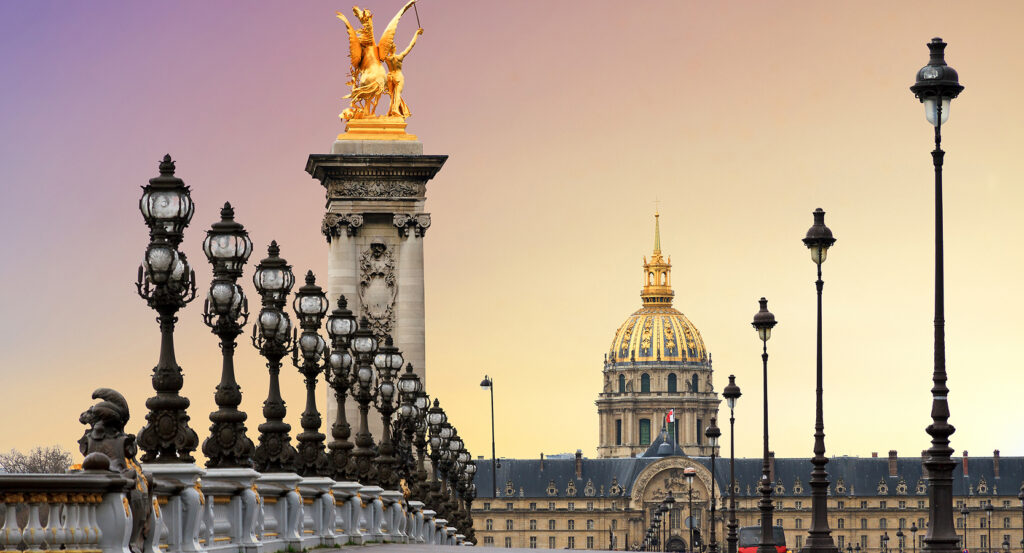
Set along the Seine near Quai d'Orsay and just steps from Avenue Winston Churchill, the bridge spans the river between the tree-lined Esplanade des Invalides and the grand forecourt shared by the Grand Palais and Petit Palais, creating an uninterrupted ceremonial axis across the 7th and 8th Arrondissements. Four 17-meter pylons mark its approaches as gilded figures rise above the quays, ornate lamps line the roadway and a shallow metal arch keeps the river crossing visually low against the surrounding city. The single sweeping span leaves the water largely unobstructed and opens long views along the Seine beneath a deck crowded with bronze, copper, stone and gilded ornament. Avenue Winston Churchill continues north between the exhibition palaces as the Esplanade extends south toward the Dôme des Invalides, giving the crossing an urban reach far beyond the riverbanks. The result is a bridge whose engineering, sculpture and axial placement turn a Seine crossing into one of the most elaborate surviving compositions created for Paris in 1900.
What defines Pont Alexandre III.
Pont Alexandre III is best known for joining the Exposition Universelle of 1900 with the Franco-Russian alliance through a bridge conceived simultaneously as advanced engineering and state ceremony. The alliance had been formalized during the 1890s under French president Sadi Carnot and Russian emperor Alexander III, and the bridge received the late tsar's name as Paris prepared a new exhibition district on both banks of the Seine. Tsar Nicholas II, Empress Alexandra Feodorovna and President Félix Faure laid the first stone on October 7, 1896, embedding the diplomatic relationship directly into the construction ceremony. Engineers Jean Résal and Amédée Alby developed the metal structure, whose exceptionally low profile answered a difficult urban requirement: the crossing needed to preserve views toward the Invalides and connect the new exhibition palaces without placing massive piers in the Seine. Construction moved into the river in 1897 with compressed-air caissons, followed in August 1898 by installation of a traveling crane for the metal superstructure and assembly of the arches that November. The finished crossing extends 154 meters in length and 40 meters in width, carrying the roadway across a single shallow arch whose low rise became one of the project's principal technical achievements. President Émile Loubet inaugurated the bridge with the Exposition Universelle on April 14, 1900, completing the ceremonial route between the exhibition grounds on the Right Bank and the Invalides axis on the Left Bank. Paris Musées later classified the 160-meter metal work among the surviving structures of the exposition, and the bridge received protection as a Monument historique in 1975. Pont Alexandre III emerged from this convergence of international diplomacy, exhibition planning and structural experimentation as a permanent component of the city built for the opening of the twentieth century.
Its sculptural program converted that diplomatic purpose into an elaborate allegorical scheme distributed across the entire crossing. Four gilded Renommées crown the marble pylons, pairing Pegasus with figures devoted to the Arts, Sciences, Industry and Commerce. Their elevated positions organize the entrances as corresponding groups below invoke different periods of French history, turning each pylon into a vertical sequence of national imagery. Georges Récipon developed the hammered-copper Nymphes de la Seine around the arms of Paris and the corresponding Nymphes de la Neva around the arms of Russia, placing the two rivers into a reciprocal composition at the center of the bridge. Jules Dalou supplied the lions guarding the Left Bank approaches, with Georges Gardet responsible for those on the Right Bank. Thirty-two bronze candelabra manufactured by Lacarrière extend the decorative scheme along the deck, including four larger compositions surrounded by cherubs. Marine ornament spreads across the metalwork through shells and aquatic forms, carrying the river into smaller components beneath the dominant statuary. Wartime photographs from August 1944 show Cointet barriers blocking the crossing and projectile damage around Récipon's Neva group during the Liberation of Paris, giving the ornamental ensemble a later physical connection with fighting in the capital. Pont Alexandre III consequently concentrates diplomatic allegory, French historical imagery, river symbolism and decorative metalwork within the structural limits of a bridge engineered to remain exceptionally low above the Seine.
How Pont Alexandre III fits.
Pont Alexandre III works as the anchor for a daytime exploration across the adjoining Invalides and Champs-Élysées districts using three nearby sites that move from an eighteenth-century private residence chosen by Auguste Rodin through Louis XIV's military foundation into Charles Girault's purpose-built palace for the fine arts.
Begin at Musée Rodin, housed in the Hôtel Biron, the rocaille residence Jean Aubert developed from 1727 for financier Abraham Peyrenc de Moras. Louis-Antoine de Gontaut-Biron acquired the estate in 1753 and doubled the garden before the property passed through owners and occupants including the papal legate Cardinal Caprara and the Russian embassy. Artists moved into the partly abandoned complex after 1905, among them Jean Cocteau, Henri Matisse, Isadora Duncan and Clara Westhoff; Rainer Maria Rilke led Rodin to the property in 1908, when the sculptor rented four ground-floor rooms before occupying the entire residence in 1911. The French state acquired the estate that year, and legislation in 1916 accepted Rodin's three donations of his sculpture, drawings, antiques and associated property while assigning Hôtel Biron to the museum that opened in 1919. Continue to Hôtel des Invalides, founded by Louis XIV in 1670 to house and care for wounded, sick and elderly soldiers. Libéral Bruant directed construction from 1671 to 1675 around a quadrilateral plan and immense central court, with the first pensioners entering in 1674. Jules Hardouin-Mansart replaced him in 1676, completed the soldiers' church in 1679 and developed the royal Dôme inaugurated by Louis XIV in 1706. The institution combined hospital, hospice, barracks, convent and manufacturing functions, eventually accommodating more than 4,000 pensioners; its later history incorporated the Musée des Plans-Reliefs in 1777, the seizure of weapons on July 14, 1789 and the transfer of Napoleon I's remains in 1840. Conclude at Petit Palais, designed by Charles Girault for the Exposition Universelle of 1900 and conceived around a sequence of galleries, rotundas and a semicircular garden. The building became the Palais des Beaux-Arts de la Ville de Paris after the exposition, and the Dutuit brothers' 1902 bequest gave its municipal collection an exceptional body of older works. Decoration continued from 1903 to 1925, with Albert Besnard spending seven years on four Symbolist vestibule panels and later campaigns extending painted and sculpted work throughout the building. The progression moves from Aubert's eighteenth-century residence and Rodin's transformation of it into a permanent artistic bequest through Bruant and Hardouin-Mansart's royal military institution into Girault's exhibition palace turned municipal museum, concentrating three different forms of Parisian patronage around the bridge's Seine axis.
Where your story begins.
Foresyte Travel reveals places that feel extraordinary long before you arrive.
Experience premium editorial crafted for luxury travelers.
Foresyte Travel may earn a commission when you book through the link on this page.














































































































