
Why Esplanade des Invalides matters.
Esplanade des Invalides is a stately ceremonial landscape where Invalides's institutional character meets Robert de Cotte's formal planning, the northern front of Louis XIV's military complex and a vast green axis carried directly to the Seine.
Set along Avenue du Maréchal Gallieni near Rue Saint-Dominique and just steps from Quai d'Orsay, the esplanade occupies a broad rectangular opening where six lawns, parallel tree lines and long gravel walks create an exceptional interval between the dense stone fronts of the 7th Arrondissement. The northern facade of Hôtel des Invalides closes the southern vista as Pont Alexandre III extends the same axis across the Seine toward the Grand Palais and Petit Palais. Rows of mature trees reinforce the long edges, separating the lawns from Rue de Constantine and Rue Fabert without obscuring the surrounding eighteenth and nineteenth-century architecture. Avenue du Maréchal Gallieni divides the central ground as terraces near the river preserve the esplanade's immense north-south perspective. The result is an expansive ceremonial landscape where military architecture, formal planting and the Seine crossing establish one of western Central Paris's clearest spatial compositions.
What defines Esplanade des Invalides.
Esplanade des Invalides is best known for the formal landscape Robert de Cotte developed before the Hôtel des Invalides during the opening decades of the eighteenth century. The ground had belonged to the Pré-aux-Clercs, an open tract extending across this part of the Left Bank before construction associated with Louis XIV's veterans' institution changed the district's scale. Work cleared the esplanade from Hôtel des Invalides to Rue de l'Université in 1704, and the composition reached the Seine by 1720. De Cotte organized the terrain into six large grass panels bordered by trees arranged in disciplined lines, with ten rows of elms reinforcing the transverse geometry before the principal facade. The ground descended gently toward the river and terminated through two broad hemicycles, extending the military complex into a landscape conceived on the scale of the surrounding quarter. Flooding in 1740 and 1802 exposed the vulnerability of the low riverfront territory, prompting construction of improved quays in 1812. The esplanade also operated as a military maneuvering ground, preserving a functional relationship with Hôtel des Invalides beyond its architectural role. The state transferred the terrain to the City of Paris in 1863 under a condition that its established configuration remain unchanged. That agreement protected de Cotte's essential spatial organization as construction intensified throughout the surrounding Faubourg Saint-Germain. Esplanade des Invalides consequently survives as an eighteenth-century exercise in metropolitan scale whose lawns, tree lines and axial geometry transformed former meadowland into the grand foreground of Hôtel des Invalides.
The esplanade repeatedly became temporary architecture during Paris's international exhibitions, culminating in the extensive construction raised there for the Exposition Universelle of 1900. Exhibition buildings had occupied the lawns during the 1889 fair, temporarily replacing much of de Cotte's open composition with pavilions before the landscape returned. Planning for 1900 incorporated the esplanade into a far larger cross-river composition joining the Left Bank exhibition grounds with a new bridge and the arts palaces on the Right Bank. Tsar Nicholas II, Empress Alexandra Feodorovna and President Félix Faure laid the first stone of Pont Alexandre III on October 7, 1896. The bridge was constructed on the esplanade's axis and inaugurated during the 1900 exhibition, directing movement north toward the new Petit Palais and Grand Palais. Official exhibition plans assigned the Esplanade des Invalides its own extensive palace complex, and surviving images show temporary French and international industrial, decorative-arts and furniture displays occupying the ground. The fair opened on April 14, 1900 under President Émile Loubet, embedding the esplanade within an exhibition that drew 51 million admissions across Paris. Gare des Invalides emerged from the same period as permanent transport infrastructure beside the historic lawns. Removal of the exhibition structures returned most of the esplanade to its established form, leaving Pont Alexandre III as the enduring intervention that expanded de Cotte's eighteenth-century axis across the Seine.
How Esplanade des Invalides fits.
Esplanade des Invalides works as the anchor for a daytime exploration through the 7th Arrondissement using three nearby sites that move from an eighteenth-century princely residence converted for national representation through a rocaille mansion chosen by Auguste Rodin into the military institution created under Louis XIV.
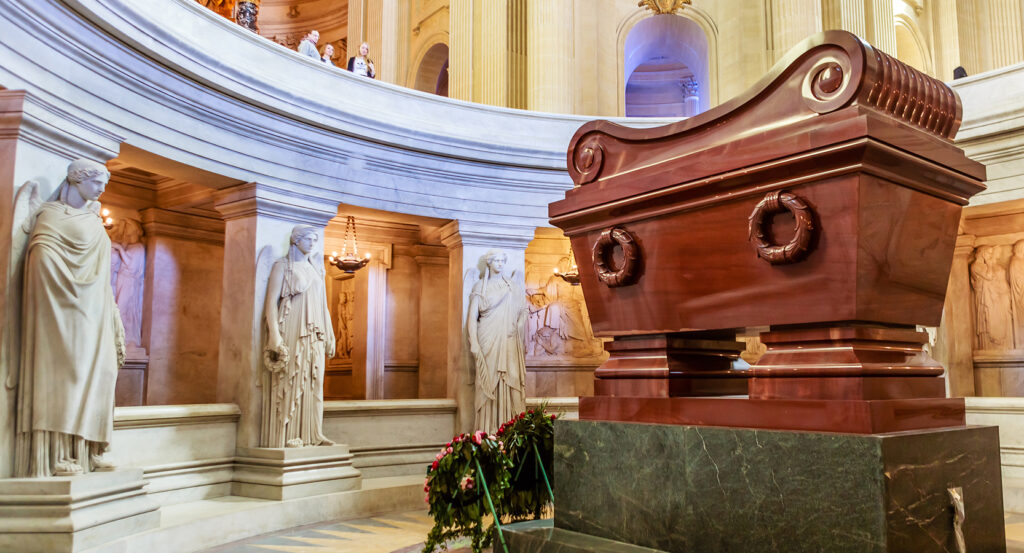
Begin at Palais Bourbon, erected with the Hôtel de Lassay between 1722 and 1728 on land acquired by Louise Françoise de Bourbon, daughter of Louis XIV and Madame de Montespan. Giardini, Lassurance, Jacques Gabriel and Jean Aubert successively directed construction of the original single-story residence between court and garden. Revolutionary confiscation made the palace national property in 1791, and Jacques-Pierre Gisors and Emmanuel-Chérubin Leconte subsequently inserted the hemicycle for the Conseil des Cinq-Cents, inaugurated on January 21, 1798. The state secured permanent ownership in 1827, after which Jules de Joly enlarged the chamber, added the library and established much of the parliamentary configuration that survives; Eugène Delacroix later painted the library ceilings. Continue to Musée Rodin, housed in the Hôtel Biron, the residence begun for financier Abraham Peyrenc de Moras during the 1720s and developed under royal architect Jean Aubert. Marshal Biron later supplied the name that endured, and the Society of the Sacred Heart occupied the estate from 1820 until its dissolution in 1904. Artists then rented rooms across the partially abandoned property, including Jean Cocteau, Henri Matisse, Isadora Duncan and Clara Westhoff; Rainer Maria Rilke directed Rodin to the house, where the sculptor rented four ground-floor rooms in 1908 and occupied the entire building from 1911. Parliament accepted Rodin's three donations in 1916, securing his sculpture, drawings and antiquities for the nation and assigning the Hôtel Biron to the museum that opened in 1919. Conclude at Hôtel des Invalides, the architectural destination that generated the esplanade itself and gave the surrounding district its enduring institutional center. Louis XIV established the complex for wounded and aging soldiers, with Libéral Bruant developing the immense veterans' residence and Jules Hardouin-Mansart completing the royal church crowned by its gilded dome. Napoleon's remains reached Hôtel des Invalides on December 15, 1840 in a vast state ceremony whose funeral procession crossed the esplanade before entering the complex; grandstands packed the grounds as the imperial carriage approached the Gate of Honour accompanied by its military escort and sailors from La Belle-Poule. The progression moves from Bourbon princely residence into parliamentary architecture through Aubert's private mansion and Rodin's national collection into the royal military institution whose construction generated the esplanade and whose ceremonies repeatedly returned the surrounding ground to a national stage.
Where your story begins.
Foresyte Travel reveals places that feel extraordinary long before you arrive.
Experience premium editorial crafted for luxury travelers.
Foresyte Travel may earn a commission when you book through the link on this page.














































































































