
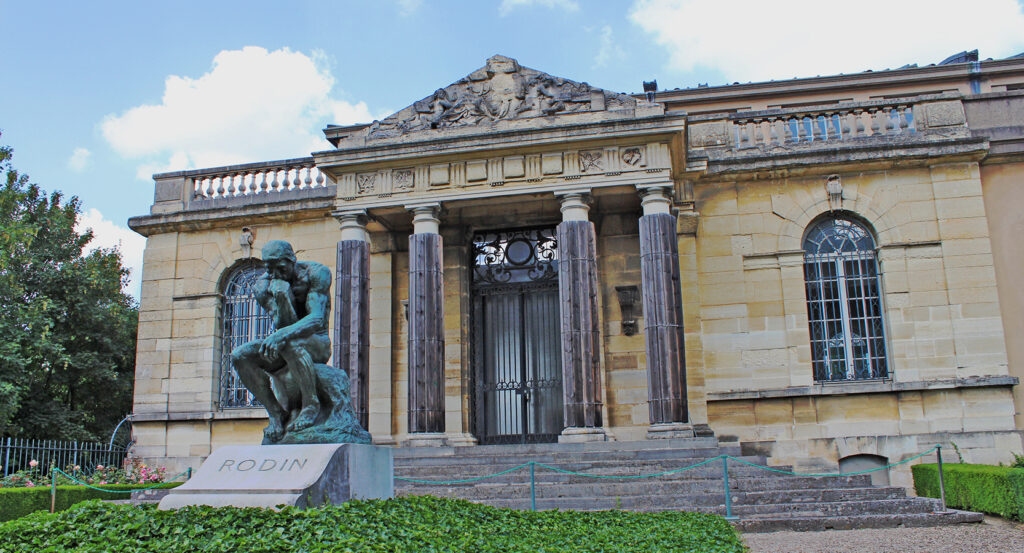
Why Musée Rodin matters.
Musée Rodin is a contemplative sculpture museum where Invalides' aristocratic character meets Auguste Rodin's self-fashioned legacy, an eighteenth-century hôtel particulier and a garden where bronze figures occupy the landscape he personally chose for them.
Set along Rue de Varenne near Boulevard des Invalides and just steps from Rue de Babylone, the museum occupies a walled estate where the pale stone Hôtel Biron, gravel courts, clipped hedges and deep garden separate its sculpture collection from the formal ministries and institutional palaces surrounding Invalides. Jean Aubert's principal building opens south through tall windows and a central pediment toward lawns extending behind the mansion. Rose beds, tree-lined paths, pools and secluded planted compartments carry the grounds far beyond the scale suggested by the restrained Rue de Varenne entrance. The Thinker, The Gates of Hell, The Burghers of Calais and Monument to Balzac appear across the garden as independent sculptural encounters, with the gilded Dôme des Invalides rising beyond the vegetation. The result is an unusually complete union of residence, landscape and sculpture in which Rodin's work occupies the Parisian property he selected as the permanent setting for his artistic estate.
What defines Musée Rodin.
Musée Rodin is best known for originating through Auguste Rodin's decision to give his work, collections and intellectual property to France on the condition that the Hôtel Biron become the permanent museum devoted to his art. Rodin discovered the property in 1908 through Rainer Maria Rilke, who had served as his secretary, and initially rented four south-facing ground-floor rooms opening toward the garden. Other tenants during the building's artistic interlude included Jean Cocteau, Henri Matisse, Isadora Duncan and sculptor Clara Westhoff, placing Rodin inside a remarkable temporary community formed after the Society of the Sacred Heart departed the estate in 1904. Rodin expanded through the mansion until occupying the entire Hôtel Biron in 1911, the same year the French state acquired the property. His attachment to the building turned a threatened private residence into the foundation of a museum project: the sculptor offered the state his plasters, marbles, bronzes, stone works, drawings and collection of antiquities while requesting that they remain at the Hôtel Biron. Three donations were accepted through legislation in 1916, and Léonce Bénédite, already central to the preservation of Rodin's artistic estate, became executor of the sculptor's will and organizer of the future institution. Rodin died on November 17, 1917. Musée Rodin opened on August 4, 1919, making the artist's former workplace the permanent repository of the body of work he had deliberately assembled for the nation. His donation also transferred intellectual property rights and the molds and models supporting authorized bronze editions, giving the museum an active role in the international circulation and protection of Rodin's work long after his death.
The collection reveals how several sculptures now treated as autonomous masterpieces emerged through Rodin's long development of The Gates of Hell. The French state commissioned the portal in 1880 for a planned decorative-arts museum, and Rodin developed more than 200 figures and groups around a composition inspired by Dante's Divine Comedy. The Thinker began at a height near 70 centimeters as The Poet, a Dante figure seated above the portal and contemplating the infernal world below, before Rodin exhibited it independently in 1888 and enlarged the figure in 1904. The Gates remained unresolved through repeated attempts at completion, including Rodin's 1900 solo exhibition, where he presented the portal. Léonce Bénédite persuaded him in 1917 to permit reconstruction for bronze casting, but Rodin died before seeing the result; Alexis Rudier produced the museum's bronze cast in 1928. Monument to Balzac followed a different path of rejection: the Société des Gens de Lettres commissioned it in 1891, Rodin spent years studying the writer through images and living models, and the organization rejected his radically simplified final figure after its 1898 presentation. Rodin never saw Balzac cast in bronze, yet the museum's garden now places that once-rejected work within the institution the sculptor himself created, alongside the portal that generated some of his most widely recognized figures.
How Musée Rodin fits.
Musée Rodin works as the anchor for a daytime exploration through the 7th Arrondissement using three nearby sites that move from Louis XIV's purpose-built military institution through a nineteenth-century Gothic Revival church into an industrial-age railway terminus converted for art.
Begin at Hôtel des Invalides, founded by Louis XIV in 1670 to house and care for wounded, sick and elderly soldiers on the then-open Plaine de Grenelle. Libéral Bruant directed construction from 1671 to 1675 around a quadrilateral plan with a vast central court, and the first pensioners entered in 1674. Jules Hardouin-Mansart succeeded him in 1676, completed the soldiers' church in 1679 and developed the royal Dôme, inaugurated by Louis XIV in 1706. The complex later entered revolutionary and imperial history when Parisians seized weapons there on July 14, 1789 and Louis-Philippe ordered Napoleon's remains returned from Saint Helena in 1840; Louis Visconti subsequently reworked the Dôme for the imperial tomb, where Napoleon's body was placed in 1861. Continue to Basilique Sainte-Clotilde, begun in 1846 from plans by François-Christian Gau and completed after his death under Théodore Ballu. Ballu carried the project to completion in 1856, and the church was consecrated the following year, establishing its twin-spired Gothic Revival silhouette within the developing Faubourg Saint-Germain. The commission belongs to the nineteenth-century recovery of medieval architectural forms in Paris and precedes Ballu's later work on major civic and ecclesiastical projects across the capital. Conclude at Musée d'Orsay, where Victor Laloux transformed the site of the burned Palais d'Orsay into an electrically operated terminus for the Compagnie du chemin de fer de Paris à Orléans. Selected in 1898 over Lucien Magne and Émile Bénard, Laloux concealed a modern metal structure behind an elaborate stone exterior calibrated to the Louvre and Palais de la Légion d'Honneur across the surrounding riverfront. Gare d'Orsay opened for the 1900 Exposition Universelle with sixteen subterranean tracks, passenger lifts, baggage elevators and a hall measuring 32 meters high, 40 meters wide and 138 meters long. Passenger service outgrew its short platforms by 1939, and the building passed through uses ranging from reception of prisoners after the Second World War to Orson Welles's filming of The Trial before reopening as Musée d'Orsay in 1986. The progression moves from Bruant and Hardouin-Mansart's royal institution for soldiers through Gau and Ballu's nineteenth-century recovery of Gothic form into Laloux's stone-clad electric railway station, carrying the surrounding district across three major episodes in Parisian architecture before its conversion into the cultural concentration surrounding Musée Rodin.
Where your story begins.
Foresyte Travel reveals places that feel extraordinary long before you arrive.
Experience premium editorial crafted for luxury travelers.
Foresyte Travel may earn a commission when you book through the link on this page.














































































































