
Why Musée d'Orsay matters.
Musée d'Orsay is a soaring cultural institution where Saint-Thomas-d'Aquin's aristocratic Left Bank character meets a Beaux-Arts railway terminus transformed into one of the world's great concentrations of nineteenth-century art.
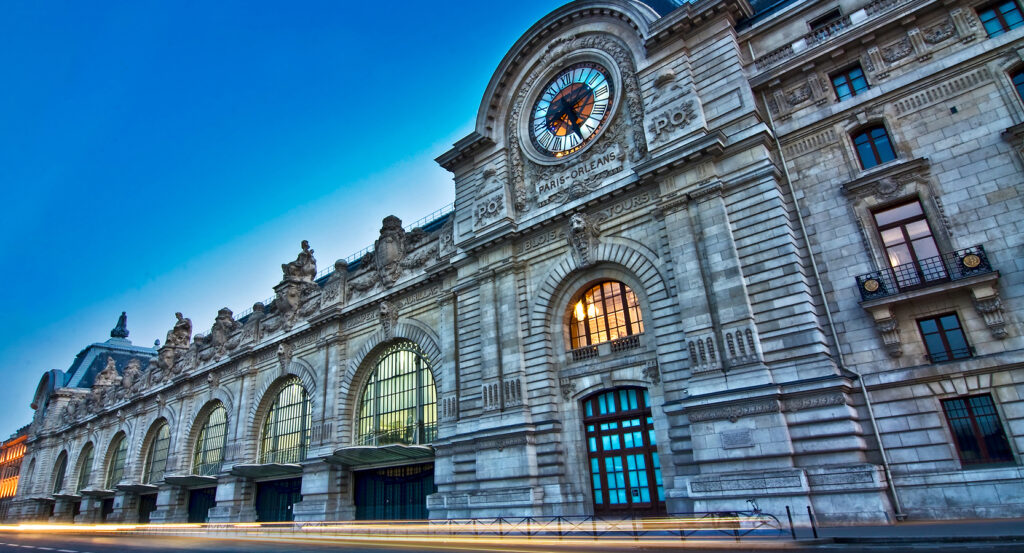
Set along Quai Anatole France near Rue de Bellechasse and just steps from the Seine, the museum occupies an immense riverside block where Victor Laloux's limestone elevations, grand clocks and former railway hotel face the Tuileries across the water as the narrower streets of the 7th Arrondissement close around its southern edge. The 138-meter-long former train hall opens beneath an iron-and-glass vault rising 32 meters above the central nave, preserving the scale required for a major metropolitan terminus. Terraces climb through the hall toward galleries inserted within the old station volume, keeping the original architecture continuously visible between sculpture, painting and decorative arts. The great clock facing the Seine frames the Right Bank skyline as the building's stone exterior conceals the metal structure that made the station technologically advanced at the opening of the twentieth century. The result is a museum whose extraordinary collection remains inseparable from the industrial architecture, riverfront position and urban ceremony of the building created to contain an entirely different form of movement.
What defines Musée d'Orsay.
Musée d'Orsay is best known for converting the Gare d'Orsay, Victor Laloux's technologically advanced terminus for the 1900 Exposition Universelle, into a museum devoted principally to Western art created between 1848 and 1914. The Compagnie du chemin de fer de Paris à Orléans sought a central terminus to replace the more distant Gare d'Austerlitz and consulted Lucien Magne, Émile Bénard and Laloux in 1897 before selecting Laloux the following year. The architect faced a site opposite the Tuileries and beside the Palais de la Légion d'honneur, leading him to conceal an iron railway structure behind an elaborate stone exterior designed for its prestigious riverfront surroundings. Construction required only two years, and the station and adjoining hotel opened on July 14, 1900 with sixteen underground tracks, electric traction, passenger elevators, baggage lifts and inclined planes. Gare d'Orsay served southwestern France until 1939, when longer trains rendered its platforms inadequate for mainline traffic. Its immense interior subsequently handled parcels for prisoners during the Second World War and returning prisoners after Liberation, hosted Charles de Gaulle's 1958 press conference announcing his return to power, provided a set for Orson Welles's The Trial in 1962 and accommodated the Renaud-Barrault theater company and auctioneers displaced during work at Hôtel Drouot. Demolition threatened the station before renewed appreciation of nineteenth-century architecture secured heritage protection in 1973. President Valéry Giscard d'Estaing initiated the formal museum decision on October 20, 1977, establishing the institutional conversion that preserved Laloux's station and gave France a museum spanning the period between the Louvre and modern collections.
The museum conversion joined Laloux's surviving railway architecture with a new spatial system developed by ACT-Architecture and Gae Aulenti. Renaud Bardon, Pierre Colboc and Jean-Paul Philippon won the architectural competition in 1979 with a proposal retaining the great nave as the principal organizing axis and converting the former station canopy into the museum entrance. Gae Aulenti received responsibility for the interior design in March 1980 and divided the collection across three principal levels, using stone-clad exhibition volumes along the nave and elevated terraces overlooking the central sculpture route. The museum opened to the public on December 9, 1986 after François Mitterrand inaugurated it eight days earlier. Painting, sculpture, photography, architecture, graphic arts and decorative arts were brought into the same institution, allowing works by Manet, Monet, Degas, Renoir, Cézanne, Van Gogh, Gauguin and their contemporaries to sit within a wider account of artistic production during the period. Gustave Caillebotte's 1894 bequest became particularly important to the national Impressionist holdings, bringing Renoir's Bal du moulin de la Galette and other works into the French state collection. Claude Monet had earlier organized a public subscription after Manet's death to secure Olympia from the painter's widow, another acquisition that eventually entered Orsay's holdings. The museum consequently united a railway building rescued from demolition with national collections formed through artists, collectors, state acquisitions and major bequests, making the history of nineteenth-century art inseparable from the history of its preservation.
How Musée d'Orsay fits.
Musée d'Orsay works as the anchor for a daytime exploration across the western Left Bank and adjoining Tuileries using three nearby institutions that move from an eighteenth-century princely residence through Monet's purpose-built cycle of water-lily paintings into Auguste Rodin's preservation of his own artistic estate.
Begin at Palais de la Légion d'honneur, built in 1787 by Pierre Rousseau for the German prince Frédéric de Salm-Kyrbourg and positioned on the Seine directly beside the future Gare d'Orsay site. Napoleon ordered its acquisition for the Légion d'honneur in 1804, converting the Hôtel de Salm into the headquarters of the order. Fire devastated the palace during the final days of the Paris Commune in 1871, leaving its exterior standing as the interiors burned; a public subscription among recipients of the Légion d'honneur and Médaille militaire financed reconstruction under Anastase Mortier between 1871 and 1878. The former stable wing became the Musée national de la Légion d'honneur et des ordres de chevalerie in 1925, extending the institution into the history of French and international decorations. Continue across the Seine to Musée de l'Orangerie, where Claude Monet's Nymphéas transformed a former Tuileries greenhouse into an environment created around a single late artistic undertaking. Monet developed the project in sustained correspondence with Georges Clemenceau and the French fine-arts administration, shaping the installation across nearly a decade. The Musée Monet opened on May 20, 1927, months after the painter's death, placing his panoramic water-lily compositions within elliptical rooms conceived for continuous viewing. Later reconstruction between 1960 and 1965 created a second level for the collection assembled by Paul Guillaume and Domenica Walter, followed by another campaign between 1978 and 1984 as the institution became an independent national museum. Conclude at Musée Rodin, occupying the Hôtel Biron, the rococo residence Jean Aubert developed during the 1720s and 1730s for financier Abraham Peyrenc de Moras. Rodin discovered the partially abandoned estate through Rainer Maria Rilke in 1908, rented four ground-floor rooms and occupied the entire mansion from 1911. After the French state acquired the property, Rodin negotiated a remarkable arrangement: his works in plaster, marble, bronze and stone, his drawings, antiquities and intellectual property passed to the nation in exchange for preserving the Hôtel Biron as his museum. Parliament accepted his three donations in 1916, Léonce Bénédite assumed responsibility for organizing the collection and the museum opened on August 4, 1919. The progression moves from Rousseau's princely residence converted into Napoleon's institutional headquarters through Monet and Clemenceau's purpose-built environment for the Nymphéas into Rodin's extraordinary arrangement for preserving his work at Hôtel Biron, connecting three different mechanisms through which private creation entered France's national cultural inheritance.
Where your story begins.
Foresyte Travel reveals places that feel extraordinary long before you arrive.
Experience premium editorial crafted for luxury travelers.
Foresyte Travel may earn a commission when you book through the link on this page.














































































































