
Why Musée de l'Orangerie matters.
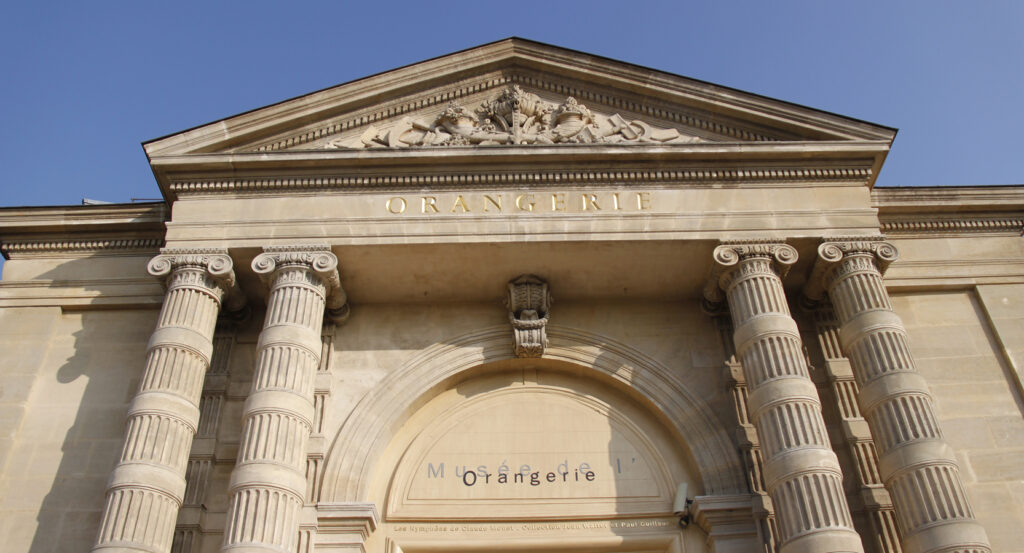
Musée de l'Orangerie is a contemplative art museum where the Tuileries' formal garden character meets Claude Monet's panoramic Nymphéas, a Second Empire orangery and an exceptional collection spanning Impressionism and early modern painting.
Set along the Terrasse du Bord de l'Eau near Place de la Concorde and just steps from the Seine, the museum occupies the southwestern corner of the Jardin des Tuileries where clipped gardens, broad gravel promenades and open river views surround a long stone pavilion set apart from the denser architecture across Rue de Rivoli. The southern elevation stretches toward the river through tall glazed bays conceived to admit winter sunlight, balanced by a substantially closed northern wall originally intended to shield citrus trees from cold winds. Broad terraces extend around the building as the garden's western basins and tree-lined walks open toward Place de la Concorde, giving the compact museum an unusually expansive setting. The building's restrained profile leaves the surrounding garden and sky prominent before the enclosed galleries shift attention toward painting at an immersive scale. The result is a museum whose garden setting, daylight and elongated architecture prepare directly for one of the twentieth century's most ambitious encounters between painting and architectural space.
What defines Musée de l'Orangerie.
Musée de l'Orangerie is best known for Claude Monet's Nymphéas, eight immense compositions conceived for two oval rooms as the culmination of the water-lily cycle that occupied the painter for nearly three decades. Monet developed the cycle from the water garden at Giverny, eventually producing close to 300 paintings and more than forty large-format panels around the pond, vegetation and changing light. The day after the Armistice of November 11, 1918, he offered a group of Nymphéas to France as a symbol of peace, beginning a long collaboration over their permanent installation. The State assigned the Orangerie to the Sous-Secrétariat d'État aux Beaux-Arts in 1921, and Monet committed the large panels to the building in 1922. Camille Lefèvre developed the architectural project under Monet's close attention, arranging two elliptical galleries whose sequence permits the paintings to surround the viewer across curved walls. Natural illumination enters from above, fulfilling Monet's intention that changing daylight participate in the presentation. The eight compositions extend across twenty-two panels and nearly one hundred meters of painted surface, moving through motifs including Morning, Clouds, Green Reflections, Setting Sun and Reflections of Trees. Monet died in December 1926, before seeing the completed installation. The Nymphéas opened at the Orangerie in May 1927, establishing an architectural environment conceived around a single late artistic project rather than a conventional succession of individual canvases.
The Jean Walter and Paul Guillaume collection gives the museum a second coherent account of French painting from the 1860s through the 1930s. Paul Guillaume began assembling the collection in 1914 as his career as an art dealer connected him with the emerging Parisian avant-garde, eventually acquiring hundreds of European paintings alongside African and Oceanian works. His holdings crossed generations through Renoir and Cézanne into Picasso, Matisse, Modigliani, Derain, Soutine and Marie Laurencin, supporting his ambition to establish a public museum of modern French art. Guillaume died in 1934 before completing that project, and his widow Domenica subsequently reshaped the collection as works were sold and new acquisitions entered. She later married architect and industrialist Jean Walter, whose name joined Guillaume's when the French State purchased the paintings in 1959 and 1963 subject to her usufruct. Olivier Lahalle directed alterations between 1960 and 1965 to accommodate the collection, and Culture Minister André Malraux inaugurated its public presentation in 1966. The holdings now comprise 148 works, including twenty-five Renoirs, fifteen Cézannes, twelve Picassos, ten Matisses, five Modiglianis, twenty-two Soutines and major groups by Derain, Utrillo and Henri Rousseau. Renovation from 1978 to 1984 subsequently established the complete Walter-Guillaume collection permanently at the Orangerie as the institution became an independent national museum.
How Musée de l'Orangerie fits.
Musée de l'Orangerie works as the anchor for a daytime exploration of the western Tuileries using three nearby sites that move from seventeenth-century royal landscape design through a Second Empire building created as the Orangerie's architectural counterpart into the ceremonial square connecting the former palace grounds with the Champs-Élysées.
Begin at Jardin des Tuileries, created for Catherine de Médicis in 1564 on terrain occupied by tile makers beyond the contemporary city walls. André Le Nôtre completely redesigned the garden for Louis XIV beginning in 1664, organizing it through the Grand Carré, wooded Grand Couvert and Grande Allée whose westward sightline extended into the emerging Champs-Élysées. The palace burned during the Commune in 1871 and its ruins disappeared in 1883, leaving the garden to preserve the principal spatial structure of the former royal domain. Pascal Cribier and Louis Benech won the 1990 competition for its modern rehabilitation, and the grounds now contain sculpture spanning the seventeenth through twenty-first centuries. Continue to Jeu de Paume, whose origin followed destruction of the Passage Sandrié court during construction of the Palais Garnier in 1861. Napoleon III authorized its club to relocate to the Tuileries, where Melchior Viraut designed a new court inaugurated on January 29, 1862. Viraut deliberately adopted decorative principles from the Orangerie erected nine years earlier, creating paired buildings at the garden's western corners. The structure later passed from sport into exhibition use and museum history, including its twentieth-century association with the Louvre's Impressionist collections before becoming a center devoted to photography and image-based art. Conclude at Place de la Concorde, where Ange-Jacques Gabriel created an 8.64-hectare royal square honoring Louis XV and inaugurated in 1772. Revolution renamed it Place de la Révolution in 1792, and Louis XVI, Marie-Antoinette, Danton and Robespierre were among those executed there before the Concorde name marked post-Terror reconciliation. The Luxor Obelisk rose at its center in 1836, and Jacques-Ignace Hittorff subsequently developed the fountains, rostral columns and other components that established much of the nineteenth-century composition. The progression moves from Le Nôtre's reordering of royal landscape through Viraut's deliberate architectural pairing with the Orangerie into Gabriel and Hittorff's ceremonial square, extending the museum through three stages in the construction of Paris's great western axis.
Where your story begins.
Foresyte Travel reveals places that feel extraordinary long before you arrive.
Experience premium editorial crafted for luxury travelers.
Foresyte Travel may earn a commission when you book through the link on this page.














































































































