
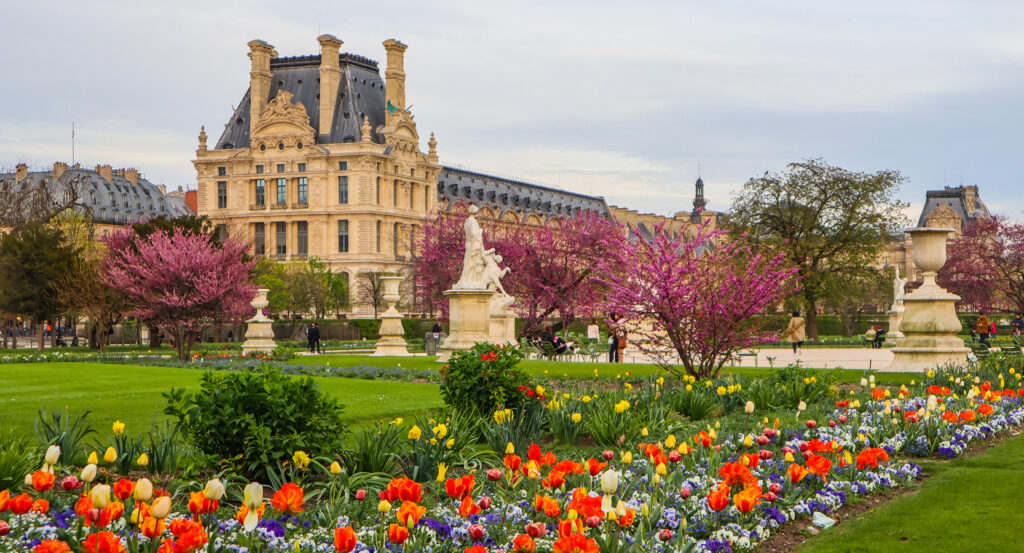
Why Jardin des Tuileries matters.
Jardin des Tuileries is a stately formal garden where the Louvre quarter's royal character meets André Le Nôtre's axial landscape, centuries of public promenade and an open-air sculpture collection extending from the ancien régime to contemporary art.
Set along Rue de Rivoli near Place du Carrousel and just steps from the Seine, the garden occupies a vast rectangular enclosure where clipped tree corridors, formal parterres, broad gravel walks and expansive basins create a green interval between the Louvre and Paris's western ceremonial axis. The Grande Allée runs through the center toward the octagonal basin as wooded bosquets form denser compartments along both sides. Elevated terraces border the Seine and Rue de Rivoli, giving the garden long perspectives across its tree canopy and the architecture enclosing Central Paris. Horseshoe ramps rise around the western Octogone, strengthening the transition from the intimate shaded groves toward the immense open ground at the garden's western boundary. The result is a precisely ordered landscape where geometry, water, sculpture and controlled sightlines turn the former royal garden into one of the clearest surviving demonstrations of French formal garden design.
What defines Jardin des Tuileries.
Jardin des Tuileries is best known for the transformation André Le Nôtre began for Louis XIV in 1664, when an existing royal garden beside the Tuileries Palace acquired the axial structure that still governs its landscape. Catherine de Médicis had created the first garden in 1564 beside the palace she commissioned after the death of Henri II, using ground previously occupied by tile makers whose kilns supplied the Tuileries name. That sixteenth-century garden followed an Italian-derived arrangement with six principal paths aligned on palace pavilions. Le Nôtre reorganized this inheritance around a powerful central avenue extending between a round eastern basin and the western octagonal basin, accompanied by wooded compartments and elevated terraces along the Seine and northern boundary. His western vista extended beyond the garden toward the territory that developed into the Champs-Élysées, placing the Tuileries within an urban axis far larger than the palace grounds themselves. Jean-Baptiste Colbert preserved public access after Le Nôtre's work, helping establish the garden as an early setting for the Parisian practice of the public promenade. Wooden benches numbered close to two hundred by the end of the seventeenth century as walking, sitting and social observation became established components of life inside the former royal precinct. The Revolution transferred the garden to the state in 1792, severing its institutional dependence on royal ownership. Communards burned the adjoining Tuileries Palace in 1871, and removal of its ruins in 1883 permanently opened the eastern end toward the Louvre. The garden survived the disappearance of the building for which it had been created, leaving Le Nôtre's seventeenth-century landscape as the principal physical carrier of the Tuileries name.
Sculpture gradually converted the garden into an outdoor collection spanning several centuries of French artistic patronage. Works arriving from Versailles and Marly under the Regency from 1716 established an important early group, including sculptures originating in the closing decades of the seventeenth century. Antoine Coysevox and other royal sculptors entered a landscape whose terraces, basins and bosquets provided architectural settings for freestanding figures and ornamental vases. Later governments repeatedly changed the collection as artistic priorities shifted, producing an ensemble that now reaches from royal sculpture through Auguste Rodin, Jean Dubuffet, Giuseppe Penone and Louise Bourgeois. Fragile original marbles have moved into the Louvre's Cour Marly and Cour Puget, with replicas preserving their intended positions outdoors. A 1990 competition initiated another major chapter when Pascal Cribier and Louis Benech joined architect François Roubaud, art historian Monique Mosser and Penone on a restoration tied to the Grand Louvre project. Penone created L'Arbre des voyelles for the renewed garden, inserting contemporary sculpture into a collection built through successive regimes. The present Domaine national du Louvre et des Tuileries contains 140 statues and vases, sustaining a sculptural sequence assembled through more than three centuries.
How Jardin des Tuileries fits.
Jardin des Tuileries works as the anchor for a daytime exploration through the 1st Arrondissement using three nearby sites that move from Louis XIV's purpose-built royal square through Richelieu's seventeenth-century palace into the great eighteenth-century square that later became a principal stage of the French Revolution.
Begin at Place Vendôme, whose ordered facades grew from plans by Jules Hardouin-Mansart and Robert de Cotte's generation of royal architects for a square initially known as Place Louis-le-Grand. Its coordinated elevations use arcaded ground floors, mascarons, Corinthian pilasters and alternating dormers to establish a continuous architectural enclosure around the octagonal ground. Napoleon later placed a bronze victory column at its center, begun in 1806 and completed in 1810 under a team including Jean-Baptiste Lepère and Jacques Gondouin. The 44.3-meter column drew upon Trajan's Column in Rome and wrapped its stone core with hundreds of bronze relief plaques devoted to the Austerlitz campaign; the Commune pulled it down in 1871 before reconstruction in 1875. Continue to Palais-Royal, erected opposite the Louvre for Cardinal Richelieu by Jacques Lemercier beginning in 1634. The property became a royal residence after Richelieu's death and passed to the Orléans family in 1661, beginning a long sequence of alterations that reshaped the palace around its garden. Three wings enclosing that garden belong to the late eighteenth-century redevelopment, when arcaded commercial galleries transformed the precinct into a major center of Parisian commerce and sociability. The complex later accumulated institutions now including the Conseil d'État, Conseil constitutionnel and Ministry of Culture, preserving the political role of a palace whose origins lie in Richelieu's proximity to the royal Louvre. Conclude at Place de la Concorde, designed by Ange-Jacques Gabriel as Place Louis XV and completed in 1772 around the western continuation of Paris's great central axis. Revolutionary government renamed it Place de la Révolution in 1792, and Louis XVI, Marie-Antoinette, Danton and Robespierre were executed there during the following two years. The Concorde name arrived in 1795 as a gesture toward national reconciliation, and the Luxor Obelisk erected in 1836 became the center of the nineteenth-century composition later enriched by Jacques-Ignace Hittorff's fountains, rostral columns and statuary. The progression moves from Hardouin-Mansart's royal architectural order through Richelieu and Lemercier's palace complex into Gabriel's royal square and its revolutionary transformation, carrying the surrounding district through three concentrated expressions of monarchy, state power and urban design.
Where your story begins.
Foresyte Travel reveals places that feel extraordinary long before you arrive.
Experience premium editorial crafted for luxury travelers.
Foresyte Travel may earn a commission when you book through the link on this page.














































































































