
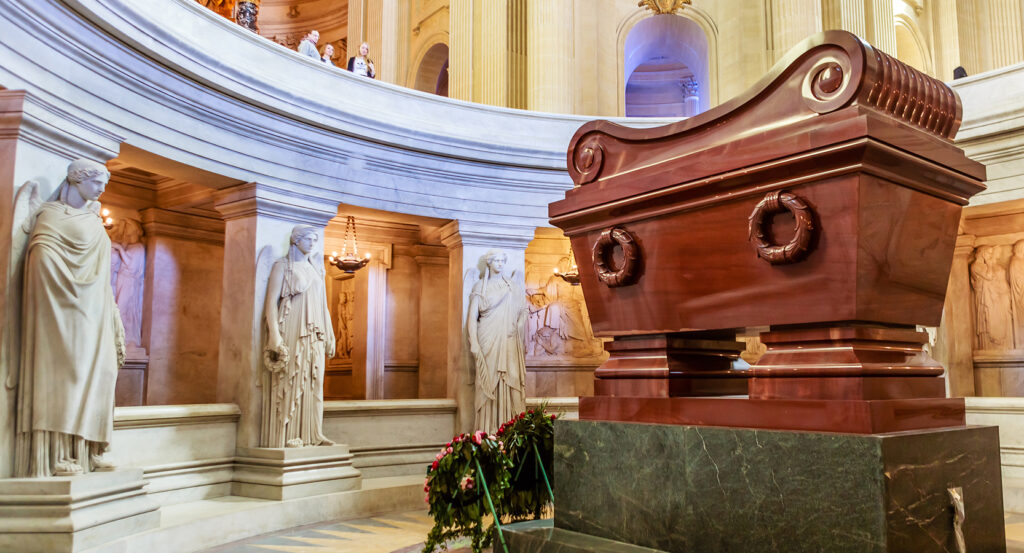
Why Hôtel des Invalides matters.
Hôtel des Invalides is a commanding military complex where Invalides' ceremonial character meets Louis XIV's vast veterans' institution, a rigorously ordered classical ensemble and the gilded dome that has governed this quarter's skyline for more than three centuries.
Set along Rue de Grenelle near Boulevard des Invalides and just steps from Avenue de Tourville, the complex occupies an immense walled precinct where pale stone facades, formal courts, clipped lawns and the long northern esplanade establish an architectural interval between the dense streets of the 7th Arrondissement and the Seine. Libéral Bruant's northern facade extends 195 meters behind the forecourt, using strict horizontal divisions, projecting pavilions and sculpted dormers before its central triumphal entrance opens toward the Cour d'Honneur. The 102-by-64-meter principal court intensifies that symmetry through two levels of arcaded galleries enclosed by four building ranges, with military trophies concentrated across the roofline. Jules Hardouin-Mansart's gilded Dôme rises beyond the southern range, drawing the long north-south composition upward from Bruant's disciplined residential architecture into a 107-meter royal church. The result is a vast architectural precinct whose facade, courts and dome turn the institutional requirements of a soldiers' home into one of the most complete surviving compositions of Louis XIV's Paris.
What defines Hôtel des Invalides.
Hôtel des Invalides is best known for Louis XIV's 1670 decision to establish a permanent home and hospital for wounded, sick, disabled and elderly soldiers, transforming royal responsibility toward veterans into an institution of unprecedented architectural scale. The king selected ground on the Grenelle plain beside the Seine and entrusted Libéral Bruant with a quadrilateral complex organized behind a grand northern front and around a large central court. Construction advanced from 1671 to 1675, and the institution quickly developed beyond hospital care into a hospice, barracks and religious community with workshops producing shoes, tapestries and illuminated books. Bruant's original conception encountered its decisive expansion in 1676, when Secretary of State for War Louvois transferred responsibility for the churches to Jules Hardouin-Mansart. Hardouin-Mansart conceived connected spaces that permitted Louis XIV and the resident soldiers to attend the same service through separate entrances, reconciling court etiquette with the institution's religious life. The soldiers' church reached completion in 1679, then work on the royal church continued through a far more ambitious centralized composition crowned by the Dôme. Louis XIV inaugurated that church in 1706, thirty-six years after founding the institution. The architectural campaign joined Bruant's regimented residential quadrangle with Hardouin-Mansart's royal chapel, giving veterans' housing, medical care, worship and monarchical ceremony distinct places inside one immense complex. Hôtel des Invalides consequently developed as both a practical institution for former soldiers and an architectural statement about the reciprocal obligations binding Louis XIV's monarchy to the army on which its power depended.
The Cour d'Honneur reveals how that founding purpose was translated into the daily organization and artistic program of the institution. Bruant arranged four ranges around the 102-by-64-meter enclosure, placing refectories capable of accommodating 1,500 residents simultaneously at ground level and sleeping quarters above them. Two levels of arcades give the elevations the appearance of a compact two-story composition even though the surrounding ranges contain four internal levels visible from the secondary courts. Pierre Hutinot developed the extraordinary series of sixty dormers crowning the court, filling their stone surrounds with weapons, armor and martial emblems that identify the military purpose of the architecture. Monumental staircases occupy the corners, and sculpted horses overcoming enemies intensify the martial imagery at the upper edges of the enclosure. The former refectories preserve painted decorations devoted to Louis XIV's campaigns, turning spaces associated with communal meals into another vehicle for royal military commemoration. Charles-Émile Seurre's statue of Napoleon I entered the southern arcade in 1911 after earlier occupying the summit of the Colonne Vendôme from 1833 to 1863, inserting an imperial figure into Bruant's royal court. Artillery collections further changed the enclosure after the Musée d'Artillerie arrived at the Invalides in 1871, followed by the creation of the Musée historique de l'Armée in 1896 and their merger as the Musée de l'Armée in 1905. The Cour d'Honneur carries the institution from seventeenth-century communal military life through Napoleonic commemoration into the museum role that became increasingly prominent after the Franco-Prussian War.
How Hôtel des Invalides fits.
Hôtel des Invalides works as the anchor for a daytime exploration of the surrounding 7th Arrondissement using three nearby sites that move from an eighteenth-century military academy through an aristocratic residence claimed by Auguste Rodin into the great Seine crossing created for the Exposition Universelle of 1900.
Begin at École Militaire, founded in 1751 from an initiative associated with Maurice de Saxe and developed as a royal institution for officer training. Ange-Jacques Gabriel directed the principal architectural campaign, creating the axial composition at the southern end of the Champ de Mars before later work involved Étienne-Louis Boullée and Alexandre-Théodore Brongniart. The school eventually trained the young Napoleon Bonaparte in 1784 and 1785, giving the institution a direct connection with the officer who would overturn the political order under which it had been founded. Military education returned to the site in successive forms during the nineteenth and twentieth centuries, with figures including Ferdinand Foch and Charles de Gaulle entering its later institutional history. Continue to Musée Rodin, occupying the Hôtel Biron built for financier Abraham Peyrenc de Moras from 1727 under architect Jean Aubert. Louis-Antoine de Gontaut-Biron acquired the estate in 1753 and doubled its garden, adding a circular pool and an English-style section to the existing French arrangement. After later diplomatic and religious occupations, artists began renting rooms there in 1905; Jean Cocteau, Henri Matisse, Isadora Duncan and Clara Westhoff joined a community whose presence preceded Rodin's arrival in 1908. Rodin initially rented four ground-floor rooms, occupied the entire mansion from 1911 and negotiated an arrangement through which his works and collection passed to the French state. Parliament accepted his donations in 1916, and Musée Rodin opened in 1919 under the direction of Léonce Bénédite. Conclude at Pont Alexandre III, conceived for the Exposition Universelle of 1900 as the Seine crossing completing a ceremonial route between the Invalides axis and the new Grand Palais and Petit Palais. Tsar Nicholas II, Empress Alexandra Feodorovna and French president Félix Faure participated in the laying of the first stone on October 7, 1896, embedding the bridge within the diplomatic symbolism of the Franco-Russian alliance. Its metal span crosses the river between four towering pylons crowned by gilded bronze Pegasus groups, preserving an unobstructed vista across the grand ensemble. President Émile Loubet inaugurated the bridge with the exposition on April 14, 1900, completing an urban composition conceived simultaneously as transport infrastructure, exhibition architecture and state ceremony. The progression moves from Gabriel's royal academy for officer training through Aubert's aristocratic residence and Rodin's conversion of it into an artistic bequest into the Franco-Russian bridge created for the 1900 exposition, extending Hôtel des Invalides through three institutions that recast royal, artistic and republican ambitions across the surrounding quarter.
Where your story begins.
Foresyte Travel reveals places that feel extraordinary long before you arrive.
Experience premium editorial crafted for luxury travelers.
Foresyte Travel may earn a commission when you book through the link on this page.














































































































