
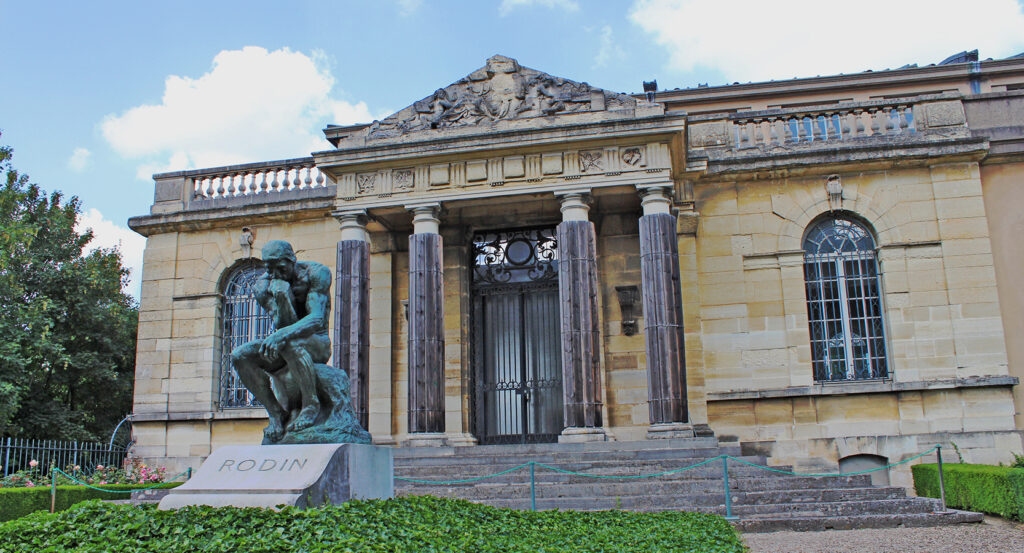
Why Hôtel Biron matters.
Hôtel Biron is a refined rocaille mansion where Invalides' aristocratic character meets an eighteenth-century country residence, a garden shaped by Marshal Biron and the Parisian home Auguste Rodin selected for his artistic legacy.
Set along Rue de Varenne near Boulevard des Invalides and just steps from Rue de Babylone, the mansion occupies a deep garden parcel where high stone walls, mature trees and long planted grounds create an unexpectedly secluded enclosure within the institutional fabric of the 7th Arrondissement. Jean Aubert's pale limestone residence stands between a formal entrance court and an expansive southern garden, its restrained elevations articulated through tall windows, sculpted pediments and curved architectural components. Broad glazed openings connect the principal rooms visually with terraces, lawns and tree-lined paths, preserving the unusual relationship between domestic interiors and open ground that distinguished the property from denser hôtels particuliers closer to Central Paris. The garden extends the residence far beyond its Rue de Varenne frontage, placing the house within greenery that separates it physically from the surrounding ministries, embassies and residential blocks. The result is a remarkably complete Parisian estate whose architecture and garden preserve the spacious aristocratic character of the Faubourg Saint-Germain before its full urbanization.
What defines Hôtel Biron.
Hôtel Biron is best known for becoming the permanent Parisian home of the Musée Rodin after passing from an eighteenth-century financier through aristocratic ownership, religious education and an early twentieth-century colony of artists. Financier Abraham Peyrenc de Moras commissioned the residence during the late 1720s, when the Faubourg Saint-Germain still offered large undeveloped parcels suited to houses conceived between court and garden. Jean Aubert, Architect to the King, ultimately oversaw a project completed during the early 1730s and developed its classical plan with rocaille decoration for a residence combining the functions of a Parisian hôtel particulier and country retreat. Peyrenc de Moras died in 1732 before completion of the first-floor interiors, and his widow subsequently rented the property to Louise-Bénédicte de Bourbon, Duchess of Maine, in 1736. Her death in 1753 opened another decisive phase when the estate passed to Louis-Antoine de Gontaut-Biron, future Marshal Biron, whose ownership supplied the name that survived subsequent changes of use. Biron concentrated his intervention on the grounds, doubling the ornamental garden, excavating a circular pool and introducing an English-style section. The Société du Sacré-Coeur de Jésus acquired the estate in 1820 and converted it into an educational institution for girls, stripping away portions of the earlier decoration as the property adapted to religious use. New educational and devotional buildings followed, culminating in Juste Lisch's chapel completed in 1876. Dissolution of the Society in 1904 ended more than eight decades of religious occupation and left the aging estate available to a group whose presence would determine its twentieth-century fate.
The years immediately after the religious community departed transformed Hôtel Biron into an improvised artistic address whose occupants brought Auguste Rodin into direct contact with the property. Tenants began entering in 1905, among them Jean Cocteau, Henri Matisse, Isadora Duncan and German sculptor Clara Westhoff. Rainer Maria Rilke, Westhoff's husband and Rodin's former secretary, occupied one of the oval salons and urged the sculptor to see the estate after discovering its neglected rooms and overgrown grounds. Rodin rented four south-facing ground-floor rooms in 1908, using them for work, exhibition and reception and arranging sculpture beside paintings, antiquities and plaster studies. His occupation expanded until he controlled the entire mansion from 1911, the same year the French state acquired the property. Rodin pursued an arrangement that tied preservation of his artistic holdings to preservation of the house, offering his sculpture, drawings, antiquities, archives, photographs and intellectual-property rights to the state on the condition that Hôtel Biron become his museum. Three donations in 1916 established that transfer, one year before his death. Musée Rodin opened at Hôtel Biron on August 4, 1919, converting a temporary studio into the permanent institution Rodin had sought and binding the survival of Aubert's eighteenth-century residence to the sculptor's own artistic estate.
How Hôtel Biron fits.
Hôtel Biron works as the anchor for a daytime exploration through the 7th Arrondissement using three nearby sites that move from another Régence mansion through Paris's first major nineteenth-century Neo-Gothic church into Louis XIV's vast institution for military veterans.
Begin at Hôtel de Matignon, where Christian-Louis de Montmorency-Luxembourg commissioned Jean Courtonne in 1722 on marshy ground being opened to aristocratic development across the Faubourg Saint-Germain. Financial difficulties transferred the unfinished project to Jacques de Matignon, and his son Jacques IV occupied the completed residence with Louise-Hippolyte Grimaldi, linking the property with Monaco's ruling family until the Revolution. Charles-Maurice de Talleyrand-Périgord acquired it in 1808 and added garden wings before financial pressure transferred the house to Napoleon I. Félix Duban directed another major campaign after the Duke and Duchess of Galliera acquired the property during the nineteenth century, and the French state eventually purchased it after the First World War. Its assignment to the head of government in 1935 converted an aristocratic residence into one of the principal institutions of the French Republic. Continue to Basilique Sainte-Clotilde, whose creation began with an 1827 municipal decision to construct a new church and gained architectural direction when Prefect Rambuteau entrusted François-Christian Gau with a Gothic project in 1833. Construction started in September 1846, using stone quarried at Châtillon-sur-Seine, and Théodore Ballu assumed direction after Gau withdrew shortly before his death in 1853. Ballu strengthened the towers, built their spires and intensified the portal composition before the church was consecrated on November 30, 1857 in the presence of Cardinal Morlot and Baron Haussmann. Aristide Cavaillé-Coll's organ subsequently became associated with César Franck, Gabriel Pierné, Charles Tournemire and Jean Langlais, extending the building's architectural significance into the history of French organ music. Pope Leo XIII elevated Sainte-Clotilde to a minor basilica in 1897. Conclude at Hôtel des Invalides, commissioned and financed by Louis XIV in 1670 to house and care for wounded, disabled and elderly soldiers. Libéral Bruant developed the immense quadrilateral complex around a central court and directed construction from 1671 to 1675. Jules Hardouin-Mansart succeeded him in 1676 and completed the Soldiers' Church in 1679 before pursuing the royal church whose gilded dome became the complex's dominant architectural feature. Work on the royal church advanced from 1686, and Louis XIV inaugurated it in 1706, completing a state institution in which hospital accommodation, military community and royal religious architecture were joined on a scale. The progression moves from Courtonne's Régence residence and its passage into governmental use through Gau and Ballu's nineteenth-century revival of Gothic architecture into Bruant and Hardouin-Mansart's immense royal foundation, developing three stages in the architectural concentration of private and state power around the Rue de Varenne.
Where your story begins.
Foresyte Travel reveals places that feel extraordinary long before you arrive.
Experience premium editorial crafted for luxury travelers.
Foresyte Travel may earn a commission when you book through the link on this page.














































































































