
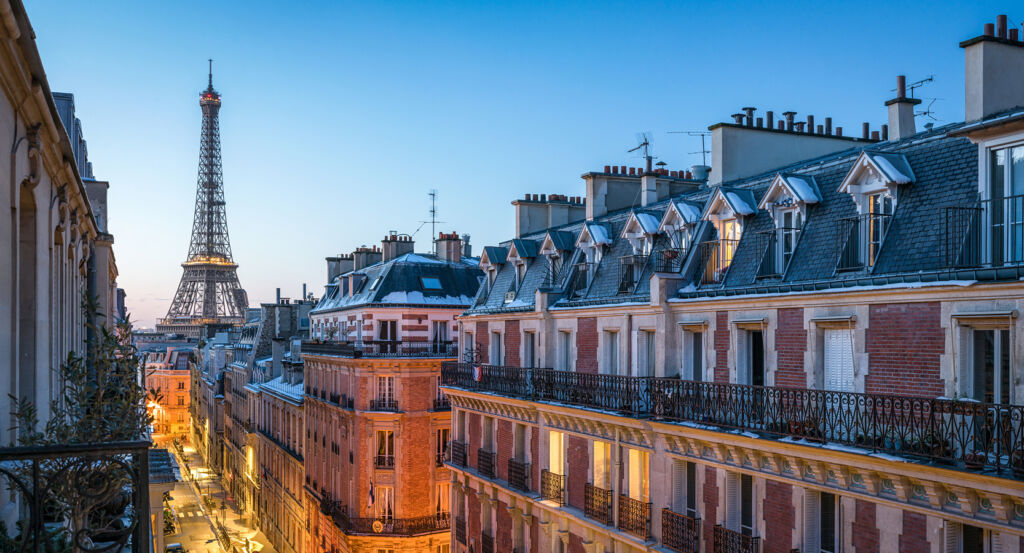
Why Eiffel Tower matters.
Eiffel Tower is a daring iron monument where the 7th Arrondissement's ceremonial character meets nineteenth-century engineering ambition, the great exhibition grounds of the Champ de Mars and a structure that permanently altered the scale of the Paris skyline.
Set along Avenue Gustave Eiffel near Quai Jacques Chirac and just steps from Pont d'Iéna, the tower occupies the northern end of the Champ de Mars where immense lawns, clipped allées and tree-lined gardens open south toward École Militaire as the Seine and Trocadéro frame its opposite side. Four immense lattice piers spread across the esplanade before curving inward through arches toward the narrow upper structure, giving the ironwork a physical breadth that changes dramatically as the tower rises. The Champ de Mars preserves a long central sightline beneath and beyond the structure, placing its vertical mass against one of western Paris's largest uninterrupted green spaces. Pont d'Iéna carries the axis across the Seine toward the elevated terraces of Chaillot, extending the composition beyond the tower into a grand cross-river sequence. The result is a vast architectural setting where iron construction, formal landscape and the Seine give the tower an urban scale inseparable from western Paris.
What defines Eiffel Tower.
Eiffel Tower is best known for the 300-meter iron structure conceived for the 1889 Exposition Universelle through a project developed by engineers Maurice Koechlin and Émile Nouguier, architect Stephen Sauvestre and entrepreneur Gustave Eiffel. Koechlin and Nouguier began exploring a thousand-foot tower in 1884, with Koechlin producing a June 6 sketch that treated the structure as an enormous bridge pier formed from four lattice columns spreading at ground level and converging upward. Sauvestre subsequently reworked its appearance with masonry pedestals, grand arches and architectural treatment for its occupied levels, helping convert the engineering concept into a proposal suitable for the exposition. Eiffel registered a patent with Koechlin and Nouguier in September 1884, then acquired their rights and became the principal public and commercial force behind the project. A competition for the 1889 exposition drew 107 proposals before Eiffel's scheme was selected for the Champ de Mars. The January 8, 1887 convention involving Eiffel, commerce minister Édouard Lockroy and Seine prefect Eugène Poubelle established the financial and operating arrangement: the projected cost stood at 6.5 million francs, public support supplied 1.5 million and Eiffel received operating rights for twenty years beginning at the end of 1889. Construction started that month and required two years, two months and five days, with the four foundations completed during the first five months and the prefabricated iron components assembled above them with extraordinary dimensional precision. Completion came on March 31, 1889, when Eiffel raised the French flag at the summit, several weeks before the exposition opened on May 15. Standing above every previous human-built structure, the tower became the exposition's dominant vertical marker and drew 1,953,122 admissions during the fair.
Scientific experimentation supplied the mechanism that carried the tower beyond the temporary concession underlying its construction. Eiffel used its unprecedented height for meteorological observations, studies of air resistance and experiments in emerging communications technologies as the twenty-year operating period approached its end. Eugène Ducretet established a wireless telegraph connection between the tower and the Panthéon on November 5, 1898 across four kilometers, followed in 1899 by transmissions reaching London. Military interest brought Gustave Ferrié into the work, and a permanent wireless installation expanded the structure's strategic importance before the First World War. German communications intercepted through the tower during the conflict demonstrated the practical value of its height, strengthening the case for permanent retention. Civil broadcasting began through Radio Eiffel Tower in 1921, followed by spoken news programming in 1925 and television experiments using a summit transmitter from 1935. A new antenna installed in 1957 raised the structure to 320.75 meters, another UHF installation brought it to 324 meters in 2000 and a digital radio antenna installed in 2022 increased the height to 330 meters. The tower survived its temporary nineteenth-century premise through this continuing technical function, evolving from an exposition structure into infrastructure for wireless telegraphy, radio and television.
How Eiffel Tower fits.
Eiffel Tower works as the anchor for a daytime exploration across the adjoining Seine and Champ de Mars district using three nearby sites that move from Ange-Jacques Gabriel's eighteenth-century military institution through the interwar reconstruction of Trocadéro into Jean Nouvel's twenty-first-century museum devoted to arts and cultures beyond Europe.
Begin at École Militaire, whose establishment under Louis XV created the architectural anchor that defined the Champ de Mars long before the tower appeared. Ange-Jacques Gabriel developed the complex for an institution founded to educate young noblemen for military careers, placing its principal composition on the southern edge of the open training ground later used for the Fête de la Fédération in 1790 and successive universal exhibitions. The Champ de Mars became a military exercise field in 1780 and subsequently hosted the Paris expositions of 1867, 1878, 1889, 1900 and 1937, allowing Gabriel's eighteenth-century complex to remain the fixed southern terminus as temporary exhibition architecture repeatedly transformed the ground before it. Continue across the Seine to Palais de Chaillot, where the 1937 Exposition Internationale replaced the earlier Palais du Trocadéro and established the elevated architectural counterpart to the tower. Its two curving wings frame an open central terrace aligned directly with Pont d'Iéna, the Eiffel Tower and École Militaire, creating the cross-river composition that now governs the western view of the monument. The 1937 rebuilding converted an exposition site into a permanent institutional ensemble and preserved the hill as the northern terminus of the Champ de Mars axis. Conclude at musée du quai Branly - Jacques Chirac, opened in 2006 after Jacques Chirac's encounter with collector Jacques Kerchache helped advance a national museum devoted to non-Western arts and civilizations. Jean Nouvel won the 1999 architectural competition for a building developed around collections inherited principally from the Musée de l'Homme and Musée national des Arts d'Afrique et d'Océanie, with construction extending from 2001 to 2006. The institution brought close to 300,000 works into a new museum beside the Seine, placing a major contemporary architectural commission within the territory long dominated by the tower. The progression moves from Gabriel's military institution and the training ground that became the Champ de Mars through the 1937 reconstruction of Trocadéro into Nouvel's museum beside the Seine, developing three architectural periods around the axis that has framed Eiffel Tower since 1889.
Where your story begins.
Foresyte Travel reveals places that feel extraordinary long before you arrive.
Enjoy editorial crafted for luxury travelers.
Foresyte may earn a commission when you book.














































































































