
Why Champ de Mars matters.
Champ de Mars is a grand historic park where the 7th Arrondissement's ceremonial character meets a former military exercise ground, revolutionary mass gatherings and the Eiffel Tower's immense iron silhouette.
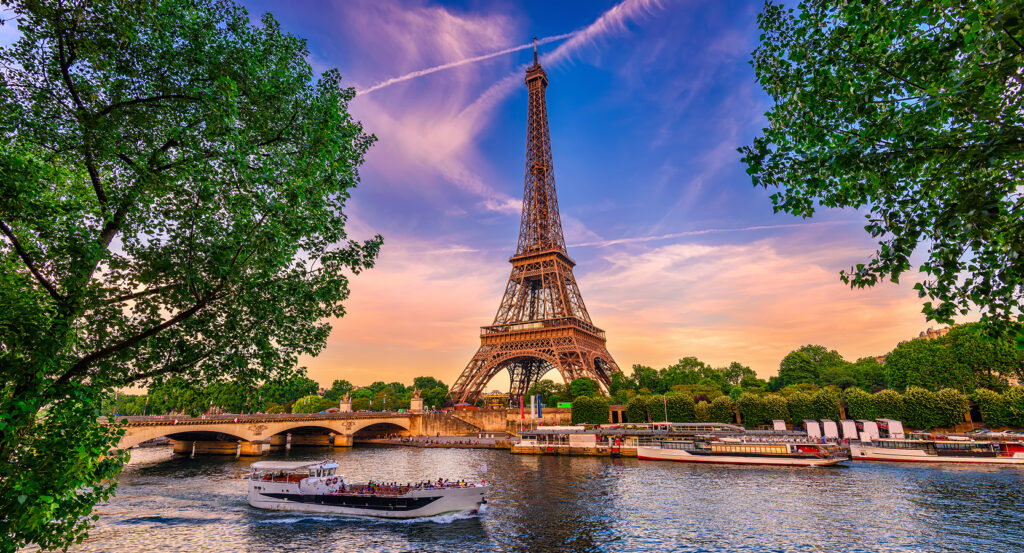
Set along Avenue Joseph Bouvard near Avenue Charles Risler and just steps from Quai Jacques Chirac, the park occupies an elongated green axis where broad lawns, clipped trees, curving side gardens and formal paths stretch between the École Militaire and the Seine. The Eiffel Tower rises across the northern end as Ange-Jacques Gabriel's École Militaire closes the opposite perspective, giving the open ground unusually powerful architectural terminals. Long central lawns preserve the scale required by the site's former military function as denser groves, ponds and winding paths create smaller enclosures along its margins. Avenue de Suffren and Avenue de La Bourdonnais define the outer edges, separating the greenery from the continuous residential blocks of the surrounding Arrondissement. The result is an immense axial park whose openness preserves the scale required by military maneuvers, revolutionary assemblies and international exhibitions across more than two centuries.
What defines Champ de Mars.
Champ de Mars is best known for its repeated transformation from military exercise ground into one of Paris's principal stages for revolutionary politics and international exhibitions. The former Grenelle plain remained agricultural territory when the École Militaire opened during the eighteenth century, and the open ground before the school became a field for military maneuvers whose name invoked Mars, the Roman god of war. Revolutionary Paris converted that military landscape into a mass political arena on July 14, 1790, when the Fête de la Fédération brought fédérés from across France before the National Assembly, royal family and an immense crowd assembled around the Autel de la Patrie. Architects Pierre-Alexandre Vignon, Jacques Cellerier and colleagues contributed to the temporary architecture and enormous earthworks that reshaped the field for the ceremony. Political unity proved brief: on July 17, 1791, National Guard forces fired on a crowd petitioning for the removal of Louis XVI, turning the same ground into the site of the Champ de Mars massacre. Revolutionary governments continued using the field for immense public ceremonies, and the École de Mars established there in 1794 trained young men amid elaborate military exercises and republican festivals. A different form of national performance arrived in 1867 when the field hosted its first Exposition Universelle, centered on a vast elliptical exhibition palace and attended by representatives of 41 countries. Further exhibitions occupied the territory in 1878, 1889 and 1900, repeatedly rebuilding the open ground as temporary architecture became a vehicle for French industry, engineering and international display. Champ de Mars consequently developed through successive reinventions of the same enormous clearing, first for soldiers, then revolutionary crowds and finally the international exhibitions that remade nineteenth-century Paris.
The Exposition Universelle of 1889 produced the structure that permanently altered the field's architectural scale. Organized during the centenary of the French Revolution, the exhibition called for a 300-meter iron tower that would stand as its grand entrance on the Champ de Mars. Maurice Koechlin and Émile Nouguier developed the structural concept through four lattice piers converging toward the summit, and architect Stephen Sauvestre refined its appearance before Gustave Eiffel championed the project. Their proposal prevailed among 107 submissions, and a convention signed on January 8, 1887 joined Eiffel with commerce minister Édouard Lockroy and Seine prefect Eugène Poubelle. Construction began that year, with masonry foundations supporting the immense iron structure assembled above them. The tower was inaugurated on March 31, 1889, when Eiffel climbed to the summit and received the Légion d'honneur. Its financing combined a 1.5-million-franc public subsidy with Eiffel's investment against 6.5-million-franc cost, accompanied by a twenty-year operating concession. Subsequent exhibitions retained the tower, and the Exposition Universelle of 1900 spread across 120 hectares from Champ de Mars through the Invalides and Central Seine corridor as 51 million admissions demonstrated the scale Parisian exhibitions had reached. After the exhibition era, Jean-Camille Formigé developed the park arrangement completed in 1908, preserving broad central lawns within a composition of formal axes and looser planted side gardens that converted the former fairground into the enduring public landscape.
How Champ de Mars fits.
Champ de Mars works as the anchor for a daytime exploration through the 7th Arrondissement using three nearby sites that move from royal military education through an institution created for wounded soldiers into a twenty-first-century museum developed around collections spanning Africa, Asia, Oceania and the Americas.
Begin at École Militaire, whose establishment under Louis XV provided the architectural reason for preserving the enormous open field that became Champ de Mars. Ange-Jacques Gabriel designed the complex for an institution intended to educate young noblemen for military service, arranging its principal buildings around formal courts and placing the central pavilion on the axis later extended across the exercise ground. The school's presence turned the agricultural Grenelle plain into military territory, and Napoleon Bonaparte entered the institution as a cadet in 1784 before completing his studies the following year. Its long facade still supplies the southern termination of the Champ de Mars perspective, preserving the architectural relationship from which the field itself developed. Continue to Hôtel des Invalides, founded by Louis XIV in 1670 to house wounded and aging soldiers and developed under architect Libéral Bruant. Construction advanced rapidly during the following decade, creating vast residential courts and the soldiers' church of Saint-Louis before Jules Hardouin-Mansart designed the adjoining royal church crowned by its gilded dome. Napoleon's remains were transferred there in 1840, and his tomb was subsequently installed beneath the dome within Louis Visconti's nineteenth-century arrangement. Conclude at musée du quai Branly - Jacques Chirac, opened in 2006 after President Jacques Chirac's encounter with collector Jacques Kerchache helped advance a national institution devoted to non-European arts and civilizations. Jean Nouvel won the 1999 architectural competition and developed the building around collections inherited principally from the Musée de l'Homme and Musée national des Arts d'Afrique et d'Océanie, joined by acquisitions begun in 1997. A collection approaching 300,000 works occupies Nouvel's elongated building beside a garden designed by Gilles Clément, carrying the surrounding territory from eighteenth-century state institutions into contemporary museum architecture. The progression moves from Gabriel's royal school and the military ground it generated through Louis XIV's institutional architecture for soldiers into Nouvel's museum developed around collections from four continents, connecting three distinct forms of national institution across the territory surrounding Champ de Mars.
Where your story begins.
Foresyte Travel reveals places that feel extraordinary long before you arrive.
Experience premium editorial crafted for luxury travelers.
Foresyte Travel may earn a commission when you book through the link on this page.














































































































