
Why Palais de Chaillot matters.
Palais de Chaillot is an imposing cultural complex where Trocadéro's grand urbanism meets late Art Deco architecture, international diplomacy and an extraordinary axial relationship with the Eiffel Tower.
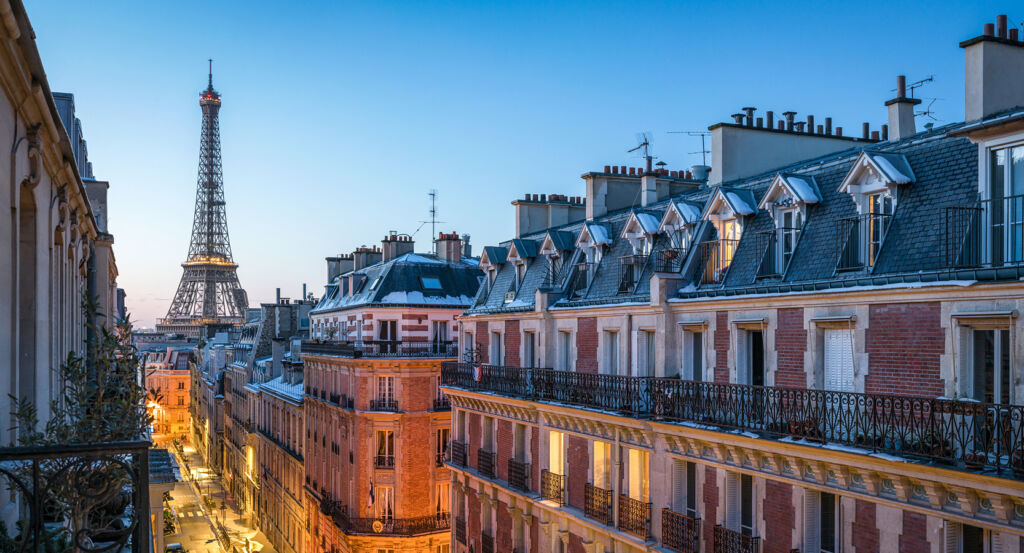
Set atop Chaillot Hill between Place du Trocadéro and the gardens descending toward the Seine, the palace occupies two sweeping wings that open around a broad esplanade facing the Eiffel Tower. Curving façades extend outward from substantial end pavilions, framing an intentionally empty center where the previous palace had contained its immense concert hall. Pale stone surfaces, horizontal galleries and restrained classical proportions give the composition a lower profile than its nineteenth-century predecessor. The elevated terrace projects the architectural axis across the fountains, Pont d'Iéna and Champ de Mars toward the tower on the opposite bank. The result is a grand ensemble whose most consequential architectural gesture is absence itself, opening the center of Chaillot Hill into one of Paris's great constructed vistas.
What defines Palais de Chaillot.
Palais de Chaillot is best known for transforming the Palais du Trocadéro into the principal grand complex of the 1937 Exposition Internationale des Arts et Techniques dans la Vie Moderne. Gabriel Davioud and Jules Bourdais had created the earlier palace for the 1878 Exposition Universelle, placing an immense central rotunda and concert hall between two curving wings. Preparations for the 1937 exposition brought a radically different scheme from Léon Azéma, Jacques Carlu and Louis-Hippolyte Boileau, who retained portions of the earlier structure but removed its central hall and towers. Carlu developed the decisive intervention by burying the new theatre beneath a vast terrace, opening an uninterrupted axis toward the Eiffel Tower and Champ de Mars. Excavation carried the theatre 23 meters into Chaillot Hill, and a huge metal structure spanning the auditorium supported the esplanade overhead. Construction advanced from September 1935 to May 1937, an exceptionally compressed schedule for a project of that scale. Raymond Delamarre and Carlo Sarrabezolles contributed grand sculptural groups to the exterior, joining a much larger program of artistic commissions integrated throughout the complex. Palais de Chaillot emerged as one of three permanent major buildings created for the 1937 exposition alongside Palais de Tokyo and Palais d'Iéna, replacing the theatrical silhouette of the old Trocadéro with the broad horizontal composition that still defines Chaillot Hill.
International diplomacy gave the palace a historical significance extending far beyond the exposition that produced it. The United Nations General Assembly convened there during its early years, when the organization still lacked a permanent headquarters in New York. On December 10, 1948, representatives of the 58 member states then constituting the General Assembly adopted Resolution 217 A (III) inside Palais de Chaillot. That resolution contained the Universal Declaration of Human Rights, whose 30 articles set out civil, political, economic, social and cultural rights in a common international text. Eleanor Roosevelt had chaired the UN Commission on Human Rights during the declaration's development and became one of the central figures associated with its creation. The adoption transformed the palace into the setting for one of the foundational texts of the postwar international order. France later embedded that association into the site itself when the central terrace received the name Parvis des Droits de l'Homme in 1985. Palais de Chaillot joins its architectural importance with an event whose significance reaches across international law, diplomacy and the global history of human rights.
How Palais de Chaillot fits.
Palais de Chaillot works as the architectural anchor for an outing connecting the private rooms of a statesman who led France through the final phase of the First World War, a cemetery dense with figures from French cultural history and the surviving Passy residence where Honoré de Balzac worked on La Comédie humaine.
Begin at Musée Clemenceau, preserving the apartment where Georges Clemenceau lived from 1895 until his death in 1929. He remained in its three rooms through both periods as president of the Council, including his return to government in November 1917 as France entered the decisive final year of the First World War. The garden apartment remained substantially as he left it, retaining his desk, books and personal surroundings. A first-floor gallery extends the collection through manuscripts, photographs, portraits and the coat and gaiters Clemenceau wore during visits to the front. Continue to Cimetière de Passy, successor to the earlier communal cemetery that closed in 1802. Successive enlargements produced its present footprint before Passy's incorporation into Paris in 1860, and architect René Berger created its grand entrance pavilion in 1934. Roughly 2,600 tombs occupy the compact grounds, including those of Claude Debussy, Édouard Manet, Berthe Morisot, Fernandel and aviation pioneer Marcel Dassault. Its concentration of artists, industrialists, aristocrats and political figures makes the cemetery an unusually compressed record of French public life. Conclude at Maison de Balzac, the only surviving Paris residence occupied by Honoré de Balzac. He rented rooms there from 1840 to 1847 and revised La Comédie humaine in his study during one of the most productive periods of his career. The hillside property preserves late-medieval troglodytic spaces beneath it, surviving traces of Passy before its absorption into metropolitan Paris. Louis Baudier de Royaumont secured Balzac's former apartment in 1908 and inaugurated a museum there in 1910; the City of Paris converted the surviving pavilion into a municipal museum after receiving it in 1949. The progression moves from Clemenceau's preserved political interior through a necropolis concentrated with French cultural figures and culminates in Balzac's surviving Passy home, tracing the private places through which the western edge of Paris preserves national political, artistic and literary history.
Where your story begins.
Foresyte Travel reveals places that feel extraordinary long before you arrive.
Enjoy editorial crafted for luxury travelers.
Foresyte may earn a commission when you book.














































































































