
Why Palais de Tokyo matters.
Palais de Tokyo is a pioneering contemporary arts center where Chaillot's grand cultural character meets the stripped concrete scale of a 1937 exhibition palace and an institution built around artistic experimentation.
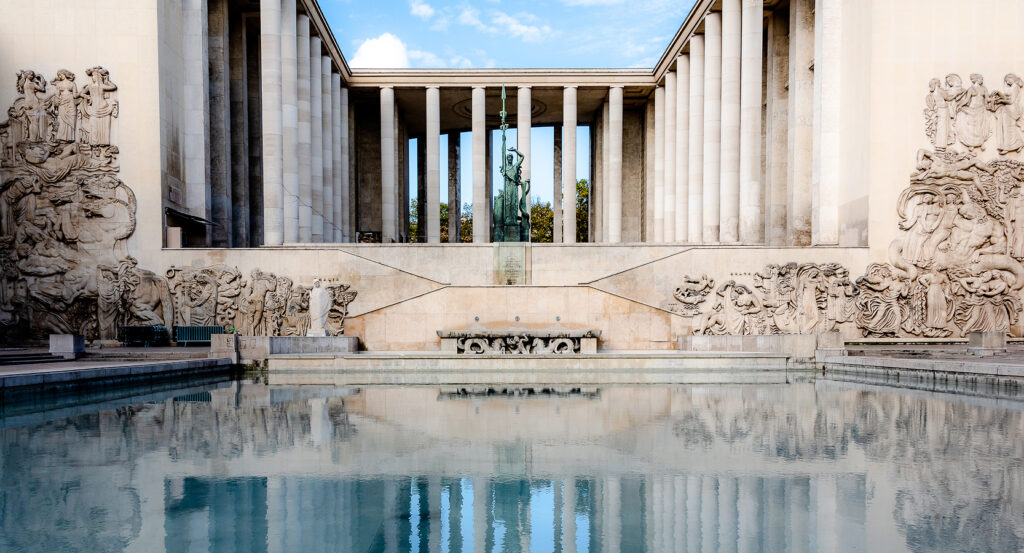
Set along Avenue du Président Wilson near Rue de la Manutention and just steps from Avenue de New York, the immense twin-wing complex occupies the slope above the Seine where limestone facades, broad terraces, grand stairways and reflecting pools create a formal architectural sequence between Place d'Iéna and the river. Two long wings frame an open eastern court whose descending terraces expose views toward the Eiffel Tower across the water. Classical colonnades and extensive sculptural decoration give the exterior ceremonial weight, then the western interior shifts dramatically into exposed concrete columns, unfinished surfaces and cavernous exhibition volumes. Avenue du Président Wilson connects the building with the museum district around Place d'Iéna as the riverside terraces open its grand composition toward the opposite bank. The result is a vast cultural complex where the formal ambition of interwar Paris surrounds an interior deliberately left open to continual artistic reinvention.
What defines Palais de Tokyo.
Palais de Tokyo is best known for occupying the western half of the double museum palace created for the 1937 Exposition Internationale des Arts et Techniques dans la Vie Moderne. Paris and the French state had separately sought new homes for their modern-art collections before the exposition created an opportunity to combine those ambitions within one architectural undertaking. A competition launched in 1934 selected Jean-Claude Dondel and André Aubert, supported by Paul Viard and Marcel Dastugue, for a symmetrical composition containing one museum belonging to Paris and another belonging to the state. President Albert Lebrun laid the foundation stone on July 5, 1936, and the building opened on May 24, 1937. The architects placed two wings perpendicular to the Seine and connected them through a grand portico, leaving the center open toward terraces descending to the river. Exterior sculpture concentrated the decorative program around Apollo Musagetes, centaurs and nymphs, allowing the architecture to combine classical composition with the restrained geometries of the 1930s. The state installed the Musée National d'Art Moderne in the western wing in 1947, establishing the building as a principal home for France's modern collection before that institution transferred to Centre Pompidou in 1977. The vacated spaces subsequently accommodated several cultural organizations, including the Fonds National d'Art Contemporain, Centre National de la Photographie and FEMIS, whose departure in 1995 cleared ground for an ambitious Palais du cinéma. That project collapsed in 1998 after extensive interior demolition had already exposed the original concrete structure, inadvertently preparing the architectural condition from which the present Palais de Tokyo emerged.
The contemporary institution developed from the decision by Culture Minister Catherine Trautmann in 1999 to devote part of the western wing to current artistic production. Nicolas Bourriaud and Jérôme Sans became its first directors, and Anne Lacaton and Jean-Philippe Vassal received the architectural commission for converting spaces already stripped during the abandoned cinema project. Their 2000 to 2002 intervention retained the exposed 1937 concrete frame and unfinished surfaces, preserving enormous volumes without imposing a conventional sequence of polished museum galleries. Palais de Tokyo opened as a site de création contemporaine in January 2002, establishing a model centered on temporary projects and active production. Lacaton and Vassal returned for a second campaign between 2010 and 2012 that extended the institution throughout the entire western wing. Reopening in April 2012 brought the occupied area to 22,000 square meters and exposed additional underground rooms, concrete structures and labyrinthine circulation left from earlier alterations. The architects recovered long internal perspectives and reopened relationships among spaces whose successive institutional occupants had fragmented the original building. Palais de Tokyo turned the physical incompleteness inherited from a failed cinema conversion into the architectural mechanism of a contemporary arts institution, allowing successive artistic projects to occupy a structure whose scale and rawness remain deliberately visible.
How Palais de Tokyo fits.
Palais de Tokyo works as the anchor for a daytime exploration through Chaillot using three nearby institutions that move from the companion modern-art museum created within the same 1937 palace through a couture house preserved at its historic workplace into a nineteenth-century museum assembled through ambitious collecting across Asia.
Begin at Musée d'Art Moderne de Paris, occupying the eastern wing of the double palace conceived by Dondel, Aubert, Viard and Dastugue. The City of Paris had sought a dedicated modern-art museum as its twentieth-century holdings outgrew the Petit Palais, then acquired major works by Matisse, Bonnard, Delaunay, Derain, Léger and Vuillard around the 1937 exposition. Doctor Maurice Girardin's 1953 bequest of more than 500 works supplied another decisive expansion, and the dedicated municipal museum opened in 1961. Raoul Dufy's La Fée Électricité entered through a 1954 gift from Électricité de France and was installed in 1964 across 250 panels covering 600 square meters, joining Matisse's La Danse among the institution's major architectural-scale works. Continue to Musée Yves Saint Laurent Paris, housed at 5 Avenue Marceau inside the Second Empire hôtel particulier where Yves Saint Laurent moved his haute couture house in 1974. Saint Laurent worked there for nearly thirty years with six or seven collaborators in his studio, supported by couture workshops employing close to two hundred tailors and seamstresses as clients placed orders in the ground-floor salons. He announced the end of his couture career on January 7, 2002, and the Fondation Pierre Bergé-Yves Saint Laurent opened in the building two years later after extensive work. The museum followed in October 2017, preserving the designer's former workplace within an institution devoted to his creative career. Conclude at Musée Guimet, founded through Émile Guimet's attempt to build a museum devoted to the religions and civilizations he encountered through collecting and travel. His 1876 to 1877 journey through Japan, China and India supplied major components of a collection first housed in a museum he financed in Lyon in 1879. Guimet negotiated its transfer to Paris, received land at Place d'Iéna and donated his collections to the French state before the new museum opened in 1889. Later archaeological missions expanded the holdings through Louis Delaporte's Cambodian material, Paul Pelliot's work in China and Central Asia, Jacques Bacot's Tibetan research and Alfred Foucher's work in India and Afghanistan; a 1945 exchange with the Louvre then concentrated Guimet on Asian art. The progression moves from Paris's municipal modern-art collection through Saint Laurent's preserved couture workplace into Guimet's museum assembled through collecting and archaeological missions across Asia, extending Palais de Tokyo into three institutions built through radically different approaches to twentieth-century art, fashion and scholarship.
Where your story begins.
Foresyte Travel reveals places that feel extraordinary long before you arrive.
Enjoy editorial crafted for luxury travelers.
Foresyte may earn a commission when you book.














































































































