
Why Jardins du Trocadéro matters.
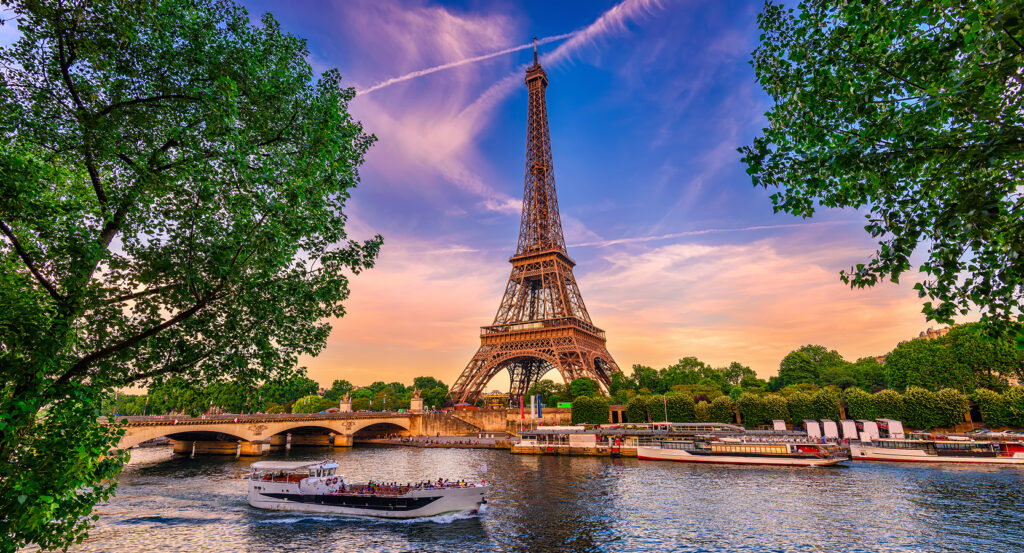
Jardins du Trocadéro is a theatrical hillside garden where Chaillot's architectural grandeur meets cascading water, mature nineteenth-century planting and the axial panorama descending across the Seine toward the Eiffel Tower.
Set along Avenue Albert de Mun near Avenue Hussein 1er de Jordanie and just steps from Place du Trocadéro, the garden occupies the broad slope between Palais de Chaillot and Quai Jacques Chirac, where wooded paths, rockwork, lawns and descending terraces frame a central corridor of pools and fountains. The curving side gardens retain mature trees and winding paths inherited from the nineteenth-century landscape as the Central Fountain of Warsaw imposes a strict geometric axis toward Pont d'Iéna. Paulownias mark the transition into the lower waterworks, contrasting with beeches, horse chestnuts, Atlas cedars and one of Paris's largest plane trees across the wooded slopes. Gilded horses, bull-headed sculptures, clipped yews and long basins intensify the formal center before the Eiffel Tower rises across the river. The result is a garden where two generations of exhibition planning remain physically distinct yet visually unified across one of Paris's most expansive urban perspectives.
What defines Jardins du Trocadéro.
Jardins du Trocadéro is best known for combining Adolphe Alphand's landscape for the 1878 Exposition Universelle with the grand water axis created for the 1937 Exposition Internationale des Arts et Techniques dans la Vie Moderne. Alphand had directed Paris's Service des Promenades et Plantations under the Second Empire, working with figures including engineer Eugène Belgrand and horticulturist Jean-Pierre Barillet-Deschamps on the extensive program of parks and promenades that reshaped nineteenth-century Paris. Trocadéro became the culminating exhibition-scale application of that work when the 1878 exposition transformed Chaillot hill around Gabriel Davioud and Jules Bourdais's new Palais du Trocadéro. Alphand organized the sloping ground through winding walks, mature planting, artificial rocks and cascades, preserving the scenic landscape techniques developed at sites including Buttes-Chaumont. A freshwater aquarium was simultaneously excavated beneath part of the garden in former stone quarries, with work beginning in July 1877 and tanks arranged along vaulted subterranean passages. Open-air pools above the galleries descended from one level to another, connecting the aquarium hydraulically with the rocky landscape surrounding it. Four large animal bronzes strengthened the exhibition composition: Pierre Louis Rouillard's horse, Emmanuel Frémiet's young elephant, Henri-Alfred Jacquemart's rhinoceros and Auguste Cain's ox. Three later moved to the Musée d'Orsay precinct after the twentieth-century reorganization of the site. The surviving trees, winding paths and rockwork still preserve Alphand's nineteenth-century landscape around a central zone radically reconstructed six decades later.
The 1937 exhibition replaced the older central cascade with a hydraulic composition conceived by architects Roger-Henri Expert, Paul Maître and Adolphe Thiers. Their Fountain of Warsaw organized the descent toward the Seine around an elongated basin whose twenty inclined water cannons project streams as far as 50 meters. Fifty-six smaller jets and twelve taller water columns expanded the hydraulic display across the central axis, turning moving water into an architectural component of the exhibition ground. Daniel-Joseph Bacqué and Léon-Ernest Drivier contributed sculpture to the new composition, extending the coordinated work of architects and sculptors across the terraces. The reconstruction accompanied an equally consequential change above the gardens, where Léon Azéma, Jacques Carlu and Louis-Hippolyte Boileau transformed the old Palais du Trocadéro into Palais de Chaillot. They removed its central rotunda and opened a vast esplanade between two curving wings, releasing an uninterrupted sightline across the gardens, Pont d'Iéna and Champ-de-Mars. Twenty-two sculptors, 58 painters and two artistic ironworkers participated in the palace decoration, placing the garden axis within one of the exhibition's largest coordinated artistic programs. The 1937 intervention recast the center of Alphand's landscape as a formal water corridor whose geometry depended on the newly opened Palais de Chaillot above it.
How Jardins du Trocadéro fits.
Jardins du Trocadéro works as the anchor for a daytime exploration across Chaillot using three nearby sites that move from an exhibition-era subterranean aquarium through a compact nineteenth-century cemetery into the preserved home of one of the central political figures of the French Third Republic.
Begin at Aquarium de Paris, whose first incarnation was constructed beneath the Trocadéro gardens for the 1878 Exposition Universelle from a concept associated with Eugène Combaz. Former quarry ground allowed the project to combine subterranean viewing galleries with pools and rocky cascades above, creating a freshwater installation integrated directly into the exhibition landscape. Contemporary technical descriptions placed the aquarium across 2,800 square meters, with water supplied from the Vanne and circulated through descending pools before reaching the enclosed tanks. A major reconstruction preceded the 1937 exhibition, when the aquarium became the largest in Europe; closure followed in 1986 before a complete redevelopment enabled reopening in 2006. Continue to Cimetière de Passy, successor to the earlier communal cemetery along Rue Lekain that closed in 1802. Successive enlargements established the present burial ground before Passy entered Paris in 1860, and its position near Chaillot attracted prominent families from politics, industry, finance and the arts. Architect René Berger created the grand entrance and reception pavilion in 1934, with three bas-reliefs by sculptor Janthial added in 1935. The compact 1.7-hectare enclosure contains thousands of tombs beneath a dense canopy of trees, including graves associated with figures such as Édouard Manet, Claude Debussy and Berthe Morisot. Conclude at Musée Clemenceau, preserving the apartment where Georges Clemenceau lived from 1896 until his death in 1929. The garden helped draw him to the modest building on Rue Benjamin Franklin, and the residence remained his home through the Dreyfus affair, his premiership during the final phase of the First World War and his later political life. When the property faced sale in 1926, American admirer James Stuart Douglas secretly secured the entire building; after Clemenceau's death, Douglas contributed the property as his children supplied their father's possessions. A foundation established in 1930 enabled the museum to open in 1931 with Clemenceau's apartment preserved around his working environment. The progression moves from a subterranean exhibition experiment integrated with Alphand's garden through Berger's interwar entrance to Passy's historic burial ground into Clemenceau's preserved domestic world, extending Chaillot through three institutions shaped by science, commemoration and French political history.
Where your story begins.
Foresyte Travel reveals places that feel extraordinary long before you arrive.
Enjoy editorial crafted for luxury travelers.
Foresyte may earn a commission when you book.














































































































