
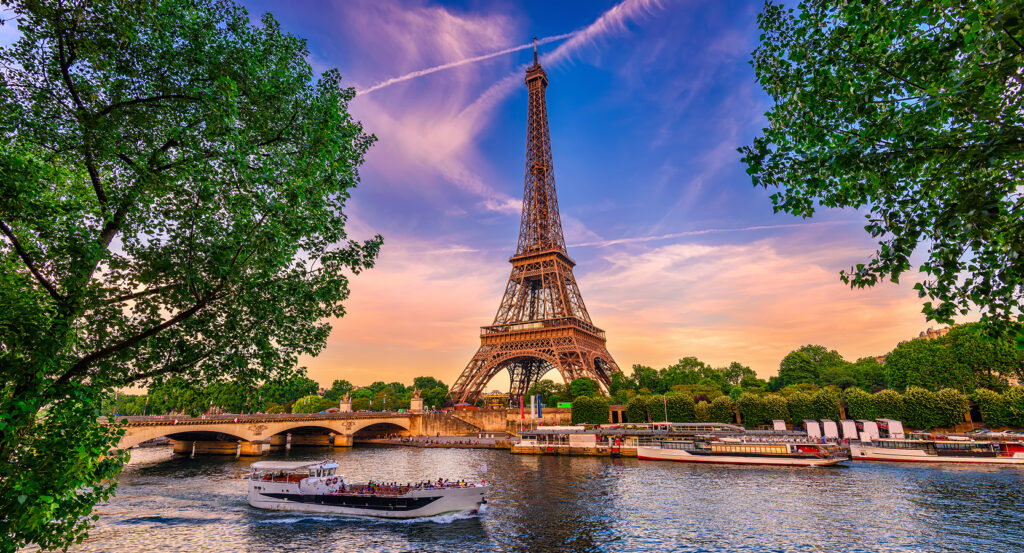
Why you should experience Pont d'Iéna in Paris, France.
Pont d'Iéna is a commanding imperial bridge where Chaillot's ceremonial character meets Napoleon's military commemoration, five stone arches and the great cross-river axis joining the Trocadéro with the Champ-de-Mars.
Set along the Seine between Avenue de New York and Quai Jacques Chirac and just steps from the Trocadéro gardens, the bridge occupies the central river crossing where the elevated Chaillot terraces, wooded embankments, broad quays and open lawns of the Champ-de-Mars create one of western Paris's largest architectural compositions. Five shallow arches carry the crossing across the Seine, their stone faces punctuated by imperial eagles as four immense mounted warriors guard the approaches from high pedestals. The northward ascent frames the terraces and fountains of Chaillot as the southern approach opens directly beneath the iron structure rising from the Champ-de-Mars. Wide pavements and the bridge's 1930s extensions give the crossing an unusual breadth, strengthening the uninterrupted spatial connection between both banks. The result is a ceremonial river threshold where Napoleonic engineering, nineteenth-century sculpture and the vast Trocadéro-Champ-de-Mars axis compress more than a century of Parisian state building into a single crossing.
What you should know about Pont d'Iéna.
Pont d'Iéna is best known for transforming Napoleon I's victory over Prussia into permanent infrastructure across the Seine. The emperor ordered a bridge opposite the École Militaire in 1807 and gave it the name of the Battle of Jena, fought on October 14, 1806 during the Prussian campaign. Jacques Dillon initially received responsibility for the project before his death transferred direction to engineer Corneille Lamandé, whose surviving model from 1806 to 1808 entered the collections of the Musée Carnavalet. Construction proceeded from 1808 to 1814 under contractor Zacharie Guillé dit Galland, producing a 155-meter masonry crossing composed of five shallow arches. François-Frédéric Lemot designed the imperial eagles placed across the tympana, with Jean-François Mouret executing the sculptural work. The bridge's political symbolism became dangerous immediately after Napoleon's fall: Prussian field marshal Gebhard Leberecht von Blücher sought its destruction during the Allied occupation of Paris in 1815, when the name commemorated one of Prussia's most humiliating defeats. Diplomatic intervention preserved the structure, and Tsar Alexander I became central to preventing its demolition. Restoration authorities neutralized its Napoleonic associations by renaming it Pont de l'École-Militaire and removing the imperial eagles. The July Monarchy restored the Pont d'Iéna name after 1830, allowing the crossing conceived as a victory memorial to recover the designation that had nearly brought about its destruction. The Ministry of Culture now protects the bridge as a Monument historique, with inscription dating to June 12, 1975.
The four mounted warriors at the approaches established a separate sculptural program decades after completion of Lamandé's bridge. A decision in 1848 introduced figures representing successive traditions of horsemanship, assigning an individual sculptor to every colossal stone group. Auguste Préault created the long-haired Gaulish rider, Louis-Joseph Daumas supplied the Roman carrying an SPQR shield, Jean-Jacques Feuchère produced the lance-bearing Arab and François-Théodore Devaulx created the helmeted Greek. Their pedestals lift horses and riders more than three meters above the approaches, turning both ends into sculptural gateways. The four works were inaugurated on August 15, 1853, adding a Second Empire-era historical sequence to a crossing conceived under the First Empire. Major enlargement for the 1937 International Exposition later increased the bridge from 14 to 35 meters, requiring the riders to be repositioned diagonally toward one another. Reinforced-concrete lateral structures expanded both sides of the original masonry bridge and received stone facing that preserved the appearance of the five-arch composition. Restoration beginning in October 2023 cleaned the riders, repaired damaged stone and reinstated missing sculptural components before the Paris 2024 Games. Pont d'Iéna consequently carries two distinct imperial-era artistic campaigns within one structure: Napoleonic eagles embedded in the bridge and four mid-nineteenth-century equestrian civilizations guarding its ends.
How to fold Pont d'Iéna into your trip.
Pont d'Iéna works as the anchor for a daytime exploration along Paris's great western ceremonial axis using three nearby sites that move from an engineering experiment built for the 1889 Exposition through a former military parade ground recast as civic landscape into Louis XV's purpose-built academy for officer training.
Begin at Eiffel Tower, conceived for the Exposition Universelle of 1889 marking the centenary of the French Revolution. A competition attracted 107 proposals before the project developed by entrepreneur Gustave Eiffel, engineers Maurice Koechlin and Émile Nouguier and architect Stephen Sauvestre secured selection. Koechlin and Nouguier conceived four lattice piers spreading across a square base 125 meters wide before converging toward the summit, producing a 300-meter structure whose unprecedented height depended upon calculations of wind forces and iron construction. Eiffel inaugurated the tower on March 31, 1889, and its placement beside the Seine established it directly on the cross-river line later strengthened by the Trocadéro reconstruction. Continue through Champ-de-Mars, whose origins predate the tower by more than a century. The former Grenelle agricultural plain became a military exercise ground after establishment of the École Militaire, then hosted the Fête de la Fédération on July 14, 1790 and successive international exhibitions in 1867, 1878, 1889, 1900 and 1937. Municipal control followed in 1889, and Jean-Camille Formigé developed the present park in the opening years of the twentieth century through central lawns, perpendicular walks and contrasting tree-filled lateral gardens. That landscape retained the long vista from the Seine toward the military academy after temporary exhibition architecture disappeared. Conclude at École Militaire, founded by Louis XV through the royal edict of January 1751 after the War of the Austrian Succession exposed the need for stronger officer education. Marshal Maurice de Saxe advanced the concept with support from Madame de Pompadour and financier Joseph Pâris Duverney, and Ange-Jacques Gabriel received the architectural commission for a complex intended to surpass the institutional scale of Hôtel des Invalides. Financial pressure interrupted the first building campaign and sent the earliest pupils temporarily to Château de Vincennes, but the Paris complex developed into the architectural terminus that still closes the Champ-de-Mars axis. A young Napoleon Bonaparte studied there in 1784 and 1785, creating an exceptional biographical connection with the emperor who later ordered the bridge at the opposite end of the same vista. The progression moves from Eiffel, Koechlin, Nouguier and Sauvestre's iron experiment through a military field repeatedly remade for national ceremonies and international exhibitions into Gabriel's royal academy, revealing how engineering, landscape and state institutions accumulated along the axis now crossed by Pont d'Iéna.
Where your story begins.
Foresyte Travel reveals places that feel extraordinary long before you arrive.
Experience premium editorial crafted for luxury travelers.














































































































