
Why Parc Monceau matters.
Parc Monceau is a fanciful historic garden where Plaine-de-Monceau's refined residential character meets an eighteenth-century landscape of architectural illusions, Second Empire park design and mansion-lined avenues created during western Paris's expansion.
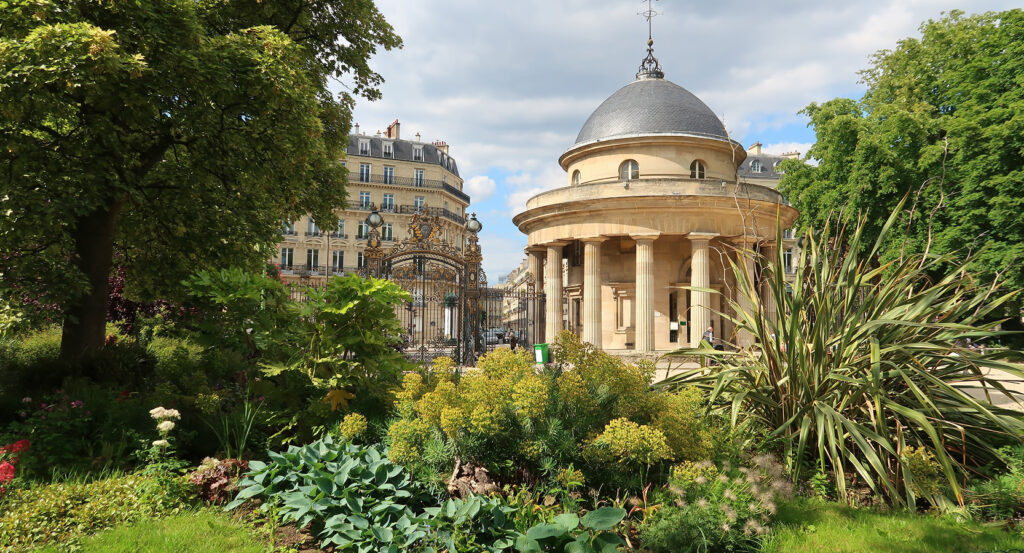
Set along Boulevard de Courcelles near Avenue de Villiers and just steps from Avenue Vélasquez, the park occupies a leafy enclosure where curving paths, broad lawns, mature specimen trees and fragments of imagined antiquity interrupt the dense Haussmann-era streets of the 8th Arrondissement. The Corinthian colonnade curving beside the Naumachie forms its strongest architectural episode, with a pyramid, grotto, bridge and surviving follies appearing among vegetation developed to produce successive changes in scale and view. Mansion-lined streets border the garden closely, particularly Avenue Vélasquez and Avenue Van Dyck, where ornate private residences create unusually formal approaches between the park and the surrounding residential quarter. Claude-Nicolas Ledoux's rotunda stands at the northern edge beside Boulevard de Courcelles, preserving a physical trace of the eighteenth-century fiscal boundary that once cut through the estate. The result is a richly composed urban garden where aristocratic invention, surviving architectural fragments and Second Empire landscaping remain embedded within the residential district that later grew around them.
What defines Parc Monceau.
Parc Monceau is best known for originating as the Folie de Chartres, the estate where Louis-Philippe d'Orléans, duc de Chartres, commissioned Louis Carrogis de Carmontelle to turn a conventional garden into an experimental landscape assembled from architecture associated with different civilizations and historical periods. The duke acquired the Mousseau property in 1769 and initially established a formal garden before entrusting its transformation to Carmontelle in 1773. Carmontelle rejected strict geometric organization for what he conceived as a succession of scenes, inserting a pyramid, classical temple, Chinese pagoda, Tartar tent, Dutch windmill, artificial ruins and other structures among irregular paths and vegetation. The Naumachie placed a basin before a semicircular Corinthian colonnade assembled from architectural fragments associated with an earlier monument, creating one of the estate's most elaborate invented antiquities. Carmontelle described his undertaking as a “pays d'illusions,” making theatrical surprise central to movement through the garden. Scottish gardener Thomas Blaikie entered the project during the 1780s and reworked portions of the planting and landscape organization as the estate continued to develop. Construction of the Mur des Fermiers Généraux cut through the property in 1787, and Claude-Nicolas Ledoux designed the Barrière de Chartres as an elegant rotunda on that new fiscal boundary. Revolutionary confiscation subsequently made the estate national property before its return to the Orléans family. Parc Monceau emerged from this sequence as one of the clearest surviving Parisian examples of the eighteenth-century fascination with scenic landscapes whose architecture deliberately collapsed geography and historical time into a single garden.
The surviving garden owes its present dimensions and much of its landscape structure to the Second Empire reconstruction directed by Jean-Charles Adolphe Alphand. The French state acquired the property in 1852, and redevelopment divided much of the former estate into building parcels as Paris expanded into the surrounding territory. Alphand redesigned the reduced garden in 1861 within the extensive park program undertaken during the prefecture of Georges-Eugène Haussmann. Gabriel Davioud participated in the architectural work associated with the renewed park, joining the group of engineers, architects and horticultural specialists responsible for Parisian public landscapes during the period. Winding paths, rolling lawns, bridges and carefully staged plantings retained fragments of Carmontelle's older garden. New streets around the perimeter generated prestigious residential parcels, allowing hôtels particuliers to form an architectural frame around the greenery during the subsequent development of Plaine-de-Monceau. Nineteenth-century statues devoted to writers and musicians later entered the grounds, extending the garden's architectural program into public commemoration. Claude Monet painted Parc Monceau repeatedly during the 1870s, using its vegetation, promenades and bourgeois recreation as subjects during a period when the former aristocratic estate had become part of modern Paris. The park consequently joins Carmontelle's eighteenth-century experiment with Alphand's public landscape, preserving both phases inside the residential quarter generated by the transformation of the larger estate.
How Parc Monceau fits.
Parc Monceau works as the anchor for a daytime exploration through the adjoining 8th Arrondissement using three nearby museums that move from an Asian collection created through nineteenth-century travel through an eighteenth-century decorative-arts collection preserved inside a family residence into a Haussmann-era mansion assembled around Italian Renaissance painting.
Begin at Musée Cernuschi, created from the collection Henri Cernuschi brought back after traveling through Asia and installed in his Avenue Vélasquez mansion. The house became a center of Parisian Japonisme between 1876 and 1896, connecting Cernuschi's collection with the period when Japanese prints were exerting substantial influence on French artists. The museum opened in 1898 under the direction of Eugène-Benoît Causse, and Henri d'Ardenne de Tizac subsequently concentrated its scholarship on early Chinese art in collaboration with sinologists Édouard Chavannes and Paul Pelliot. René Grousset expanded its archaeological holdings through Bronze Age works from Vietnam connected with Olov Janse's excavations during the 1930s, adding another major field to an institution whose development followed changing European engagement with Asian art. Continue to Musée Nissim de Camondo, built between 1911 and 1914 by René Sergent for Moïse de Camondo on property his father Nissim had occupied beside Parc Monceau. Sergent modeled the house on the Petit Trianon at Versailles but incorporated central heating, lifts and modern bathrooms behind its eighteenth-century architectural references. Moïse assembled French furniture and decorative arts within domestic rooms whose arrangement became part of the collection itself, then bequeathed the house and its contents to Les Arts Décoratifs after his death in 1935. He named the museum for his son Nissim, an aviator killed in 1917, and required the collection to remain in place; the museum opened in December 1936. Conclude at Musée Jacquemart-André, where banker Édouard André commissioned Henri Parent in 1869 to create a private mansion on the newly developed Boulevard Haussmann. André and portraitist Nélie Jacquemart married in 1881 and built their collection through sustained travel and acquisition, with Italian journeys bringing Renaissance works into rooms designed for their display. Jacquemart bequeathed the mansion and collection to the Institut de France before her death in 1912 and specified how the works should remain installed. President Raymond Poincaré inaugurated the museum on December 8, 1913, completing the conversion of a Second Empire private residence into a public collection. The progression moves from Cernuschi's transformation of Asian travel into a Parisian collection through Camondo and Sergent's recreation of eighteenth-century domestic culture into André and Jacquemart's union of Haussmann-era architecture with Renaissance collecting, extending the park through three institutions born from the private patronage surrounding it.
Where your story begins.
Foresyte Travel reveals places that feel extraordinary long before you arrive.
Experience premium editorial crafted for luxury travelers.
Foresyte Travel may earn a commission when you book through the link on this page.














































































































