
Why Saint-Georges matters.
Saint-Georges is an elegant enclave where the lower slopes of Montmartre meet nineteenth-century Paris through neoclassical streets, intimate squares, artists' houses and a residential quarter created during one of the Right Bank's decisive periods of northern expansion.
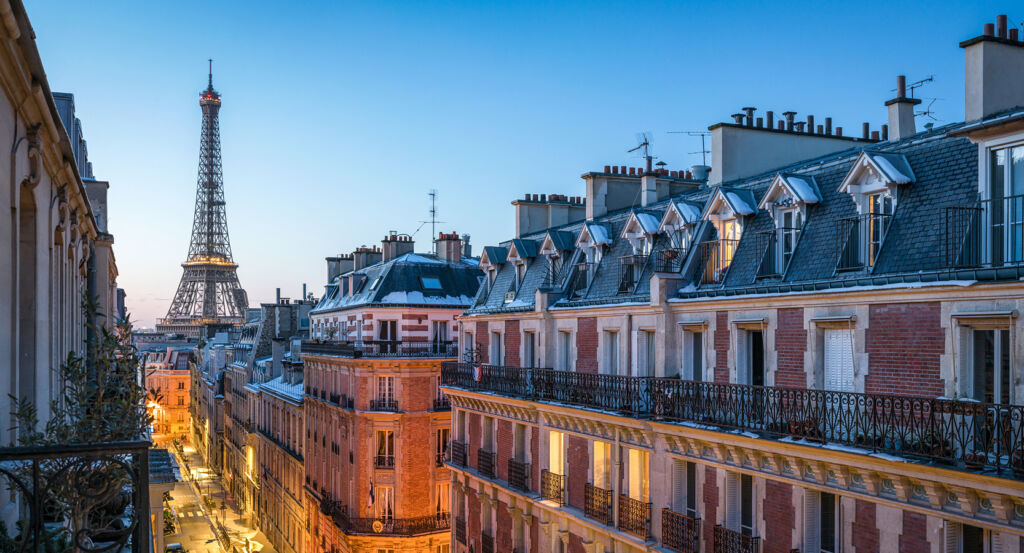
Positioned between South Pigalle, Chaussée-d'Antin, and Faubourg-Montmartre, the neighborhood occupies a gently rising pocket where Rue Saint-Georges, Rue Notre-Dame-de-Lorette and Rue La Bruyère climb from the commercial city toward the first slopes of Montmartre. Curving streets, gated courts, private gardens and restrained neoclassical facades preserve the residential scale established when orchards and cultivated ground gave way to coordinated subdivisions during the Restoration. Place Saint-Georges establishes the primary encounter through an almost circular composition whose converging streets and curved building fronts turn a compact junction into one of the quarter's clearest pieces of planned urban design. Routes toward Rue de La Rochefoucauld and Rue Blanche deepen that physical character as larger houses, former studios and apartment buildings rise with the terrain, opening occasional views across rooftops toward Central Paris and revealing how private architectural ambition followed the neighborhood uphill. The result is a district where topography and planned construction remain unusually legible together, preparing a history in which speculative development drew an extraordinary concentration of Romantic painters, writers, composers and performers into a newly built quarter.
What defines Saint-Georges.
Saint-Georges is best known for forming the core of the Nouvelle Athènes, the planned quarter whose rapid development during the 1820s created one of nineteenth-century Paris's principal concentrations of artistic life. Jean de la Peyrière and architect Léopold-Auguste Constantin initiated subdivision of the Lower Montmartre slopes in 1819 and 1820, replacing orchards and market gardens with new streets, private houses, income properties and studios. Saint-Georges itself entered intensive subdivision in 1823 and 1824, and Alexandre Delessert and Louis Nicolas Hubert Lavocat secured royal authorization to open Rue Chaptal between Rue Blanche and Rue Pigalle in 1825. Journalist Adolphe Dureau de la Malle had already supplied the emerging district with its enduring cultural name on October 18, 1823, when he used Nouvelle Athènes for the development rising across the Saint-Georges slopes. The designation connected the quarter with contemporary French enthusiasm for ancient Greece and suited architecture shaped by practitioners working within the neoclassical tradition. Performers François-Joseph Talma, Mademoiselle Mars and Mademoiselle Duchesnois joined painters Théodore Géricault, Horace Vernet, Eugène Delacroix and Théodore Chassériau across the expanding streets. Frédéric Chopin, Hector Berlioz, Charles Gounod and Georges Bizet added a formidable musical concentration, and George Sand, Théophile Gautier, Alexandre Dumas, Victor Hugo and Charles Baudelaire extended the community into literature. Physical proximity between houses, studios and salons allowed these artistic circles to overlap across a district created within little more than a generation, turning speculative urban expansion into a defining geography of Parisian Romanticism.
A later entertainment culture changed Saint-Georges through another mechanism as the streets approaching Pigalle became increasingly associated with cabarets, theaters and nocturnal performance. Rue Pigalle occupied a strategic route between the residential slopes and the entertainment district developing farther north, allowing venues to emerge close to the houses and studios inherited from the nineteenth century. Pigall's became one of the best-known interwar cabarets at 77 Rue Pigalle, and Pierre Sicard captured the establishment in a painting dating to 1925 that later entered the Musée Carnavalet. The district's performance culture also drew strength from its proximity to the Grands Boulevards and the expanding theatrical geography around Clichy and Montmartre, extending entertainment southward through streets first developed for residential life. Cabarets and late-night establishments consequently occupied a built environment whose earlier architectural scale remained largely intact, creating an unusual continuity between private nineteenth-century Paris and twentieth-century nightlife. That second cultural phase broadened Saint-Georges beyond its Romantic associations and established performance as another durable component of the quarter's history.
How Saint-Georges fits.
Saint-Georges works as the anchor for an afternoon connecting a Restoration church conceived for an expanding northern parish, a reconstructed political residence bound to the upheavals of 1871 and an interwar theater created from premises with a long association with the Parisian press.
Begin at Église Notre-Dame-de-Lorette, where Louis-Hippolyte Le Bas developed the architecture for a new parish church as population growth transformed the northern edge of Paris during the Restoration. Le Bas's surviving architectural drawings from 1823 show the detailed conception of the side aisles and chapels, placing classical order at the center of a richly decorated interior whose artistic campaign brought painting, sculpture and architecture together on a scale suited to the expanding district. The church gave the surrounding streets a major institutional focus during the same decade that construction was accelerating across the Lower Montmartre slopes. Continue to Hôtel Dosne-Thiers, where the residence inherited by Adolphe Thiers from his wife's family became a target during the Paris Commune and was destroyed in May 1871 amid hostility toward the head of the Republic's government. Reconstruction followed between 1873 and 1875 with state financing and architect Alfred Aldrophe, recommended by the Rothschild family, who produced Régence-style facades and arranged the new residence around reception rooms, private apartments and Thiers's second-floor study. The completed house returned Thiers, his wife and Félicie Dosne to Place Saint-Georges, embedding the political rupture of the Commune within the architecture of the square. Conclude at Théâtre Saint-Georges, where a site successively associated with financier Millaud, Les Annales and Comoedia entered a theatrical chapter under Camille Choisy in 1929. Choisy introduced the theater after the press had occupied and rebuilt the property, and Benoît-Léon Deutsch subsequently developed a program that included Luigi Pirandello, Jacques Deval and Denys Amiel; wartime closure interrupted the house before temporary directors restored performances under the Occupation, carrying the address from nineteenth-century finance through publishing into the stage culture of twentieth-century Paris. The progression moves from Le Bas giving an expanding Restoration parish architectural form through Aldrophe rebuilding a residence marked by the Commune into Choisy converting a press address into a theater, tracing how religion, political upheaval and performance successively shaped Saint-Georges.
Where your story begins.
Foresyte Travel reveals places that feel extraordinary long before you arrive.
Experience premium editorial crafted for luxury travelers.
Foresyte Travel may earn a commission when you book through the link on this page.














































































































