
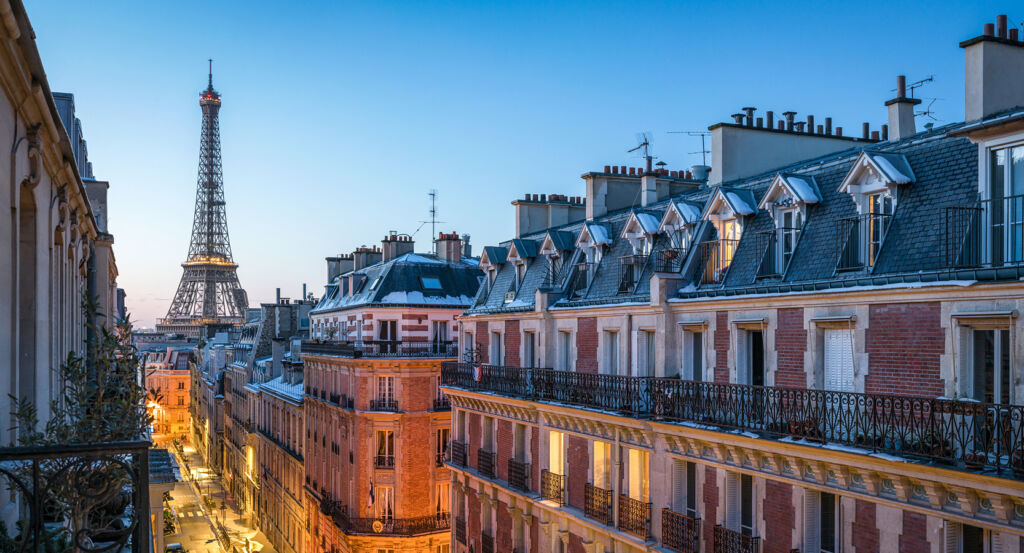
Why South Pigalle matters.
South Pigalle is a magnetic enclave where the lower slopes of Montmartre meet nineteenth-century Paris through neoclassical streets, former artists' houses and a compact quarter shaped by successive eras of Romantic culture and nocturnal entertainment.
Positioned between Montmartre, Chaussée-d'Antin, and Faubourg-Montmartre, the neighborhood occupies a northern Right Bank pocket where Rue des Martyrs, Rue Jean-Baptiste Pigalle and Rue Notre-Dame-de-Lorette climb from Saint-Georges toward Boulevard de Clichy. Sloping streets, private courtyards and five-story apartment buildings preserve the intimate scale created as orchards and market gardens disappeared beneath nineteenth-century construction. Rue des Martyrs establishes the primary encounter through an old north-south route whose continuous ascent connects the commercial streets below with Montmartre above. Place Saint-Georges deepens the atmosphere through curved facades and branching streets that reveal the coordinated residential development surrounding the square during the Restoration. The result is a neighborhood where topography, architecture and cultural history remain tightly compressed, preparing an account rooted in the planned quarter that became one of Romantic Paris's principal artistic centers.
What defines South Pigalle.
South Pigalle is best known for overlapping the Nouvelle Athènes, the planned nineteenth-century quarter that drew painters, writers, musicians and performers to the lower slopes of Montmartre. Orchards and market gardens still occupied much of the territory when Jean de la Peyrière and architect Léopold-Auguste Constantin initiated subdivision in 1819 and 1820. Development accelerated around Saint-Georges in 1823 and 1824, followed in 1825 by Alexandre Delessert and Louis Nicolas Hubert Lavocat's opening of Rue Chaptal between Rue Blanche and Rue Pigalle. Journalist Adolphe Dureau de la Malle gave the expanding quarter its Nouvelle Athènes name in the Journal des Débats on October 18, 1823, connecting its neoclassical architecture with French philhellenism during the Greek War of Independence. The new streets offered open southern views and newer residences beyond the congested central city, attracting performers François-Joseph Talma, Mademoiselle Mars and Mademoiselle Duchesnois before an extensive artistic community followed. Théodore Géricault, Horace Vernet, Théodore Chassériau and Eugène Delacroix joined musicians Frédéric Chopin, Hector Berlioz, Charles Gounod and Georges Bizet across the surrounding streets. George Sand, Théophile Gautier, Victor Hugo, Charles Baudelaire and Alexandre Dumas strengthened the literary concentration. Salons and studios turned a speculative subdivision into one of the principal concentrations of artistic life in nineteenth-century Paris.
Nightlife supplied a separate mechanism for changing South Pigalle after the artistic quarter had matured. Cabarets, cafés-concerts and dance halls accumulated toward Place Pigalle as entertainment pushed the district into a new cultural phase extending deep into the twentieth century. Bal Tabarin became one of its major institutions after composer and conductor Auguste Bosc transformed a former stable into an Art Nouveau dance hall in 1904, combining dancing with elaborate stage performance. Fire closed the Moulin Rouge in 1915, sending its French cancan troupe to Tabarin and strengthening the venue's position within the northern Paris entertainment circuit. Pierre Sandrini and Pierre Dubout acquired Tabarin in 1928, removed its earlier decoration and installed machinery that lifted scenery from below the stage for increasingly elaborate revues. The surrounding streets developed their own dense concentration of cabarets and clubs, shifting Pigalle toward an entertainment economy whose visual culture depended on illuminated facades and theatrical advertising. By the mid-twentieth century, that nocturnal concentration had established a second cultural chapter over the nineteenth-century residential quarter, giving South Pigalle its enduring collision between artistic history and Paris after dark.
How South Pigalle fits.
South Pigalle works as the anchor for an afternoon connecting a Restoration church conceived for an expanding parish, a painter's house deliberately rebuilt to preserve his life's work and an interwar theater created from premises associated with Parisian publishing.
Begin at Église Notre-Dame-de-Lorette, where Louis-Hippolyte Le Bas won the architectural competition for a new church serving the expanding northern quarter and developed a neoclassical building around the form of an early Christian basilica. Construction began in 1823, and an extensive decorative campaign brought painters and sculptors into the chapels and interior, including Eugène Devéria, whose work for the church survives in preparatory studies held by Musée Carnavalet; the completed building gave the rapidly developing district a major religious institution whose architectural language belonged directly to Restoration Paris. Continue to Musée Gustave Moreau, where the Symbolist painter converted his family residence into a purpose-built repository for his work during the final years of his life. Moreau commissioned Albert Lafon in April 1895, and construction from May 1895 through September 1896 replaced the upper domestic floors with two immense north-lit studios connected by a spiral staircase, preserved the first-floor rooms as a personal memorial and introduced a brick-and-stone facade supported by metal structure; Moreau began arranging his paintings and drawings for the future museum in 1896, and his 1897 will entrusted Henri Rupp with completing the project after his death. Conclude at Théâtre Saint-Georges, where Camille Choisy commissioned Charles Siclis to convert former press premises into a modern theater inaugurated with Jacques Albert on February 8, 1929. The property had passed through financier Millaud, Les Annales and Comoedia before Choisy introduced theatrical use; Mary Morgan assumed direction in 1943 and remained associated with the house for more than three decades, a period encompassing 2,225 performances of Marcel Achard's Patate, before François Truffaut later used the theater during production of Le Dernier Métro. The progression moves from Le Bas supplying an expanding Restoration district with neoclassical religious architecture through Moreau and Lafon converting private artistic space into a permanent museum into Siclis, Morgan and Truffaut carrying a former publishing address through theater and cinema, revealing three successive cultural institutions embedded within South Pigalle.
Where your story begins.
Foresyte Travel reveals places that feel extraordinary long before you arrive.
Experience premium editorial crafted for luxury travelers.
Foresyte Travel may earn a commission when you book through the link on this page.














































































































