
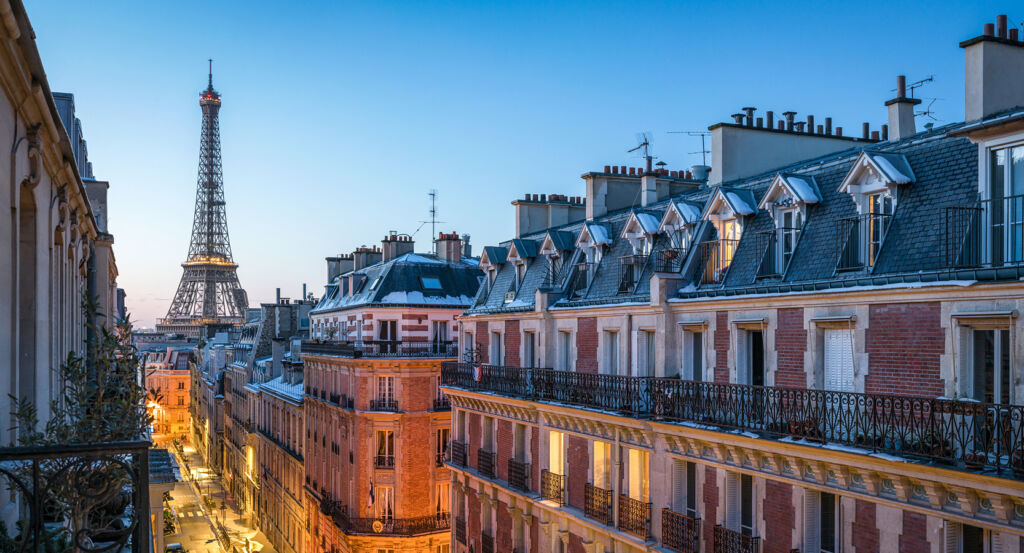
Why you should experience Off Paris Seine in Paris, France.
Off Paris Seine is an aquatic boutique hotel where Austerlitz's riverfront reinvention, maritime engineering, contemporary design culture and enduring relationship with the Seine transform the river itself into one of Paris's most unconventional places to stay.
Set along Port d'Austerlitz near Quai d'Austerlitz and just steps from Gare d'Austerlitz, the hotel floats between Pont Charles-de-Gaulle and Viaduc d'Austerlitz on twin steel hulls conceived by architect Gérard Ronzatti of Seine Design as a purpose-built piece of hospitality architecture. Its 54 rooms and four suites divide between quay and Seine exposures, while two Horizon Suites occupy the bow and the Sunset and Silver Designer Suites translate the river's changing light into monochromatic interiors by Maurizio Galante and Tal Lancman. A central passage separates the parallel wings around a plunge pool and marina, creating the illusion that the Seine continues directly through the hotel while zinc, silver-toned timber and glass reinterpret familiar materials from the Parisian cityscape. The result is a hotel where floating architecture, fashion-led interiors and constant river movement make the Seine an active component of the experience.
What you should know about Off Paris Seine.
Off Paris Seine is best known for opening on June 23, 2016 as the first floating hotel in Paris, completing 17 months of construction through a collaboration led by Citysurfing founder Christophe Gallineau, Seine Design architect Gérard Ronzatti, Novaxia, Bpifrance and operator Elegancia Hotels. Ronzatti engineered the 80-meter-long and 18-meter-wide structure around two articulated steel hulls measuring 75 meters each, creating parallel accommodation wings around an internal passage, 10-by-2-meter plunge pool, marina and central gathering spaces while allowing the entire hotel to remain permanently afloat. Construction unfolded across the Seine corridor, with the steel hulls fabricated at a shipyard in Dieppe, modular guestrooms manufactured in Faulquemont and transported to Rouen for installation before the completed structure traveled by water to its permanent berth in Paris, a modular strategy that reduced on-site construction and involved more than 200 jobs. The finished hotel contains 54 14-to-15-square-meter rooms and four 28-to-30-square-meter suites, including two double-exposure Horizon Suites at the bow and two Designer Suites conceived by Maurizio Galante and Tal Lancman, alongside an 80-person restaurant, marina, pool and 400-square-meter seasonal quayside terrace. Approximately €11 million in investment supported a project whose combination of naval engineering, modular construction, French manufacturing and purpose-built hospitality architecture introduced an entirely new hotel typology to the Paris waterfront.
Maurizio Galante and Tal Lancman extended Gérard Ronzatti's relationship between architecture and water through the lounge and Designer Suites, collaborating with Italian furniture company Opinion Ciatti and its creative director Lapo Ciatti on bespoke pieces and adapted furnishings conceived specifically for the floating interior. Opinion Ciatti anchored the lounge beneath an installation of 8,800 suspended metal squares that move subtly with the vessel and reflect changing light from the Seine, while copper-leaf reception furniture surrounds a weathered piece of 250-year-old timber incorporated into the desk as a sculptural centerpiece. Interware carried Galante and Lancman's concept into the Sunset and Silver suites through total monochromatic environments, translating the warm and cool tonal shifts of the river into furniture, surfaces and circular soaking tubs while Horizon Suites use their position at the bow to create dual exposures over the water. Together, Gérard Ronzatti, Maurizio Galante, Tal Lancman, Lapo Ciatti and Opinion Ciatti established an interior language in which naval structure, reflective metal, weathered timber, couture-influenced color and the physical movement of the Seine remain inseparable from Off Paris Seine's architectural identity.
How to fold Off Paris Seine into your trip.
Off Paris Seine works as the anchor for an afternoon tracing the botanical, architectural and industrial transformations that have continually reshaped the Seine around Austerlitz.
Begin at Jardin des Plantes, where the Jardin royal des plantes médicinales established under Louis XIII opened to the public in 1640 and evolved into the principal botanical garden of the Muséum national d'Histoire naturelle, creating a centuries-deep scientific counterpoint to the contemporary river architecture waiting downstream. Continue to Bibliothèque nationale de France - François-Mitterrand, where Dominique Perrault's four glass towers opened in 1996 around a sunken garden and grand wooden esplanade, establishing one of the defining architectural interventions of the Paris Rive Gauche transformation. Conclude at Bercy Village, where nineteenth-century wine warehouses and stone-paved courtyards preserve the material legacy of a district that became one of the world's largest wine-trading centers before its late twentieth-century reinvention. The progression moves from centuries of botanical scholarship through Dominique Perrault's grand contemporary architecture into the surviving fabric of Parisian wine commerce, revealing the layers of science, design and river-dependent industry surrounding Off Paris Seine.
Where your story begins.
Foresyte Travel reveals places that feel extraordinary long before you arrive.
Experience premium editorial crafted for luxury travelers.














































































































