
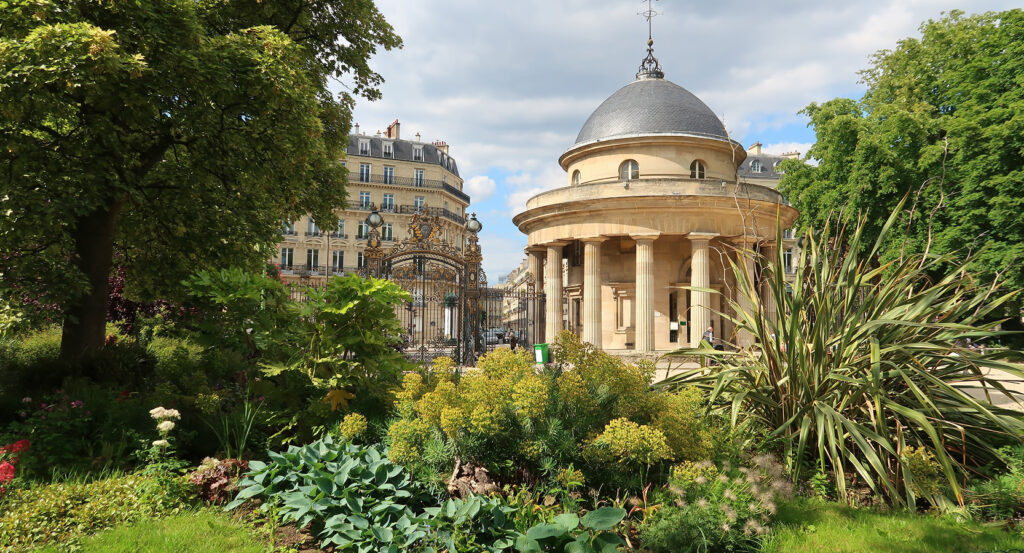
Why you should experience The Naumachia of Parc Monceau in Paris.
The Naumachia of Parc Monceau is a captivating historic folly where Parc Monceau's romantic landscape design, eighteenth-century aristocratic imagination, classical symbolism, and architectural reinvention create one of Paris' most enchanting garden compositions.
Set along Allée de la Comtesse de Ségur near Avenue Ferdousi and just steps from the Pyramid of Parc Monceau, this serene oval basin surrounds visitors with Corinthian columns, reflective water, lush vegetation, and carefully orchestrated ruins that evoke the grandeur of ancient Rome within one of Paris' most celebrated English-style gardens. Designed to surprise, delight, and transport visitors into an imagined classical world, the composition blends archaeology, theatrical illusion, and picturesque landscape design into a scene unlike any other in the capital. The result is a destination defined by artistic fantasy, historic preservation, and timeless elegance.
What you should know about The Naumachia of Parc Monceau.
The Naumachia of Parc Monceau is best known for originating within the extraordinary Jardin de Monceau created between 1773 and 1779 for Philippe d'Orléans, Duke of Chartres, whose designer Louis Carrogis Carmontelle conceived the estate not as a traditional French or English garden but as a “garden of all times and all places” filled with architectural follies representing civilizations from around the world. Inspired by the naumachiae of ancient Rome, where emperors staged elaborate mock naval battles inside grand basins, Carmontelle instead reinterpreted the concept as an ornamental oval lake framed by a dramatic Corinthian colonnade assembled from authentic sixteenth-century columns salvaged from the unfinished Rotonde des Valois commissioned by Catherine de' Medici beside the Basilica of Saint-Denis before its demolition during the eighteenth century. The Naumachia originally formed the visual climax of a fantastical landscape that also featured an Egyptian pyramid, Dutch windmill, minaret, Gothic ruins, Roman temple, Tatar tent, Swiss farm, enchanted grotto, and winding streams, creating one of Europe's most imaginative aristocratic pleasure gardens. When Baron Haussmann's redevelopment transformed the estate into the public Parc Monceau in 1861, landscape architects Jean-Charles Alphand and Gabriel Davioud deliberately preserved the Naumachia in its intentionally ruined appearance after determining that its weathered character reflected Carmontelle's original artistic vision rather than later deterioration, although the central island's obelisk was not reconstructed. The basin continues serving its original hydraulic function as the park's principal water feature while remaining one of the finest surviving examples of eighteenth-century picturesque landscape architecture and one of Paris' most celebrated romantic garden settings.
More than two centuries after its creation, the Naumachia still achieves Carmontelle's ambition of surprising every visitor through carefully composed illusion. Reflections across the oval basin dissolve the boundary between architecture and landscape, while genuine Renaissance columns, artificial ruins, and tranquil water demonstrate how imagination, theatrical design, and historical fragments combined to produce one of the defining masterpieces of European garden art.
How to fold The Naumachia of Parc Monceau into your trip.
The Naumachia of Parc Monceau works as the romantic centerpiece of an exploration through Parc Monceau's extraordinary collection of architectural follies and historic landscapes.
Begin at the Rotonde de Chartres, where Claude Nicolas Ledoux's grand tollhouse introduces the aristocratic origins of the estate before wandering into the park toward The Naumachia of Parc Monceau. Continue to the Pyramid of Parc Monceau, whose Egyptian inspiration reveals another chapter of Carmontelle's remarkable vision of gathering civilizations from across the world into a single fantastical landscape. Finish at Musée Nissim de Camondo, where one of France's finest collections of eighteenth-century decorative arts extends the story of aristocratic taste, architectural patronage, and cultural refinement that shaped the neighborhood surrounding Parc Monceau. The progression moves naturally from Ledoux's grand gateway to Carmontelle's greatest garden composition before culminating in one of Paris' most extraordinary historic house museums, revealing why Parc Monceau remains the city's supreme expression of eighteenth-century landscape imagination.
Where your story begins.
Foresyte Travel reveals places that feel extraordinary long before you arrive.
Experience premium editorial crafted for luxury travelers.














































































































