
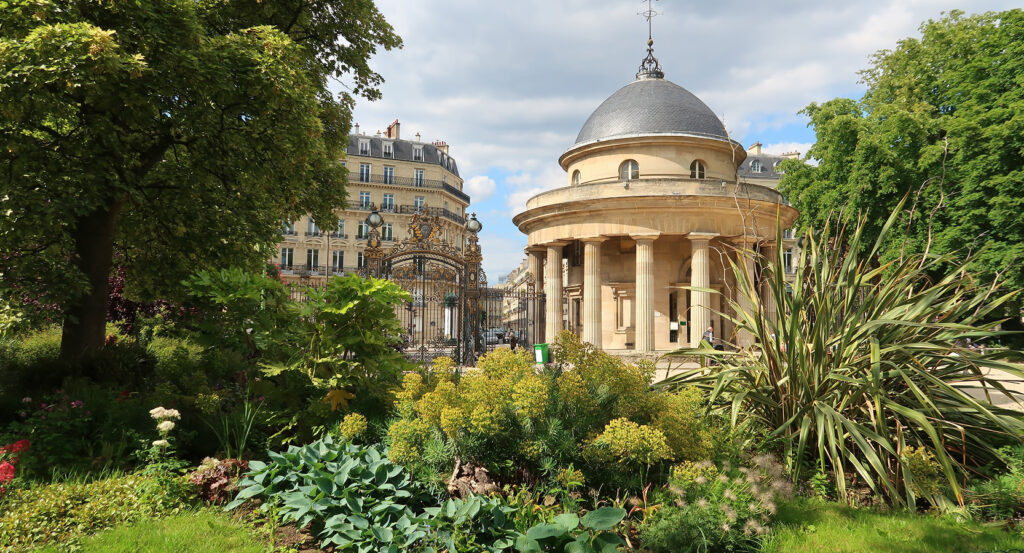
Why you should experience Pavillon de Chartres in Paris, France.
Standing gracefully at the corner of Parc Monceau, the Rotunda de Chartres Pavilion feels like a portal to another era, a neoclassical jewel that has watched Paris evolve for more than two centuries.
Its circular form, crowned with a shallow dome and lined with Corinthian columns, once served as a tollhouse on the edge of the city, marking the border of pre-Haussmannian Paris. Today, it blends seamlessly into the park's leafy calm, its symmetry and pale stone glowing warmly against the greenery. The pavilion's balanced proportions and quiet dignity invite reflection, a reminder that even in a city of artistic daring, restraint has its own kind of grandeur. Standing before it, you can almost feel the rhythm of the 18th century pulsing faintly beneath modern footsteps.
What you should know about Pavillon de Chartres.
The pavilion was designed in 1787 by Claude-Nicolas Ledoux, the visionary architect behind Paris's Barrière d'Enfer and the city's network of toll pavilions.
Originally part of the Fermiers Généraux wall, built to collect taxes on goods entering the capital, the Rotunda de Chartres was transformed after the Revolution into one of Paris's most elegant park entrances. Its survival through centuries of change is nothing short of miraculous. Today, it stands as one of the few remaining vestiges of Ledoux's grand vision for a circular city, a masterpiece of form and proportion that still whispers of Enlightenment ideals. Few buildings so effortlessly bridge utility and art, an enduring tribute to the harmony between architecture and philosophy.
How to fold Pavillon de Chartres into your trip.
Approach the pavilion from the park's main path, letting its classical lines emerge through the trees as if revealed by time itself.
Visit in the golden hour, when the sunlight slants low across its fluted columns and the dome glows like burnished ivory. Take a moment to trace the decorative carvings and the graceful symmetry that make Ledoux's work so distinct. Then step back to admire how the pavilion frames the park beyond, a balance of structure and softness that perfectly captures the Parisian art of blending past and present. Whether you linger for a photo, a sketch, or a simple breath of stillness, the Rotunda de Chartres reminds you that beauty in Paris rarely shouts; it endures, quietly and completely.
Where your story begins.
Foresyte Travel reveals places that feel extraordinary long before you arrive.
Experience premium editorial crafted for luxury travelers.














































































































