
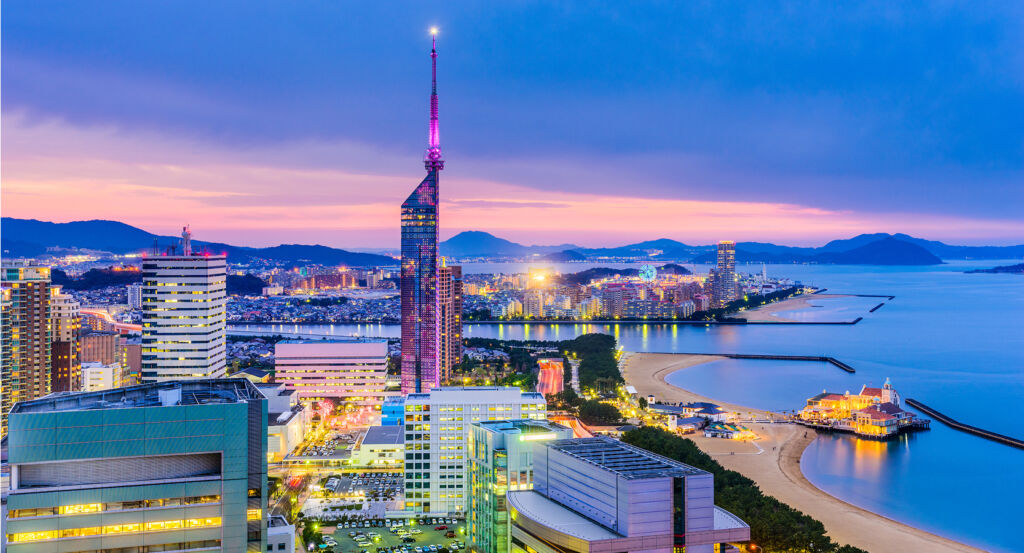
Why APA Hotel Hakata Gion Station matters.
APA Hotel Hakata Gion Station is a compact, strategically placed city stronghold that positions Fukuoka as a place of disciplined movement and historical proximity, where efficiency and cultural depth coexist.
Set directly beside Gion Station and within walking distance of Hakata's older districts, this hotel occupies a quieter, more grounded axis of the city than its Hakata Station, adjacent counterparts. Arrival feels controlled and deliberate. You step off the street into an environment designed to absorb movement quickly and return order just as fast. There is no theatrical buffer between city and interior. The lobby is clean, vertical, and procedural, communicating immediately that this is a hotel built to perform. Circulation is tight and intentional, allowing guests to move through check-in, elevators, and corridors with minimal hesitation. Materials are unmistakably APA: resilient surfaces, neutral palettes, and finishes chosen to withstand constant turnover. Lighting is bright and directive in shared spaces, reinforcing orientation and pace. The atmosphere feels disciplined, contained, and quietly assertive. Guest rooms follow APA's precision-first blueprint with unapologetic clarity. Space is compact but engineered to be complete. Nothing is decorative. Beds are firm and reliable, designed to deliver predictable rest after long days navigating the city or early mornings catching trains. Furnishings are standardized and efficient, reducing decision-making and preserving mental bandwidth. Windows frame dense urban scenes, streets, neighboring buildings, passing light, reinforcing that the hotel exists inside Fukuoka's lived infrastructure. Bathrooms are compact, modern, and frictionless, supporting routine with mechanical precision. Across the property, the experience feels contained, repeatable, and structurally confident. APA Hotel Hakata Gion Station is ideal for travelers who want Fukuoka to feel ordered, accessible, and historically adjacent, a city encountered through systems.
What defines APA Hotel Hakata Gion Station.
APA Hotel Hakata Gion Station is best known for micro-efficiency and cultural adjacency, a design logic that pairs dense operational discipline with proximity to some of Fukuoka's oldest neighborhoods.
Unlike APA properties built purely around transit throughput, this location benefits from sitting at a quieter hinge point between modern infrastructure and traditional urban fabric. Gion Station connects you quickly, but the surrounding streets slow the city's pace just enough to register history. Temples, shrines, and older commercial lanes sit within easy reach, giving the hotel a contextual depth that contrasts with its hyper-efficient interior logic. Inside, the building operates as a closed system optimized for repetition. Circulation paths are short and unmistakable. You learn the building in minutes, then stop thinking about it entirely. This disappearance is intentional. APA's philosophy here is not comfort through expansion, but comfort through predictability. Materials reinforce this restraint. Surfaces are hard-wearing and matte, finishes resist glare, and textures dampen sound. Acoustic control is particularly important in such a compact environment. Despite the hotel's density, interior noise resolves quickly, preserving rooms as dependable spaces for rest. Lighting strategy follows the same operational clarity. Public areas are brightly lit to maintain alertness and orientation, while guest rooms use controlled, consistent lighting that supports sleep. This balance matters for travelers arriving late, leaving early, or managing compressed schedules. Service culture mirrors the building's discipline. Interactions are brief, procedural, and respectful of autonomy. Staff focus on accuracy and speed rather than personalization, reinforcing the hotel's role as infrastructure rather than host. Another understated strength of APA Hotel Hakata Gion Station is how it reframes scale. The hotel does not attempt to soften its compactness; it normalizes it. Over multiple nights, this creates a rhythm. You stop resisting the constraints and start operating within them efficiently. The hotel does not narrate culture or attempt experiential storytelling. It relies instead on position and consistency, allowing the surrounding city to provide meaning while the hotel provides order.
How APA Hotel Hakata Gion Station fits.
APA Hotel Hakata Gion Station works best when you treat it as a precision base near history, a place that supports fast movement while keeping you close to Fukuoka's older layers.
Begin your mornings decisively. Step outside and choose direction. Walk toward temples and quieter streets, or descend into the transit network and pivot toward Tenjin, Nakasu, or Hakata Station within minutes. Use the hotel's predictability to your advantage. There is no learning curve each day. You wake, move, return, and reset. Midday returns feel functional. The room is not a lounge; it is a tool. Use it to rest, recalibrate, and redeploy. Afternoons lend themselves to contrast. Explore historic corridors, markets, and riverside paths, then return to the hotel's disciplined environment as a counterbalance. Evenings remain flexible. Dine nearby, explore nightlife further out, or return early knowing the hotel will receive you efficiently regardless of timing. For longer stays, the effect compounds. Fukuoka begins to feel navigable through repetition. Routes stabilize. Confidence replaces calculation. Business travelers benefit from the hotel's speed, consistency, and proximity to transit. Leisure travelers who value structure over indulgence gain freedom from planning overhead. Anchoring your stay at APA Hotel Hakata Gion Station allows Fukuoka to be encountered as a city of layers held together by systems, not a place that demands resonant interpretation. The hotel does not compete with luxury, intimacy, or narrative-driven stays. It offers something else entirely: discipline. In doing so, it delivers a stay that feels controlled, efficient, and unmistakably urban, where rest is engineered, movement is simplified, and the city reveals itself through repetition, contrast, and proximity.
Where your story begins.
Foresyte Travel reveals places that feel extraordinary long before you arrive.
Enjoy editorial crafted for luxury travelers.
Foresyte may earn a commission when you book.

















































































































