
Why Arts-et-Métiers matters.
Arts-et-Métiers is a richly stratified enclave where the western Marais meets Central Paris through medieval street alignments, commercial passages and an unusually concentrated fabric shaped by craft, trade and successive waves of metropolitan rebuilding.
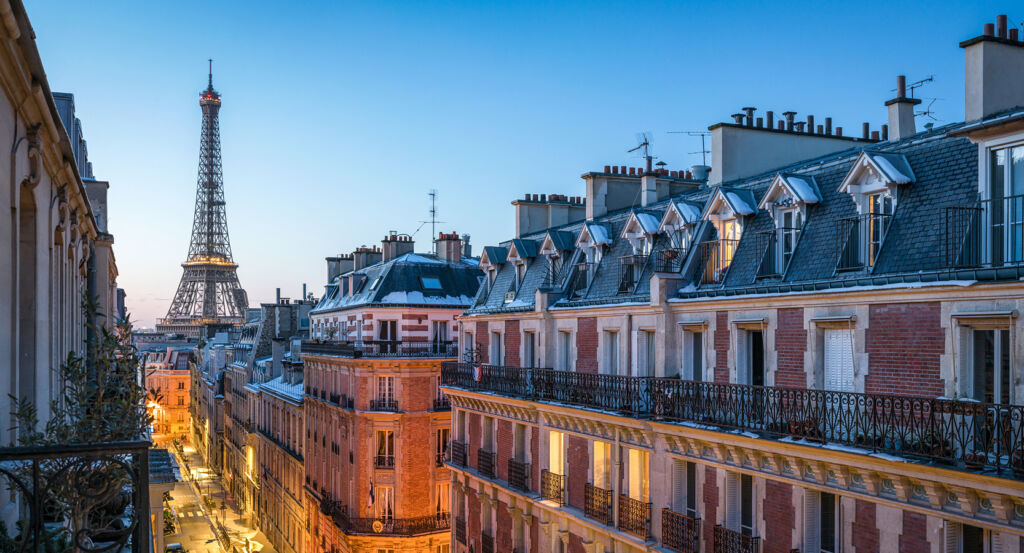
Positioned between the Marais, Sentier, and République, the neighborhood occupies a compact Right Bank pocket where Rue Saint-Martin, Rue de Turbigo and Boulevard de Sébastopol connect narrow inherited streets with the larger axes of Central Paris. Long blocks conceal interior courts and passages behind tightly spaced facades, allowing streets barely wide enough for medieval circulation to coexist with avenues opened for the movement and commerce of a far larger nineteenth-century capital. Rue Saint-Martin establishes the primary encounter through a north-south route that carried movement between Central Paris and its northern approaches for centuries, with adjoining streets repeatedly bending, narrowing and widening around inherited property boundaries. Rue au Maire and Rue Volta deepen the physical character through a finer urban grain where small storefronts and compact residential buildings preserve the scale of an older commercial district. Passage du Pont-aux-Biches introduces another layer through an enclosed pedestrian route raised across ground whose physical history differs sharply from the major streets surrounding it. The result is a neighborhood where intimate passages, ancient routes and later metropolitan interventions remain compressed within a few blocks, preparing a history anchored by a religious site that the French Revolution redirected toward science, invention and technical education.
What defines Arts-et-Métiers.
Arts-et-Métiers is best known for developing around Saint-Martin-des-Champs, an ancient religious site that became the home of the Conservatoire national des arts et métiers and permanently connected the quarter with French scientific and industrial education. Archaeological excavation beneath the former church uncovered a Merovingian funerary sanctuary dating from the fifth through eighth centuries, establishing sacred use long before the surviving medieval complex emerged. Henri I selected the site in 1059 and 1060 for a religious community, installing Augustinian canons before the foundation entered the orbit of Cluny and grew into a substantial priory outside the early city. A new church followed after the earlier sanctuary proved inadequate, and its surviving choir became an important work of twelfth-century architecture through an innovative combination of ambulatory and radiating chapels. Revolutionary suppression ended the monastic chapter and opened an entirely different future for the enclosure. Henri Grégoire secured the creation of the Conservatoire des arts et métiers from the National Convention on October 10, 1794, conceiving an institution where inventions, machines, tools and technical knowledge would be assembled and explained for public instruction. A law of June 10, 1798 assigned the former Saint-Martin-des-Champs priory to the Conservatoire, which occupied the complex the following year. The institution expanded its educational purpose in 1819 with public instruction applying science to industrial arts and initial chairs devoted to applied chemistry, applied mechanics and industrial economics, converting a medieval religious enclosure into a national center for transmitting technical knowledge.
Rue Réaumur supplied a separate mechanism for reshaping Arts-et-Métiers as commerce and architectural experimentation altered the district around the turn of the twentieth century. Earlier sections of the route had emerged during nineteenth-century restructuring, but its westward extension through older blocks created a broad commercial axis connecting the neighborhood toward the Bourse. Expropriations erased smaller streets and properties as the new alignment advanced, a process captured by Charles Marville in photographs showing demolition beside surviving shops and the distant former priory. The resulting avenue became a concentrated field for architects working with iron structure, broad glazing and increasingly ambitious commercial facades. Charles Ruzé completed buildings at 105 Rue Réaumur in 1899 and 121 in 1900, the latter distinguished by pronounced curves across its elevation. Farther west, the Société Générale building at 132 to 134 introduced a commanding corner composition crowned by a clock, and Georges Chédanne completed the building later associated with Le Parisien libéré at 124 in 1904 and 1905. Older eighteenth-century buildings survived among these constructions, leaving Rue Réaumur as an unusually concentrated architectural sequence through the commercial modernization of Central Paris.
How Arts-et-Métiers fits.
Arts-et-Métiers works as the anchor for a daytime exploration connecting a seventeenth-century convent chapel enriched by nineteenth-century religious art, a Second Empire theater carried through operetta, experimental performance and digital culture, and a triumphal arch created to commemorate Louis XIV's military campaigns.
Begin at Église Sainte-Élisabeth-de-Hongrie, constructed from 1628 as the chapel of a convent belonging to Franciscan Third Order sisters before nineteenth-century expansion elevated the building for its new role as a parish church. Merry-Joseph Blondel painted Saint Elizabeth laying her crown before Christ in 1824, and the interior later received one hundred seventeenth-century carved reliefs originating in the choir stalls of the Abbaye Saint-Vaast in Arras; Louis Suret's great organ followed in 1853 and earned a gold medal at the 1855 Exposition Universelle, binding the former convent chapel to several distinct generations of French religious art and craftsmanship. Continue to Gaîté Lyrique, created at Rue Papin in 1862 after Haussmannian works displaced the earlier Théâtre de la Gaîté from Boulevard du Temple, with a new auditorium seating 1,800 people and a theatrical history soon associated with Jacques Offenbach. Later chapters brought Russian ballet, the newly founded Orchestre de Paris, Patrice Chéreau's production of La Dispute, Robert Wilson's Le Regard du Sourd and Silvia Monfort's circus school into the building before the short-lived Planète Magique attraction occupied altered interiors in 1989; architect Manuelle Gautrand subsequently reworked the surviving historic fabric ahead of its 2011 reopening as a cultural center. Conclude at Porte Saint-Martin, erected in 1674 by Pierre Bullet at the junction of Rue Saint-Martin and the grands boulevards as a royal triumphal arch celebrating the campaigns of Louis XIV. Bullet, a disciple of François Blondel, worked with sculptors connected to Versailles, including Martin Desjardins and Pierre Le Gros, and the relief program commemorated the capture of Besançon, the taking of Limbourg and French victories against the Triple Alliance, translating contemporary military events into architecture at one of the principal northern approaches to the city. The progression moves from a Franciscan chapel enriched through successive artistic commissions through a Second Empire theater repeatedly adapted to new forms of performance into Bullet's architecture of royal commemoration, revealing the religious, theatrical and political institutions that accumulated around the northern edge of Arts-et-Métiers.
Where your story begins.
Foresyte Travel reveals places that feel extraordinary long before you arrive.
Experience premium editorial crafted for luxury travelers.
Foresyte Travel may earn a commission when you book through the link on this page.














































































































