
Why Porte Saint-Martin matters.
Porte Saint-Martin is a theatrical enclave where the historic northern approaches to Paris meet the Grands Boulevards through seventeenth-century royal architecture, former faubourg streets and an extraordinary concentration of performance culture.
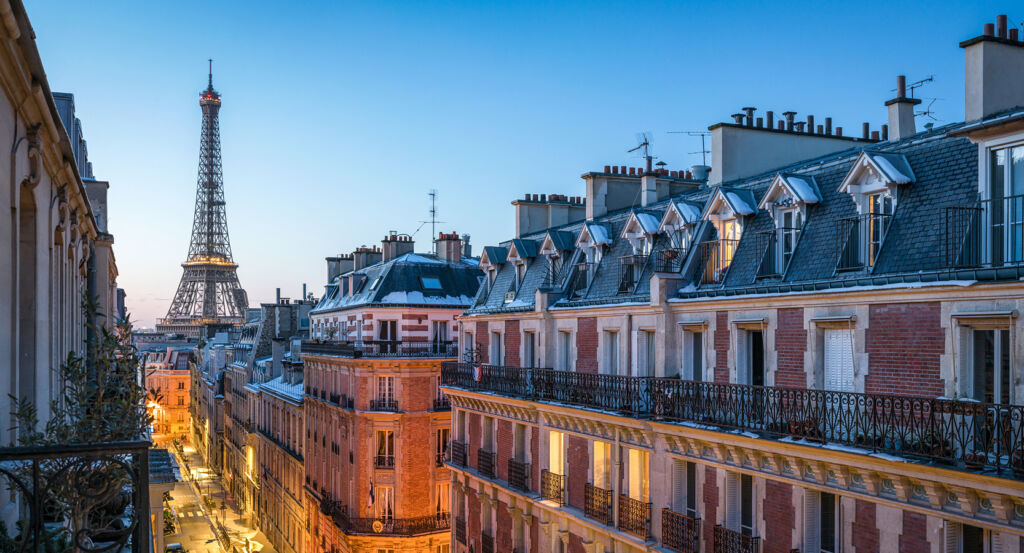
Positioned between Strasbourg-Saint-Denis, Arts-et-Métiers, and République, the neighborhood occupies a pivotal Right Bank pocket where Boulevard Saint-Martin crosses the ancient route carried north by Rue Saint-Martin and Rue du Faubourg Saint-Martin. Broad boulevard frontage gives way quickly to narrower streets, passages and deep building plots, preserving the physical transition between the old city and the suburban territory that developed outside its defenses. Boulevard Saint-Martin establishes the primary encounter through its raised roadway, tree-lined edges and theaters gathered around the former line of fortifications. Rue du Faubourg Saint-Martin extends the district north through a denser commercial corridor descended from the route toward Saint-Denis, among two Roman roads that structured the territory of the present 10th Arrondissement. Streets around Rue René Boulanger add another scale through curving alignments and residential blocks immediately behind the boulevard, allowing the immense ceremonial arch to remain visually dominant. The result is a neighborhood where vanished defenses became promenades and performance streets, preparing a history in which Louis XIV's decision to open Paris beyond its walls permanently changed both the architecture and cultural purpose of the district.
What defines Porte Saint-Martin.
Porte Saint-Martin is best known for occupying the former northern defensive threshold where Louis XIV replaced fortification with ceremonial architecture and initiated the Grands Boulevards that reshaped this edge of Paris. The faubourg beyond the walls had expanded from the fourteenth century as artisans, gardeners, market gardeners and winegrowers established themselves outside the crowded city, carrying settlement north along routes whose origins extended into the Roman period. Louis XIV ordered the obsolete fortifications removed in 1670 after French territorial expansion reduced their defensive importance, converting their former line into an open urban boundary. Pierre Bullet designed the Porte Saint-Martin in 1674 as a triumphal arch marking the division between city and faubourg, working within the architectural tradition of his teacher François Blondel. Sculptors associated with royal projects at Versailles participated in its decoration, including Martin Desjardins and Pierre Le Gros, whose relief program commemorated the capture of Besançon, the taking of Limbourg and French victories connected with the collapse of the Triple Alliance. The faubourgs continued growing beyond the freestanding arch until their incorporation into Paris in December 1701. A broad tree-planted Nouveau Cours appeared along the former fortification line in 1704 and 1705, retaining the military term boulevard even after the ramparts had disappeared. Reconstruction of the Grand Égout between 1737 and 1740 further encouraged development south of the present 10th Arrondissement, and theaters subsequently clustered around Porte Saint-Martin, establishing a cultural specialization that has survived for centuries.
Theater supplied a separate mechanism for turning the former defensive threshold into one of Paris's principal entertainment districts. Fire destroyed the Opéra's Palais-Royal auditorium in June 1781, prompting Marie-Antoinette to demand a replacement and architect Nicolas Lenoir to deliver a new house on Boulevard Saint-Martin within months through continuous day-and-night construction. The auditorium held 1,800 spectators across four tiers of boxes when Piccinni's Adèle de Ponthieu opened the building on October 27, and the Opéra mounted 41 productions there before leaving in 1794, including works by Grétry, Sacchini, Philidor and Salieri. Beaumesnil's Tibulle et Délie appeared there in 1784, entering the institution's history as the first opera by a woman presented by the company. The building subsequently entered the Romantic era under Harel, with Alexandre Dumas and Victor Hugo among the dramatists whose works established the boulevard as a center for nineteenth-century drama. Fire during the Commune destroyed the theater in May 1871, but Oscar de la Chardonnière reconstructed it in 1873 with sculptural work by Jacques-Hyacinthe Chevalier. Its reopening with Hugo's Marie Tudor restored a performance tradition later extended by Sarah Bernhardt and the 1897 premiere of Edmond Rostand's Cyrano de Bergerac.
How Porte Saint-Martin fits.
Porte Saint-Martin works as the anchor for an afternoon connecting a nineteenth-century commercial passage divided by Haussmann-era street construction, a centuries-old parish rebuilt through successive Gothic campaigns and a Second Empire theater created during the boulevard district's architectural reinvention.
Begin at Passage Brady, constructed in 1828 by the merchant Brady as the covered-passage boom carried enclosed commerce into the streets north of the Grands Boulevards. By 1831 its shops had developed into a bazaar of secondhand clothing dealers alongside reading rooms and baths, embedding multiple forms of commerce and recreation within the same interior route; construction of Boulevard de Strasbourg severed the passage in 1854, leaving only its western portion roofed, before Indian and Pakistani businesses transformed its commercial character during the 1970s and 1980s. Continue to Église Saint-Laurent, whose religious history reaches the fifth century, when a sanctuary arose beside a monastery along the route toward Saint-Denis. A medieval successor eventually proved too small for the growing faubourg, and construction of the present church began during the fifteenth century, with its choir consecrated in 1429 amid the pointed arches, sculpted vault bosses, tall windows and elaborate glazing of Flamboyant Gothic architecture; the unfinished nave and facade then carried the project across subsequent centuries, embedding successive architectural periods within a parish whose development followed the northern expansion of Paris. Conclude at Théâtre de la Renaissance, established on Boulevard Saint-Martin in 1872 as theatrical construction returned to an area devastated during the Commune. Its presence beside the older Porte Saint-Martin theater reinforced the boulevard's concentration of performance houses, and surviving views held by Musée Carnavalet show the Renaissance facade facing a streetscape of omnibuses, horses, electric lamps and a Morris advertising column, capturing the district after theatrical architecture had become inseparable from metropolitan circulation and publicity. The progression moves from enclosed nineteenth-century commerce fractured by boulevard construction through a parish carrying medieval religious architecture across centuries into a theater district embedded in the rebuilt streets of post-Commune Paris, revealing how successive forms of movement, worship and performance accumulated around Porte Saint-Martin.
Where your story begins.
Foresyte Travel reveals places that feel extraordinary long before you arrive.
Experience premium editorial crafted for luxury travelers.
Foresyte Travel may earn a commission when you book through the link on this page.














































































































