
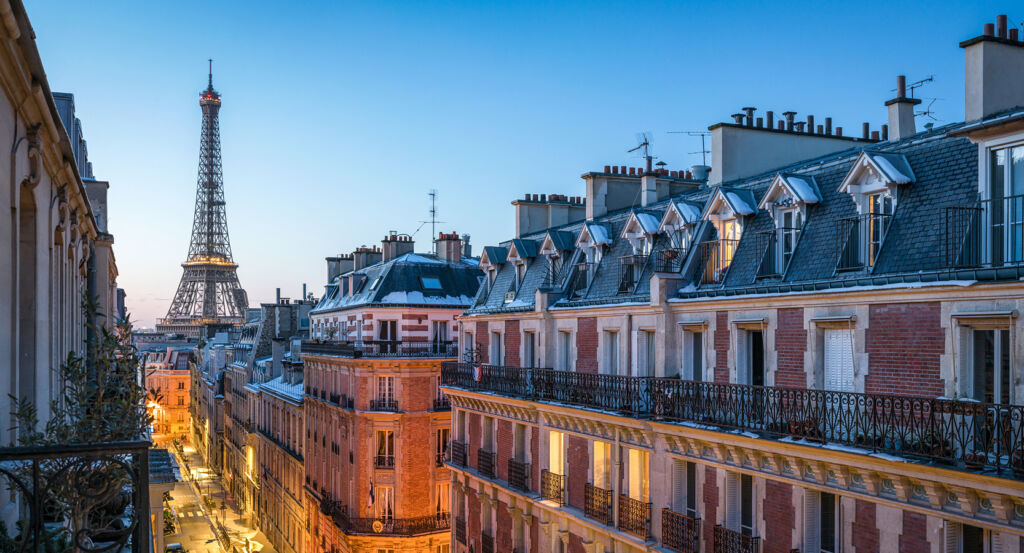
Why Avenue de la République matters.
Avenue de la République is a grand Folie-Méricourt corridor where republican ideals, Haussmannian planning, architectural elegance, and energetic Parisian life converge along one of the capital's most important eastern boulevards.
Running through Folie-Méricourt between Place de la République and Père-Lachaise, this expansive avenue unfolds through elegant Haussmann architecture, lively cafés, neighborhood boutiques, tree-lined promenades, celebrated performance venues, and thriving residential streets that embody the dynamic character of eastern Paris. Broad sidewalks, mature plane trees, harmonious limestone façades, and an enduring neighborhood atmosphere create an environment where civic life, commerce, and everyday Paris unfold in remarkable balance. Every stretch of the avenue reflects another chapter in the transformation of nineteenth-century Paris into a modern European capital. The result is a corridor defined by architectural distinction, civic significance, and one of the city's most influential urban avenues.
What defines Avenue de la République.
Avenue de la République is best known as one of Baron Haussmann's major Second Empire boulevards, opened in 1858 as Boulevard du Prince-Eugène before being renamed in 1879 following the establishment of the French Third Republic, transforming the avenue into one of the capital's clearest architectural expressions of France's transition from imperial rule to republican government. Constructed under Napoleon III to improve circulation between the rapidly expanding eastern districts and Central Paris, the boulevard required the demolition of dense medieval neighborhoods while introducing broad carriageways, coordinated limestone façades, modern sewer systems, landscaped promenades, and unified building regulations that became hallmarks of Haussmann's revolutionary urban planning. The avenue's renaming reflected the profound political transformation that followed the fall of the Second Empire, embedding republica character directly into the city's geography while creating a ceremonial connection with Place de la République, where the Monument à la République by brothers Léopold and Charles Morice was unveiled in 1883 as one of France's foremost civic memorials. Throughout the twentieth century the corridor became a focal point for civic demonstrations, labor marches, neighborhood commerce, and daily Parisian life, while preserving an exceptional ensemble of Second Empire residential architecture that continues illustrating Haussmann's vision of a healthier, more efficient, and visually unified capital. Together, these political, architectural, engineering, and urban achievements establish Avenue de la République as one of Paris' defining republican boulevards.
Broad tree-lined promenades, harmoniously designed apartment buildings, thriving neighborhood businesses, and enduring civic activity continue illustrating how the avenue successfully balances grand planning with everyday urban life. The remarkable relationship between Haussmann's engineering, the birth of the French Third Republic, and one of the capital's most symbolically important public squares demonstrates why Avenue de la République remains one of Paris' most historically significant civic corridors. Few Parisian avenues combine political symbolism, urban innovation, architectural coherence, and democratic character with such remarkable continuity.
How Avenue de la République fits.
Avenue de la République works as an exploration through Folie-Méricourt's celebrated civic landmarks and historic neighborhoods.
Begin at Place de la République, where the Monument à la République introduces the democratic ideals that define the avenue before strolling beneath its elegant rows of plane trees. Continue to Cirque d'Hiver Bouglione, whose remarkable nineteenth-century architecture celebrates one of Paris' oldest continuously operating circuses. Conclude at Père-Lachaise Cemetery, where the resting places of Oscar Wilde, Frédéric Chopin, Jim Morrison, Édith Piaf, and countless other cultural icons provide a memorable finale celebrating the remarkable relationship between civic history, architectural planning, and Parisian cultural heritage. The progression moves naturally from republican symbolism to architectural innovation before culminating in one of the world's most celebrated historic cemeteries, revealing why Avenue de la République remains one of Paris' most distinguished urban avenues.
Where your story begins.
Foresyte Travel reveals places that feel extraordinary long before you arrive.
Experience premium editorial crafted for luxury travelers.
Foresyte Travel may earn a commission when you book through the link on this page.














































































































