
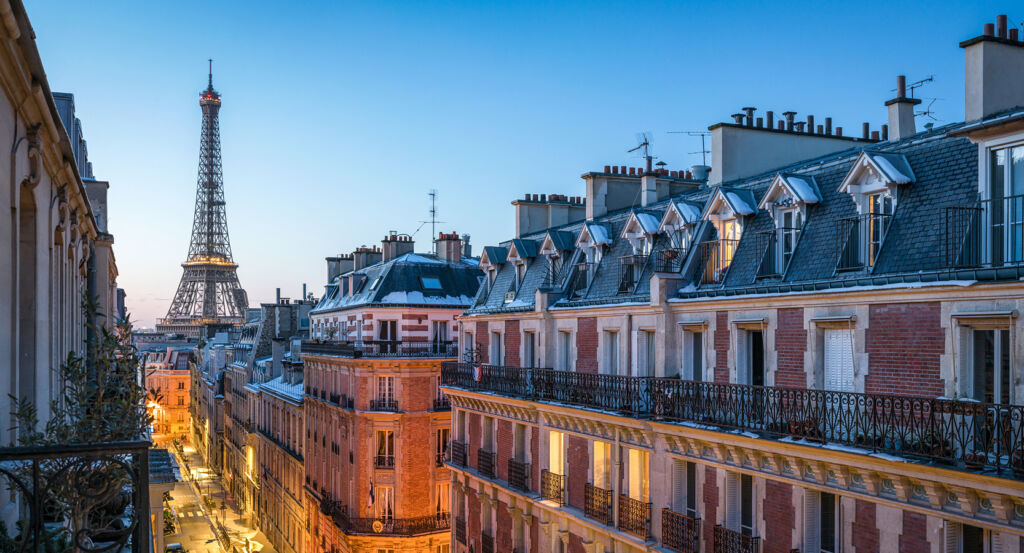
Why Avenue du Maine matters.
Avenue du Maine is a spirited Montparnasse corridor where artistic innovation, railway history, architectural evolution, and Left Bank culture converge along one of the capital's most influential avenues.
Running through Montparnasse between Place du 18 Juin 1940 and Porte de Vanves, this expansive boulevard unfolds through celebrated brasseries, historic theaters, elegant Haussmann architecture, modern cultural venues, lively cafés, and thriving neighborhood streets that capture the enduring energy of southern Paris. Broad sidewalks, mature tree-lined sections, energetic commercial districts, and a seamless blend of nineteenth- and twentieth-century architecture create an atmosphere where creativity, commerce, and everyday Parisian life intersect. Every stretch of the avenue reflects another chapter in the remarkable transformation of Montparnasse into one of Europe's great artistic and transportation hubs. The result is a corridor defined by cultural significance, architectural diversity, and one of the city's most dynamic urban avenues.
What defines Avenue du Maine.
Avenue du Maine is best known for serving as the historic spine of Montparnasse, where the arrival of Gare Montparnasse in 1840 transformed the surrounding district into one of the world's foremost artistic neighborhoods, attracting an extraordinary community of painters, sculptors, writers, photographers, and intellectuals who reshaped twentieth-century culture. The avenue follows the ancient Route du Maine, the historic road linking Paris with Le Mans and Brittany, preserving a transportation corridor whose origins predate the modern city by centuries. During the late nineteenth and early twentieth centuries, nearby studios and cafés welcomed Pablo Picasso, Amedeo Modigliani, Chaïm Soutine, Constantin Brâncuși, Diego Rivera, Joan Miró, Marc Chagall, Fernand Léger, Man Ray, and countless other members of the École de Paris, while literary figures including Ernest Hemingway, Samuel Beckett, Jean-Paul Sartre, Simone de Beauvoir, and Guillaume Apollinaire established Montparnasse as the intellectual heart of the Left Bank. The avenue also witnessed one of France's most ambitious postwar redevelopment projects with the construction of the Tour Montparnasse between 1969 and 1973 by architects Eugène Beaudouin, Urbain Cassan, Louis de Hoÿm de Marien, and Jean Saubot, rising 210 meters to become the tallest building in France until 2011 and permanently redefining the Paris skyline. Together, these transportation, artistic, literary, architectural, and engineering achievements establish Avenue du Maine as one of Paris' defining cultural corridors.
Historic railway infrastructure, renowned artistic institutions, modern architectural landmarks, and generations of celebrated cafés continue illustrating how the avenue evolved from an ancient regional road into one of the world's most influential creative districts. The enduring relationship between Gare Montparnasse, the École de Paris, and the neighborhood's extraordinary concentration of internationally renowned artists and writers demonstrates why Avenue du Maine remains synonymous with innovation, artistic freedom, and the cultural character of the Left Bank. Few Parisian avenues combine transportation history, artistic revolution, literary achievement, and architectural transformation with such remarkable international significance.
How Avenue du Maine fits.
Avenue du Maine works as an exploration through Montparnasse's celebrated artistic landmarks and cultural institutions.
Begin at Gare Montparnasse, where one of France's most important railway terminals introduces the remarkable history that transformed the neighborhood into a global creative center before strolling along Avenue du Maine. Continue to Tour Montparnasse, whose panoramic observation deck reveals one of the finest views across the Paris skyline. Conclude at Montparnasse Cemetery, where the resting places of Jean-Paul Sartre, Simone de Beauvoir, Samuel Beckett, Charles Baudelaire, and numerous cultural icons provide a memorable finale celebrating the extraordinary artistic and intellectual legacy that continues defining the district. The progression moves naturally from transportation history to architectural innovation before culminating in one of France's most important cultural landscapes, revealing why Avenue du Maine remains one of Paris' most historically significant avenues.
Where your story begins.
Foresyte Travel reveals places that feel extraordinary long before you arrive.
Experience premium editorial crafted for luxury travelers.
Foresyte Travel may earn a commission when you book through the link on this page.














































































































