
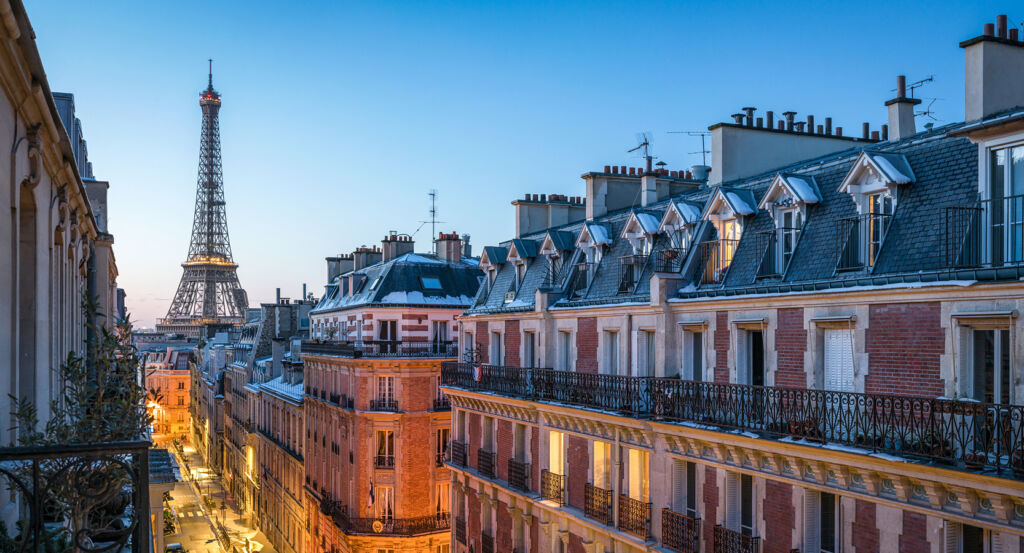
Why Montparnasse matters.
Montparnasse is a storied enclave where the southern Left Bank meets modern Paris through broad boulevards, surviving artists' streets and an urban crossroads shaped by generations of painters, writers, sculptors and travelers.
Positioned between Saint-Germain-des-Prés, Denfert-Rochereau, and Necker, the neighborhood occupies a southern Left Bank junction where Boulevard du Montparnasse, Boulevard Raspail and Avenue du Maine converge across territory shared by the 6th, 14th and 15th Arrondissements. Long boulevard perspectives and dense stone apartment blocks open unexpectedly into short lanes, planted courts and former studio compounds, preserving changes in scale created as suburban ground became part of metropolitan Paris. Boulevard du Montparnasse establishes the primary encounter through an east-west axis where cafés, cinemas and commercial facades occupy the public frontage once associated with the quarter's international artistic population. Streets extending south toward Rue Campagne-Première and Rue Delambre deepen the physical character through narrower parcels and surviving studio buildings that place domestic architecture beside spaces created for painting and sculpture. The station precinct adds a contrasting metropolitan scale, with rail infrastructure and later high-rise construction concentrating movement at the western end of the historic boulevard. The result is a neighborhood where artistic production, café culture and metropolitan expansion accumulated within a remarkably compact territory, preparing a history in which Montparnasse became one of the principal international centers of twentieth-century creative life.
What defines Montparnasse.
Montparnasse is best known for becoming an international artistic center during the opening decades of the twentieth century, when painters, sculptors, poets and writers converged on the inexpensive studios and cafés south of the Seine. Artists began moving toward the district in substantial numbers after 1900, extending a creative migration away from Montmartre into streets where workshops stood among modest houses and commercial premises. Amedeo Modigliani, Chaïm Soutine, Léonard Foujita, Moïse Kisling, Ossip Zadkine, Marc Chagall and Man Ray belonged to an international population whose careers crossed through studios, exhibitions and personal networks around the boulevard. Cafés became an essential extension of that world: La Rotonde drew artists under proprietor Victor Libion, who extended credit to customers with little money, and Le Dôme developed another meeting point for foreign painters and writers. Alice Prin, known as Kiki de Montparnasse, entered this circle as a model before becoming a painter, performer and defining figure of the quarter's interwar culture, forming relationships with Soutine, Foujita, Kisling and Man Ray. The Jockey opened in 1923 and pushed Montparnasse nightlife beyond the café into late-night performance, placing Kiki at the center of another creative network. American writers and artists joined Europeans arriving from Italy, Russia, Poland and elsewhere, giving the district an international concentration that Paris municipal history characterizes as the artistic center of the 1920s. Montparnasse consequently became less a single school than a dense geography of studios, cafés, friendships, exhibitions and nightlife through which several strands of modern art crossed the same streets.
Railway development supplied a separate mechanism for changing Montparnasse by connecting its western edge with expanding suburbs and western France. The first station opened in 1840 for the Paris to Versailles railway, with Louis Visconti designing a terminus beside Boulevard du Montparnasse on ground now occupied by the Tour Montparnasse precinct. Rising traffic quickly overwhelmed that structure, leading architect Victor Lenoir and engineer Eugène Flachat to create a replacement completed in 1852 on the same site. Expansion of western railway connections subsequently tied the district to Normandy and Brittany, bringing successive populations through a quarter already growing beyond the older Left Bank. The station also produced one of nineteenth-century Paris's most enduring railway images on October 22, 1895, when a Granville to Paris locomotive overran the buffers, crossed the concourse and crashed through the facade above Place de Rennes. Twentieth-century redevelopment eventually shifted the railway terminus southward, clearing its former site for a comprehensive rebuilding of the station district. The present Gare Montparnasse opened in 1969, severing the direct architectural relationship between the historic boulevard and its nineteenth-century terminus but preserving rail travel as one of the forces governing movement through the neighborhood.
How Montparnasse fits.
Montparnasse works as the anchor for a daytime exploration connecting an independent art academy that trained an international avant-garde, a sculptor's preserved studio complex and a nineteenth-century cemetery that became the burial place of major figures from French literature, philosophy and art.
Begin at Académie de la Grande Chaumière, founded in 1904 on the street carrying the same name and devoted to painting and sculpture at a moment when Montparnasse was drawing students from across Europe and beyond. Its teaching history gathered Antoine Bourdelle, Maurice Denis, Othon Friesz, Fernand Léger, Lucien Simon, Ossip Zadkine, Eugène Grasset and other major practitioners, establishing an alternative artistic institution near Boulevard du Montparnasse through which instruction, life drawing and independent studio culture became directly connected to the district's growing international population. Continue to Musée Bourdelle, where Antoine Bourdelle settled in the Impasse du Maine in 1885 among gardens, vineyards and neighboring artists including Aimé-Jules Dalou and Eugène Carrière. Bourdelle remained there until his death in 1929, conceived plans for a future museum during his final years, and left a sculpture studio that his wife Cléopâtre preserved before donating the property to the City of Paris in 1947; the museum opened in 1949 around the apartment and surviving workshops, then gained later architectural additions. Conclude at Montparnasse Cemetery, opened as the Cimetière du Sud on July 25, 1824 outside the contemporary limits of Paris as part of the reorganization that moved major burial grounds away from overcrowded parish cemeteries. Its 19 hectares subsequently became the burial place of Charles Baudelaire, Jean-Paul Sartre, Simone de Beauvoir, Samuel Beckett, Man Ray, Constantin Brâncuși and other figures whose work crossed literature, philosophy and visual art, turning a cemetery created during Paris's early nineteenth-century expansion into an extraordinary concentration of cultural history. The progression moves from independent artistic instruction through Bourdelle's preserved working environment into a burial ground gathering writers, philosophers and artists across generations, tracing how Montparnasse converted creative practice into an enduring cultural geography.
Where your story begins.
Foresyte Travel reveals places that feel extraordinary long before you arrive.
Experience premium editorial crafted for luxury travelers.
Foresyte Travel may earn a commission when you book through the link on this page.














































































































