
Why Necker matters.
Necker is a broad-grained enclave where Montparnasse meets the historic approaches to Vaugirard through railway corridors, long residential streets and institutional compounds that turned former peripheral ground into a dense extension of the Left Bank.
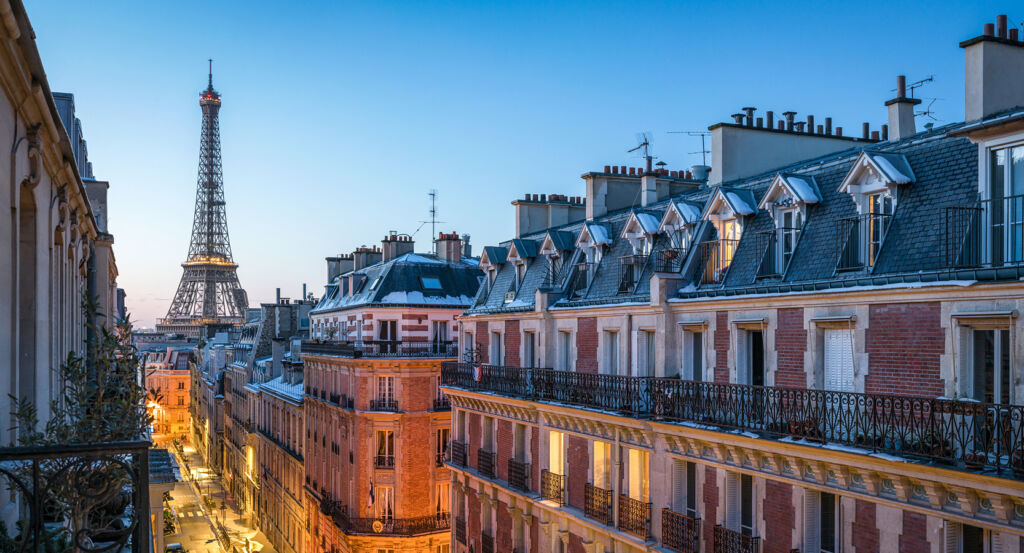
Positioned between Montparnasse, Saint-Lambert, and Grenelle, the neighborhood occupies an eastern section of the 15th Arrondissement where Boulevard de Vaugirard, Rue de Sèvres and Avenue de Breteuil frame territory once separating established Paris from the village of Vaugirard. Broad avenues and nineteenth-century apartment blocks alternate with quieter streets whose schools, hospitals, religious buildings and enclosed gardens preserve the larger parcels that preceded intensive urbanization. Boulevard de Vaugirard establishes the primary encounter along the railway edge, where the station complex imposes an unusual metropolitan scale against residential blocks extending westward into the Arrondissement. Rue Falguière and adjoining streets deepen the physical character through narrower frontages and former workshop territory connected historically with the artistic world of Montparnasse. Avenue de Breteuil adds a contrasting geometry through its long planted axis and formal perspective toward Hôtel des Invalides, placing Necker against one of western Paris's great eighteenth-century spatial compositions. The result is a neighborhood where railway expansion, older suburban routes and successive institutional foundations created striking shifts of scale, preparing a history rooted in territory that once lay between Paris and Vaugirard.
What defines Necker.
Necker is best known for developing from sparsely occupied ground between historic Paris and Vaugirard into an urban quarter whose name preserves Suzanne Necker's eighteenth-century philanthropic intervention on Rue de Sèvres. The road itself had long connected Paris with Sèvres when Suzanne Necker, wife of Louis XVI's finance minister Jacques Necker, established a hospital for impoverished patients there in 1778. She installed the 120-bed institution in buildings formerly occupied by the Benedictines of Notre-Dame-de-Liesse and directed it for the following decade. Revolutionary nationalization brought the hospital under state control in 1792, and the institution carried the name Hospice de l'Ouest before receiving the Necker name during the early nineteenth century. A second medical institution had developed nearby from Languet de Gergy's 1724 establishment for girls, which became the Maison Royale de l'Enfant-Jésus in 1751 and the Hôpital des Enfants-Malades in 1802, the first hospital devoted specifically to sick children. The two neighboring hospitals joined in 1926, consolidating separate histories of philanthropy, pediatric medicine and public health within a single complex. Necker's broader territory entered a new civic geography in 1860 when Paris absorbed Vaugirard and Grenelle and created the 15th Arrondissement from their lands alongside portions of the older city. The neighborhood name consequently binds the district's metropolitan expansion to a medical foundation that preceded annexation by more than eighty years.
Railway development supplied a separate mechanism for converting Necker's eastern edge into one of Paris's principal gateways. The first station serving the Paris to Versailles line opened in 1840 near Boulevard du Montparnasse with two tracks and a metal hall designed by Louis Visconti, placing railway infrastructure on ground then belonging to Vaugirard. Traffic growth quickly overwhelmed that terminal, and a larger Gare de l'Ouest replaced it in 1852 through a project associated with architect Victor Lenoir and major engineering works carrying the tracks across Avenue du Maine. Expansion continued as western railway services connected Paris with destinations across Brittany and Normandy, making the station an increasingly powerful force in the surrounding district. The twentieth century shifted the terminal southward: Gare du Maine supplemented the older station during the 1930s, and the historic complex disappeared during the redevelopment that produced the present Gare Montparnasse, inaugurated in 1969, and the adjoining Maine-Montparnasse complex. Tracks now extend deep into Necker behind the station, creating a broad infrastructural corridor whose scale still separates the neighborhood's eastern edge from the finer street fabric farther west.
How Necker fits.
Necker works as the anchor for a daytime exploration connecting an artist colony that nurtured one of modern sculpture's major figures, a Russian painter's Montparnasse academy turned wartime canteen and a biomedical institute created after a breakthrough in rabies treatment.
Begin at Musée Bourdelle, where Antoine Bourdelle rented his first studio at 16 Impasse du Maine in January 1885 and remained for more than forty years as the surrounding artists' colony expanded with painters, engravers and sculptors. Carpenter Pierre Auguste Paillard had begun constructing studios on the property in 1878, using high north-facing windows and mezzanines suited to artistic work; Bourdelle gradually occupied additional rooms as commissions increased, producing Head of Apollo, Hercules the Archer and Dying Centaur there before conceiving a museum for his work during the 1920s. His widow Cléopâtre, daughter Rhodia and son-in-law Michel Dufet carried that ambition forward, and the museum opened in 1949 before later additions by Henri Gautruche and Christian de Portzamparc expanded the original studio complex. Continue to Villa Vassilieff, where Russian painter and sculptor Marie Vassilieff established an academy in 1911 amid the international artistic community gathering around Avenue du Maine. The premises became a canteen during the First World War, providing inexpensive meals within a Montparnasse world populated by artists whose finances deteriorated sharply during wartime; the combination of studio, academy and communal dining place embedded Vassilieff within the social infrastructure that supported the district's avant-garde. The site later housed the Musée du Montparnasse before the City of Paris reopened it in 2016 as Villa Vassilieff, preserving an address connected directly with the quarter's early twentieth-century artistic migration. Conclude at Institut Pasteur, whose creation followed Louis Pasteur's successful treatment of Joseph Meister for rabies in July 1885 and the international demand generated by subsequent vaccinations. A public appeal launched in 1886 raised more than two million gold francs, enabling acquisition of an 11,000-square-meter Rue Dutot property in March 1887; architect Charles Girault Petit developed two parallel buildings joined by a central corridor before his death transferred supervision to Brébant, and President Sadi Carnot inaugurated the institute on November 14, 1888. Its scientific lineage subsequently included Nobel laureates Élie Metchnikoff, Alphonse Laveran, André Lwoff, Jacques Monod and François Jacob, carrying Pasteur's original combination of rabies treatment, infectious-disease research and teaching into successive generations of biomedical discovery. The progression moves from Bourdelle turning an artists' colony into a workshop for modern sculpture through Vassilieff converting artistic education into wartime communal support into Pasteur joining an international funding campaign with experimental medicine, revealing the creative and scientific institutions that emerged along Necker's border with Montparnasse.
Where your story begins.
Foresyte Travel reveals places that feel extraordinary long before you arrive.
Experience premium editorial crafted for luxury travelers.
Foresyte Travel may earn a commission when you book through the link on this page.














































































































