
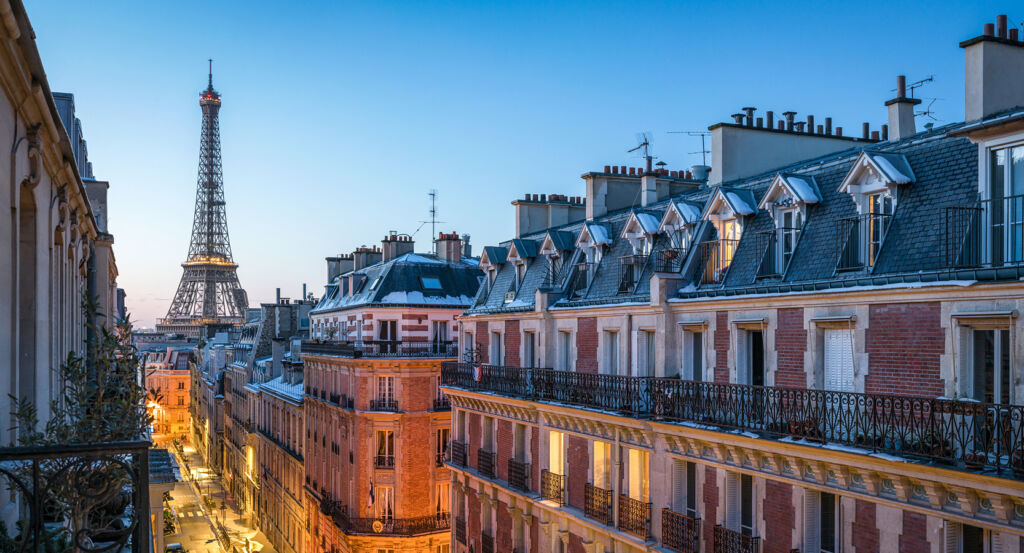
Why 15th Arrondissement matters.
15th Arrondissement is a broad Left Bank enclave where former villages meet the Seine through long commercial streets, residential quarters and industrial ground absorbed into Paris during its nineteenth and twentieth-century expansion.
Positioned between Montparnasse, Invalides, and Issy-les-Moulineaux, the neighborhood occupies an expansive southwestern sector where the historic centers of Vaugirard and Grenelle extend toward the river through Rue de Vaugirard, Rue de la Convention, Rue du Commerce and the avenues radiating from Place Cambronne. Its scale changes block by block, moving between the dense street walls of Vaugirard, the rectilinear plan of Grenelle, broad railway approaches around Montparnasse and larger riverside parcels created through successive phases of industrial development. Rue du Commerce establishes one primary encounter through a long retail corridor embedded within Grenelle's planned nineteenth-century blocks, where compact intersections and continuous facades retain the legibility of a district conceived before annexation into Paris. Rue de Vaugirard supplies a distinct spatial mechanism farther east as one of the capital's longest streets crosses the former village core through a denser fabric of shops, churches, passages and residential buildings before reaching the Montparnasse edge. The result is an Arrondissement whose unusual breadth preserves the traces of separate villages, speculative development and metropolitan expansion within a continuous urban territory, preparing a history built from Vaugirard and Grenelle before both entered Paris in 1860.
What you should know 15th Arrondissement.
15th Arrondissement is best known for combining the former communes of Vaugirard and Grenelle into a single Parisian district during the territorial expansion of 1860. Vaugirard had emerged centuries earlier from rural ground belonging to the Abbaye de Saint-Germain-des-Prés, and by 1341 its inhabitants had secured a public chapel after objecting to the distance separating their settlement from the parish church at Issy. That sanctuary received relics of Saint Lambert in 1453, giving the future Saint-Lambert quarter a religious center as vineyards and agricultural holdings spread across the surrounding territory. Grenelle followed a different course across a plain whose name derived from garanella, with much of the sparsely settled ground belonging to the Abbaye Sainte-Geneviève during the seventeenth century. Jean-Baptiste-Léonard Violet and Alphonse Letellier acquired 105 hectares from the former Grande Ferme de Grenelle and began subdividing the plain in 1824, imposing a structured street plan that directed artisan and industrial activity toward the Seine. Growth proved rapid enough for Grenelle to separate from Vaugirard and become an independent commune in 1830. Napoleon III's enlargement of Paris ended that municipal independence three decades later, joining most of both communes with portions of the former Parisian 10th and 11th Arrondissements to create the modern 15th across 850 hectares. The new Arrondissement retained the contrasting geometries of its predecessors, leaving the older village fabric of Vaugirard beside the planned streets of Grenelle as two foundational layers of southwestern Paris.
Javel developed a separate industrial history along the Seine that carried the Arrondissement from chemical production into automobile manufacturing. A riverside settlement known as Javetz existed by the fifteenth century around a small port and boat facility, later acquiring a windmill and guinguette frequented by bathers, fishermen and boaters. Industrialization began in 1777 with a chemical works whose production became associated with potassium hypochlorite after Claude-Louis Berthollet applied chlorine compounds to bleaching, giving eau de Javel a name that eventually traveled far beyond Paris. The Fabrique d'Eau de Javel employed 200 workers in 1875 before disappearing in 1889, and later industrial occupation prepared the riverfront for another manufacturing chapter. André Citroën established a munitions factory there in 1915, then redirected production toward automobiles after the First World War. Thirty cars left the assembly lines each day in 1919; five years later output had reached 250 per day, and a new 55,000-square-meter factory supported subsequent production associated with the Traction Avant and DS. Automobile manufacturing eventually withdrew, with the last DS leaving the Javel lines in 1972 and Citroën completing its departure from the site in 1982, closing an industrial sequence that had connected chemistry, mechanized production and the Seine for two centuries.
How 15th Arrondissement fits.
15th Arrondissement works as the anchor for a daytime exploration connecting an artist's preserved Montparnasse workshops, a purpose-built museum devoted to French communications and a Franco-Japanese cultural institution conceived through presidential diplomacy.
Begin at Musée Bourdelle, where Antoine Bourdelle settled at 16 Impasse du Maine in January 1885 and worked for more than four decades inside a community of painters, engravers and sculptors. Pierre Auguste Paillard had begun constructing the atelier complex in 1878 with north-facing glass roofs and mezzanines, and Bourdelle gradually occupied additional studios as commissions expanded; Tête d'Apollon, Héraklès archer, Carpeaux au travail and Centaure mourant emerged from these spaces before the sculptor began planning a museum for his work in 1922. His studios opened for visits in 1938, the museum followed in 1949, Henri Gautruche added the plaster hall in 1961 and Christian de Portzamparc completed another extension in 1992. Continue to Musée de La Poste, whose institutional history began with the Musée Postal inaugurated in 1946 under director Eugène Vaillé before expanding collections forced a search for larger premises. Postal authorities selected a Boulevard de Vaugirard property in 1966, demolished the existing building in 1970 and opened the new museum in 1973, pairing André Châtelain's architecture with Robert Juvin's sculpted facade; the collection traces communications across horses, railways, aviation, telegraphy and telephony alongside the development of postage stamps and mail art. Conclude at Maison de la culture du Japon à Paris, whose origins reach François Mitterrand's 1982 state visit to Japan and discussions with Prime Minister Zenkō Suzuki over creating a Paris institution devoted to Japanese culture and bilateral exchange. Yasuhiro Nakasone advanced the project with Nippon Keidanren, an international jury selected Masayuki Yamanaka and Kenneth Armstrong's architectural proposal in 1990, construction began in September 1994 and Jacques Chirac joined Princess Sayako for the inauguration on May 13, 1997 before the building opened publicly that September during the Year of Japan in France. The progression moves from Bourdelle turning an artist community into the physical foundation of a museum through a national postal collection receiving purpose-built architectural form into French and Japanese leaders establishing a permanent institution for international cultural exchange, tracing three distinct ways creative work, communications and diplomacy acquired enduring addresses across the 15th Arrondissement.
Where your story begins.
Foresyte Travel reveals places that feel extraordinary long before you arrive.
Experience premium editorial crafted for luxury travelers.
Foresyte Travel may earn a commission when you book through the link on this page.














































































































