
Why Saint-Germain-des-Prés matters.
Saint-Germain-des-Prés is an elegant enclave where the medieval Left Bank meets literary Paris through an ancient abbey precinct, intimate streets, publishing history and the cafés that made its name inseparable from twentieth-century intellectual culture.
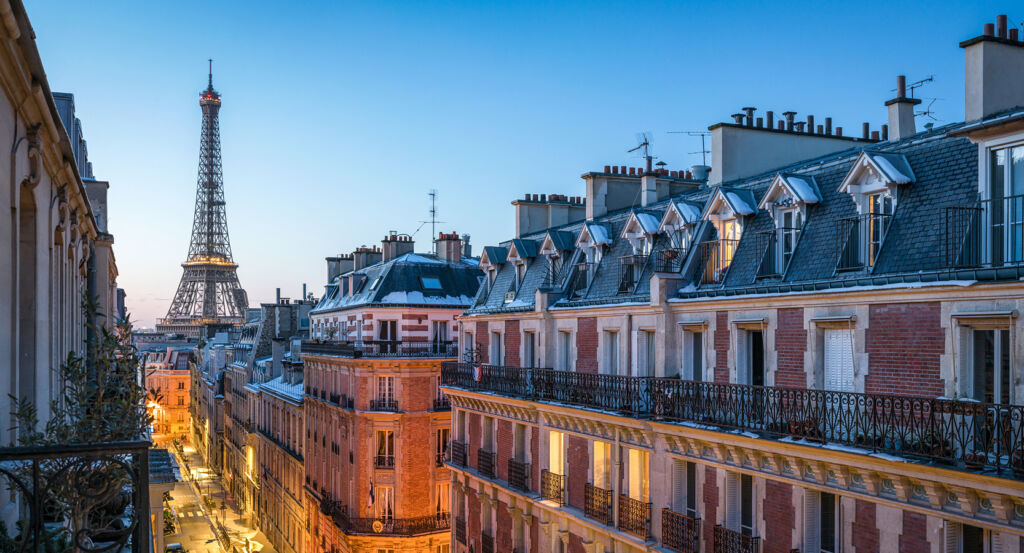
Positioned between Odéon, Monnaie, and the Seine, the neighborhood occupies a compact Left Bank pocket where Boulevard Saint-Germain crosses a much older network extending through Rue de Buci, Rue Bonaparte and Rue Jacob toward the river. Narrow streets, small blocks and secluded courtyards preserve a dense urban scale around the abbey, with later boulevards and apartment buildings layered across territory that developed for centuries beyond the earliest city walls. Boulevard Saint-Germain establishes the primary encounter through its broad nineteenth-century axis, yet the adjoining streets quickly contract into passages lined by galleries, bookshops, former publishing addresses and residential buildings whose proportions restore the older scale of the quarter. Rue de Buci deepens the physical character through an inherited commercial route connecting the abbey district with the historic approaches to Saint-André-des-Arts, creating one of the neighborhood's strongest transitions between institutional Paris and street commerce. Rue Jacob and Rue de l'Abbaye introduce another register through former monastic ground whose courtyards and fragmented alignments retain the spatial memory of an ecclesiastical domain once extending across a substantial portion of the surrounding Left Bank. The result is a neighborhood where monastic history, publishing culture and intellectual life occupy successive layers of the same compact territory, preparing a history that begins with one of the oldest religious foundations in Paris.
What defines Saint-Germain-des-Prés.
Saint-Germain-des-Prés is best known for developing around the abbey founded under the Merovingian king Childebert I, whose religious complex became one of medieval Paris's major centers of worship, landholding and intellectual life. Childebert ordered the Basilica of Sainte-Croix and Saint-Vincent to house relics and royal tombs, and his burial in 558 coincided with its dedication by Germain, bishop of Paris. The monastery subsequently took Germain's name, acquired substantial endowments under Charlemagne and adopted the Benedictine rule, placing it among the major scholarly religious houses of early medieval Gaul. Scandinavian incursions devastated the abbey during the ninth century and forced another architectural chapter. Abbot Morard began reconstruction 990 under Robert II, producing the western tower, nave, Chapelle Saint-Symphorien and an apse that established the Romanesque core still legible in the surviving church. Expansion continued as the monastic community grew, culminating in Pope Alexander III's consecration of a larger choir in 1163. The abbey later became an important center of the Maurist congregation during the seventeenth century, strengthening traditions of historical and scholarly work before the Revolution dissolved the monastic community and radically reduced its extensive precinct. Nineteenth-century restorations led by Étienne-Hippolyte Godde and Victor Baltard preserved the surviving church after much of the surrounding abbey had disappeared, leaving its tower and nave as architectural witnesses to more than a millennium of institutional change.
Publishing, cafés and postwar cultural life supplied a separate mechanism for establishing Saint-Germain-des-Prés as an international intellectual center. Publishing houses concentrated across the quarter during the twentieth century, with Gallimard occupying its first headquarters on Rue Saint-Benoît and Grasset and Le Seuil joining a broader literary geography extending through neighboring streets. Writers, editors and philosophers worked within walking distance of cafés that provided enduring gathering places beyond their offices and apartments. Jean-Paul Sartre and Simone de Beauvoir became closely associated with the quarter during and after the German occupation, and the postwar concentration of writers, journalists, performers and publishers gave Saint-Germain a cultural reach far beyond the Left Bank. Jazz added another strand as basement clubs drew French musicians together with American performers during the late 1940s and 1950s, binding literary experimentation to a nocturnal musical culture. Boris Vian moved between those worlds as novelist, trumpeter and chronicler of the district's clubs, becoming one of the figures most closely associated with postwar Saint-Germain. The concentration eventually shifted as publishing offices dispersed and luxury retail expanded from the late twentieth century, yet the streets around Saint-Benoît and the abbey still preserve the unusually tight geography in which books, philosophy, music and café culture once reinforced one another.
How Saint-Germain-des-Prés fits.
Saint-Germain-des-Prés works as the anchor for a daytime exploration connecting a Romantic painter's purpose-built studio, France's historic school of artistic training and Mazarin's seventeenth-century college on the Seine.
Begin at Musée national Eugène-Delacroix, occupying the apartment and studio where Eugène Delacroix lived from 1857 until his death on August 13, 1863. Delacroix moved to Rue de Furstemberg to remain close to Église Saint-Sulpice during work on its Chapelle des Saints-Anges, then commissioned the garden studio himself and filled it with thousands of sketches, drawings and objects connected with his 1832 journey to Morocco; the Société des Amis d'Eugène Delacroix, formed around admirers including Maurice Denis, preserved the property and opened the museum in 1932, carrying a private working environment into a permanent institution devoted to the painter. Continue to École nationale supérieure des Beaux-Arts, whose site absorbed architectural fragments and teaching traditions assembled after the Revolution as artistic education moved into the former Petits-Augustins convent. Alexandre Lenoir had used the property for the Musée des Monuments Français, gathering sculpture and architectural fragments displaced during Revolutionary destruction, before the restored monarchy assigned the complex to the École des Beaux-Arts; architect Félix Duban subsequently developed the Palais des Études and incorporated historic fragments into an educational ensemble where architecture itself became part of artistic instruction. Conclude at Institut de France, whose riverside palace began as Cardinal Mazarin's Collège des Quatre-Nations after his 1661 bequest of two million livres for a school serving young men from Pignerol, Alsace, Artois and Roussillon, territories incorporated into France through seventeenth-century treaties. Louis Le Vau began the complex in 1663 around a curving facade and central chapel intended for Mazarin's tomb, with the cardinal's library of more than 40,000 volumes forming another component of the foundation; the college opened in 1688, later educated figures including d'Alembert and Lavoisier, and became the home of the Institut de France in 1805 after Napoleon transferred the institution from the Louvre. The progression moves from Delacroix preserving the physical conditions of Romantic artistic production through institutional training built around France's accumulated artistic inheritance into Mazarin and Le Vau joining education, collecting and architecture on the Seine, tracing three distinct mechanisms through which Saint-Germain-des-Prés became a center of French cultural production.
Where your story begins.
Foresyte Travel reveals places that feel extraordinary long before you arrive.
Enjoy editorial crafted for luxury travelers.
Foresyte may earn a commission when you book.














































































































