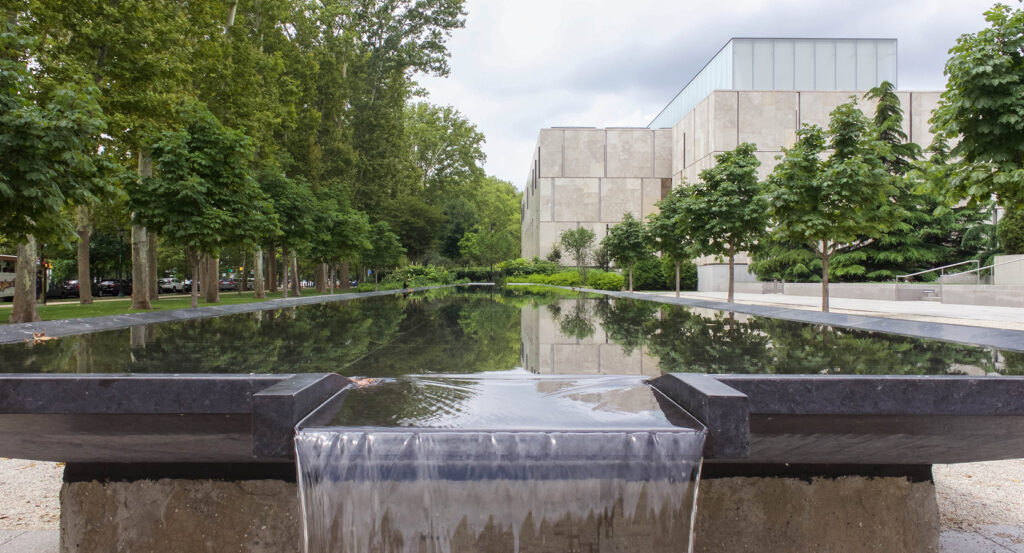
Why you should experience Calder Gardens in Philadelphia, Pennsylvania.
The Calder Gardens at the Barnes Foundation in Philadelphia is where the museum's philosophy of balance and beauty extends into the open air, a tranquil space that unites art, architecture, and nature in quiet harmony.
Set between minimalist stone walls and gently landscaped greenery, the garden feels like a living extension of the galleries inside. Bronze and steel sculptures rise among trees and water features, their forms echoing the geometric order of the building's façade. Each piece is given space to breathe, to cast long shadows, to interact with light and season, from abstract modernist forms that seem to ripple in motion to figurative works that root the space in timeless human expression. The result is an outdoor museum without walls: peaceful, contemplative, and alive with subtle movement. Here, art isn't something to stand before, it's something to walk through, to feel changing with every step and every hour of the day.
What you should know about Calder Gardens.
The Calder Gardens reflects the same guiding principles that shaped Dr. Albert C. Barnes's original vision, an insistence that art must exist in relationship with its surroundings.
When the Foundation relocated to the Benjamin Franklin Parkway, architects Tod Williams and Billie Tsien designed the museum and its landscape as one continuous composition, blending modern precision with natural serenity. The Sculpture Garden became an essential part of that dialogue, a meditative transition between the intensity of the galleries and the rhythm of the city beyond. Many of the works installed here come from the Foundation's own holdings, including sculptures by Ellsworth Kelly, Jacques Lipchitz, and Joel Shapiro, alongside pieces loaned from contemporary artists that continue the Barnes legacy of experimentation. What few visitors realize is that the garden was also engineered as an ecological landscape: native plantings provide seasonal variation, reflecting Dr. Barnes's belief in learning through observation. The carefully positioned reflecting pool amplifies sound and shadow, making the sculptures seem to move with the breeze. Every placement, each line of sight, each reflection, was meticulously considered to create a sense of equilibrium between structure, art, and the living world.
How to fold Calder Gardens into your trip.
When visiting the Barnes Foundation, the Calder Gardens offers the perfect moment to pause, reflect, and re-energize between gallery experiences.
Step outside through the glass corridor leading from the main atrium, and you'll feel the energy of the city soften. Begin by walking the central pathway slowly, letting the sculptures reveal themselves in sequence, some tucked into alcoves, others framed by the building's limestone geometry. Spend a few minutes by the reflecting pool, where shifting sunlight plays across the surface and transforms the mood of the art throughout the day. Morning visits capture soft golden light; afternoons bring crisp shadows and stronger contrasts. Sit on one of the stone benches beneath the trees and simply listen, to water, footsteps, distant city hum, and you'll understand what Dr. Barnes meant by the harmony between art and life. If you visit in spring or autumn, the surrounding foliage deepens the experience, adding color to the canvas of steel and bronze. Before you leave, look back at the building's façade: the sculptures, the trees, the sky, all arranged in balance, just as Barnes intended. The Outdoor Sculpture Garden is not merely an exterior feature; it's the Foundation breathing, a living gallery where art and nature complete one another.
Where your story begins.
Foresyte Travel reveals places that feel extraordinary long before you arrive.
Experience premium editorial crafted for luxury travelers.