Why Benjamin Franklin Parkway matters.
Benjamin Franklin Parkway is Philadelphia's grand spine, where art, history, and light flow as one continuous current.
Stretching diagonally from City Hall to the Philadelphia Museum of Art, the Parkway is more than a street, it's a living gallery, a European-style promenade infused with American soul. Inspired by Paris's Champs-Élysées and designed by visionaries Paul Cret and Jacques Gréber in the early 1900s, it was imagined as a cultural artery, a place where beauty and intellect could meet movement and modern life. Today, that dream endures. Each block feels alive with both motion and stillness: flags from around the world flutter overhead, trees rustle in the wind, and sunlight drifts across fountains and facades as if tracing history itself. You can walk it, bike it, or simply stand still and feel the rhythm, the hum of cars, the footsteps of museumgoers, the hush before a performance at the Academy of Natural Sciences. The Parkway's magic lies in how it holds contrast, grand yet human, structured yet spontaneous. It's where Philadelphia remembers its past and projects its promise forward, a timeless corridor that connects not just places, but purpose.
What defines Benjamin Franklin Parkway.
Its endurance isn't accidental, it's architectural poetry built to breathe.
When the Parkway was unveiled in 1918, it marked a new era for American cities: a vision of civic grandeur rooted in accessibility and openness. The design deliberately broke from Philadelphia's rigid grid, carving a diagonal path that invited light, air, and movement into the city's heart. Lined with Beaux-Arts buildings, fountains, and museums, the Rodin Museum, the Barnes Foundation, the Franklin Institute, and culminating in the Philadelphia Museum of Art, the Parkway became a physical manifestation of human aspiration. It wasn't designed for commerce or haste, but for contemplation and connection. Over a century later, its proportions still feel balanced, its spaces still invite gathering, and its symbolism still connects. The Parkway hosts parades, protests, and festivals alike, moments of collective emotion framed by architecture meant to inspire it. It's a civic stage that evolves with each generation, yet never loses its composure. In a city known for its grit and authenticity, the Parkway stands as Philadelphia's grand gesture, graceful, generous, and endlessly relevant.
How Benjamin Franklin Parkway fits.
To experience the Parkway's timeless flow, let yourself move with it, slowly, deliberately, as it was meant to be walked.
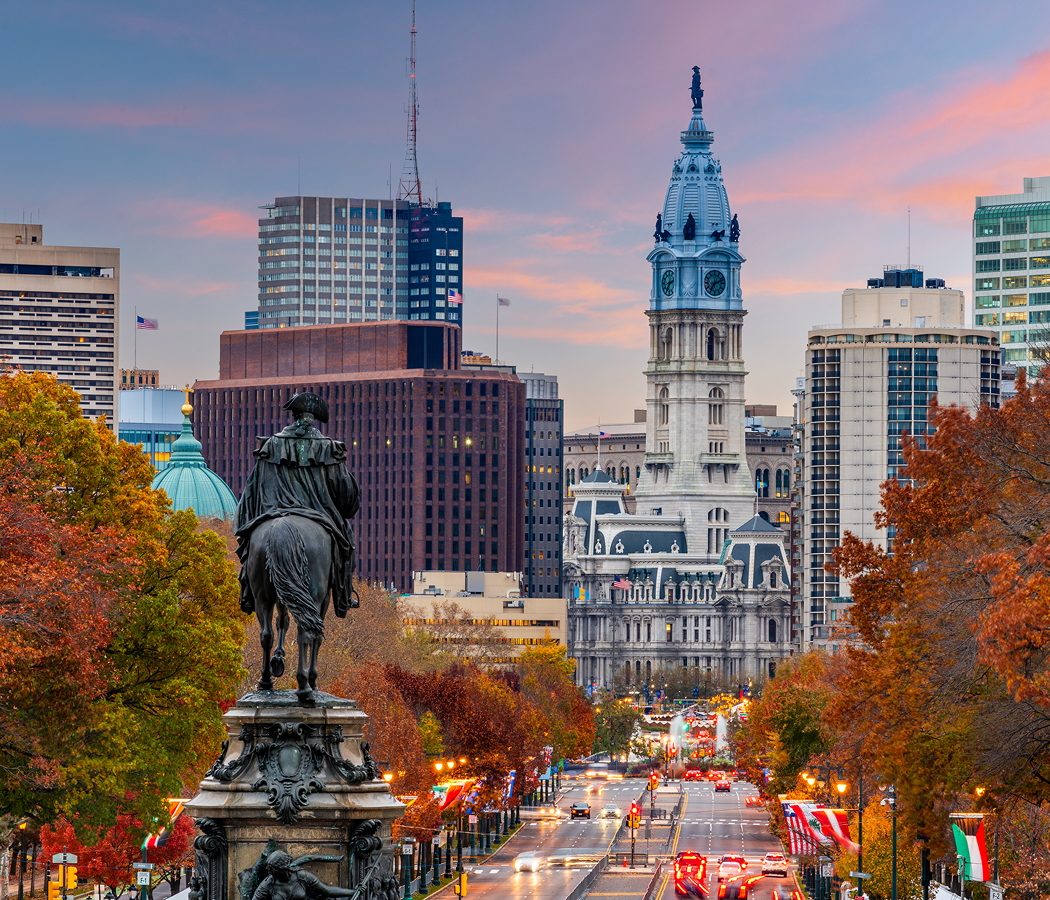
Start at City Hall and look northwest: the sightline stretches perfectly to the “Rocky Steps” of the Philadelphia Museum of Art, framed by flags and trees that guide you like a visual compass. Stroll past LOVE Park and pause at Logan Circle, where Swann Memorial Fountain shimmers beneath the open sky, a masterpiece in motion. From there, wander toward the cultural corridor: stop at the Barnes Foundation for its luminous art collection, step into the Rodin Museum's quiet garden, or explore the Franklin Institute's electric energy. As you approach the Art Museum, turn back, the skyline unfolds behind you, each building a note in the city's ongoing symphony. Visit in the morning for solitude or in the evening when the lights reflect on the pavement like a river of stars. Whether you're walking, biking, or simply watching the world drift by, Benjamin Franklin Parkway invites you to slow down, to rediscover elegance, proportion, and purpose in a world that rarely pauses.
Where your story begins.
Foresyte Travel reveals places that feel extraordinary long before you arrive.
Enjoy editorial crafted for luxury travelers.
Foresyte may earn a commission when you book.