
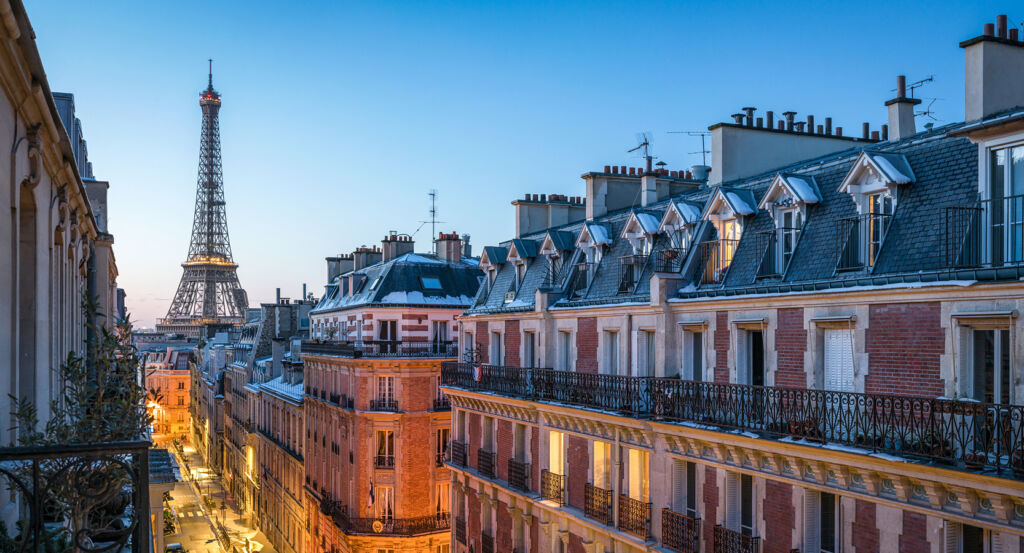
Why you should experience Best Western Plus Opéra Batignolles in Paris, France.
Best Western Plus Opéra Batignolles is an unassuming four-star hotel where Batignolles's village memory, railway inheritance, garden culture and contemporary neighborhood confidence converge within a compact Rue de Rome address.
Set along Rue de Rome near Rue Cardinet and just steps from Pont Cardinet, the 44-room property occupies the seam between the nineteenth-century Batignolles streets and the newer district extending northward around the former railway lands. Upper-floor rooms look toward Montmartre and the neighborhood gardens, while a complete refurbishment introduced bright colors, contemporary furniture and contrasting materials across an inventory ranging from Classic rooms to a Junior Suite. The lounge develops the house-scale atmosphere through an Honesty Bar accessible throughout the day and night, preserving a communal element within an otherwise deliberately streamlined property. The result is a hotel where small scale, residential surroundings and exceptional transport access capture Batignolles as a Paris neighborhood still capable of functioning with the intimacy of the independent settlement it once was.
What you should know about Best Western Plus Opéra Batignolles.
Best Western Plus Opéra Batignolles is best known for operating only 44 rooms at 165 Rue de Rome within Batignolles, the former independent commune of Batignolles-Monceau that existed outside Paris before its territory was incorporated into the capital in 1860. The fully refurbished accommodation program currently spans Classic, Superior, Deluxe, Triple Deluxe and Junior Suite categories, with Queen beds defining Superior rooms, King beds defining Deluxe rooms and upper-floor accommodations opening views toward Montmartre and the Batignolles gardens. Best Western documents contemporary furniture, bright colors and unusual materials as the organizing style of the renovation, while guestrooms incorporate minibars, coffee facilities and flat-screen televisions within the compact four-star format. Pont Cardinet station stands 100 meters from the hotel, while Rome Métro is 800 meters away, positioning the property at a transport junction whose railway presence has shaped this edge of Batignolles since the nineteenth century. The property additionally holds Green Key certification, placing an independently assessed environmental program alongside its 44-room scale and completely renewed interiors.
The hotel's room hierarchy gives the renovation more definition than its restrained footprint initially suggests, progressing from Double Classic accommodations through Queen-bedded Superior rooms to King-bedded Deluxe rooms, Triple Deluxe configurations and the property's Junior Suite. The ground floor follows the same emphasis on flexible use through a lounge whose Honesty Bar remains available at any hour, allowing the communal space to shift naturally from coffee and conversation into an evening drink. Best Western's current environmental program adds Green Key certification, while guestroom specifications incorporate recycling provisions, LED lighting and environmentally oriented amenities within the operating model. Together, the 44-room inventory, complete refurbishment, five-category accommodation structure, Honesty Bar and Green Key certification define a property whose factual interest lies in disciplined small-scale hospitality rather than performance, an approach particularly compatible with Batignolles's residential character.
How to fold Best Western Plus Opéra Batignolles into your trip.
Best Western Plus Opéra Batignolles works as the anchor for an afternoon tracing the gardens, architecture and theatrical culture that grew from Batignolles's nineteenth-century emergence as a community beyond Central Paris.
Begin at Square des Batignolles, created in 1862 by Jean-Charles Adolphe Alphand as a 1.66-hectare English-style garden, where a waterfall, stream, lake and rare trees translated Napoleon III's enthusiasm for English landscaping into one of the district's defining public spaces. Continue to Église Sainte-Marie des Batignolles, whose first construction began under architect Auguste Isidore Molinos in the 1820s with financial support from Charles X and the duchesse d'Angoulême, before subsequent expansion accompanied the rapid growth of the newly created Batignolles-Monceau commune. Conclude at Théâtre Hébertot, where an 1838 theater designed by Adolphe Azémar developed from Théâtre des Batignolles into Théâtre des Arts before Jacques Hébertot took control in 1940, beginning three decades associated with performers and playwrights including Gérard Philipe, Jean Cocteau, Albert Camus and Edwige Feuillère. The progression moves from Alphand's carefully engineered landscape through the parish architecture of an expanding nineteenth-century community into a theater that carried Batignolles onto the Parisian stage, revealing the village institutions and cultural ambition surrounding Best Western Plus Opéra Batignolles.
Where your story begins.
Foresyte Travel reveals places that feel extraordinary long before you arrive.
Experience premium editorial crafted for luxury travelers.














































































































