
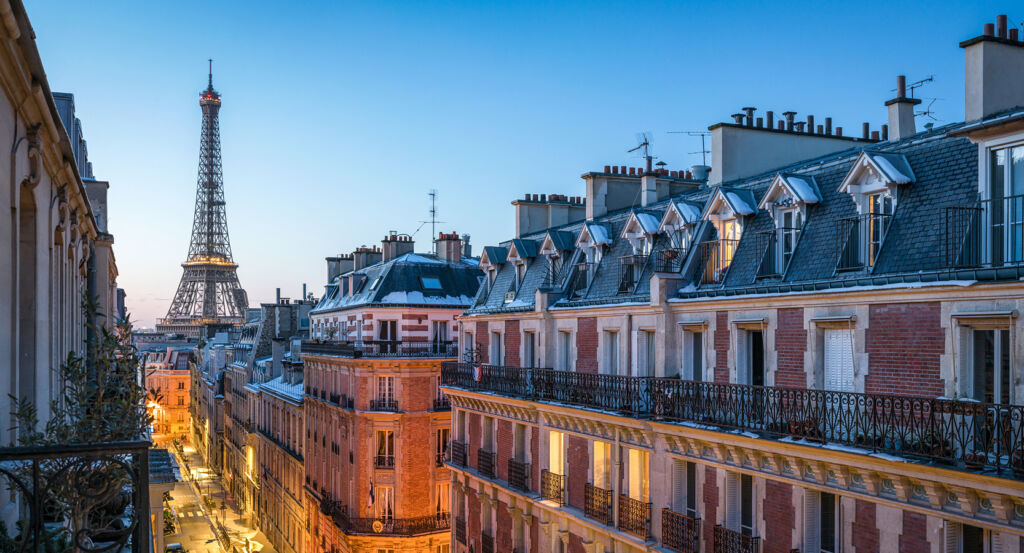
Why Batignolles matters.
Batignolles is a village-like enclave where northwestern Paris meets the former countryside beyond the old capital through sloping residential streets, intimate squares and a nineteenth-century urban fabric that still carries the scale of an independent commune.
Positioned between Épinettes, Plaine Monceau, and the Europe quarter, the neighborhood occupies a northwestern pocket where Rue des Batignolles, Rue des Dames and Rue Legendre cross an inherited street network stretching toward the railway corridor at Pont Cardinet. Five- and six-story apartment houses alternate with lower buildings, recessed courtyards and irregular intersections, preserving changes in scale created as country houses and garden plots disappeared beneath successive waves of nineteenth-century construction. Rue des Batignolles establishes the primary encounter through a commercial spine descending toward Place de Clichy, with short side streets repeatedly opening into quieter residential blocks set behind the principal route. Streets around Place du Docteur-Félix-Lobligeois deepen that character through curved alignments, mature trees and closely spaced facades that retain the spatial intimacy of the settlement preceding annexation, even as denser Parisian construction surrounds them. The northern edge introduces a striking change beside the railway cutting, where bridges, tracks and later development expose the infrastructure that divided the former commune and connected its growth to the expanding Saint-Lazare network. The result is a neighborhood whose village proportions, inherited routes and metropolitan edges remain simultaneously legible, preparing a history in which suburban development produced an independent municipality before Paris absorbed Batignolles into the seventeenth Arrondissement.
What defines Batignolles.
Batignolles is best known for developing from a sparsely populated settlement belonging to Clichy into the center of Batignolles-Monceau, an independent commune whose rapid nineteenth-century growth preceded its incorporation into Paris in 1860. The territory remained associated with the Dames de Montmartre until the Revolution, and prosperous merchants began establishing country residences across its semi-rural ground during the opening decades of the nineteenth century. Development accelerated under the First Empire when the Navarre and Rivoire enterprise subdivided land for small houses with gardens, followed by larger residential buildings aimed at households seeking lower costs beyond Paris. Population expansion pushed Batignolles and neighboring Monceau toward a new political status, and the settlements separated from Clichy in 1830 to form Batignolles-Monceau with 3,500 inhabitants. Independence generated the institutions of a self-contained town, including its own municipal administration, market and cemetery, as population continued to climb. Railway expansion then cut directly through the young commune as the Saint-Lazare system pushed northwest, introducing a deep rail trench and extensive freight facilities into territory that had recently consisted of suburban streets and open ground. The law of June 16, 1859 expanded Paris to the Thiers fortifications, and Batignolles-Monceau entered the capital on January 1, 1860 as part of the newly formed seventeenth Arrondissement. The former village reached metropolitan status through a compressed sequence of speculative subdivision, demographic expansion, municipal independence and annexation that remains fundamental to the structure of the modern neighborhood.
Artistic life supplied a separate mechanism through which Batignolles acquired significance during the decades following annexation. Édouard Manet lived in the district, and the Café Guerbois on Avenue de Clichy became a gathering point for painters and writers challenging the conventions of the official Salon. Frédéric Bazille moved into a larger Batignolles studio with Pierre-Auguste Renoir in early 1868, placing them near gatherings attended by Manet, Edgar Degas, Henri Fantin-Latour, Émile Zola, Zacharie Astruc and Edmond Duranty. Bazille painted his studio on Rue La Condamine in 1870, placing friends inside the working environment through which artistic exchange had become embedded in the quarter. Fantin-Latour gave the association its most durable collective image with Un atelier aux Batignolles, exhibited at the Salon of 1870, arranging Manet at the easel beside Renoir, Astruc, Zola, Edmond Maître, Bazille and Claude Monet. The painting captured a network formed before Impressionism received its name, connecting artists who would pursue distinct careers through the social geography of studios and cafés concentrated around Batignolles. That concentration made the neighborhood part of the prehistory of Impressionism itself, with residential proximity and recurring encounters helping bind together figures engaged in redefining modern French painting.
How Batignolles fits.
Batignolles works as the anchor for an afternoon connecting the parish church built for its surging pre-annexation population, a village theater that became a major twentieth-century stage and a banker's neo-Renaissance residence later converted for an entirely different public purpose.
Begin at Église Sainte-Marie-des-Batignolles, whose construction followed the neighborhood's extraordinary demographic rise during the 1820s, when Dr. Lemercier organized a subscription to provide the growing settlement with a chapel. Architect Molinos fils built the initial nave and four-column peristyle, consecrated on October 4, 1829, before Batignolles-Monceau became an independent commune the following year and the chapel became its parish church in 1831. Paul-Eugène Lequeux expanded the building in 1841 with a choir and lateral chapels, and another enlargement in 1851 added aisles as the local population reached 40,000, turning successive architectural campaigns into a physical measure of the village's growth. Continue to Théâtre Hébertot, whose ancestry begins with Besançon Souchet's 1830 attempt to establish a performance venue despite the Sévestre brothers holding the royal theatrical privilege for Paris and surrounding settlements. Souchet commissioned Torasse to create a hall capable of conversion for performances, and after that first venture closed, a new theater received authorization in 1838; later directors developed the house before Robert d'Humières renamed it Théâtre des Arts, Jacques Rouché brought figures including Jacques Copeau, Charles Dullin and Louis Jouvet into its orbit, and Georges Pitoëff staged numerous productions there between 1925 and 1931. Jacques Hébertot reopened the theater under his own name in 1940 and directed it until 1970, carrying a village entertainment institution into the modern Paris stage tradition. Conclude at Cité de l'Économie inside Hôtel Gaillard, commissioned after banker and collector Émile Gaillard acquired two adjoining plots in 1878 to house a medieval and Renaissance art collection that had outgrown his previous residence. Jules Février designed the residence between 1878 and 1884 with polychrome brick, sculpted decoration, steep roofs and turrets drawing on French Renaissance châteaux; the commission strengthened the 36-year-old architect's career and earned him the Grande médaille d'architecture. Gaillard also developed two neighboring private houses on the property, creating an ensemble whose later conversion from collector's residence to banking premises and then an economics museum carried the site through three distinct institutional lives. The progression moves from a parish church repeatedly enlarged to match a surging suburban population through a theater carrying village performance into twentieth-century dramatic culture into Gaillard and Février translating private collecting into ambitious residential architecture, tracing the civic, theatrical and bourgeois institutions that accompanied Batignolles from independent settlement into metropolitan Paris.
Where your story begins.
Foresyte Travel reveals places that feel extraordinary long before you arrive.
Enjoy editorial crafted for luxury travelers.
Foresyte may earn a commission when you book.














































































































