
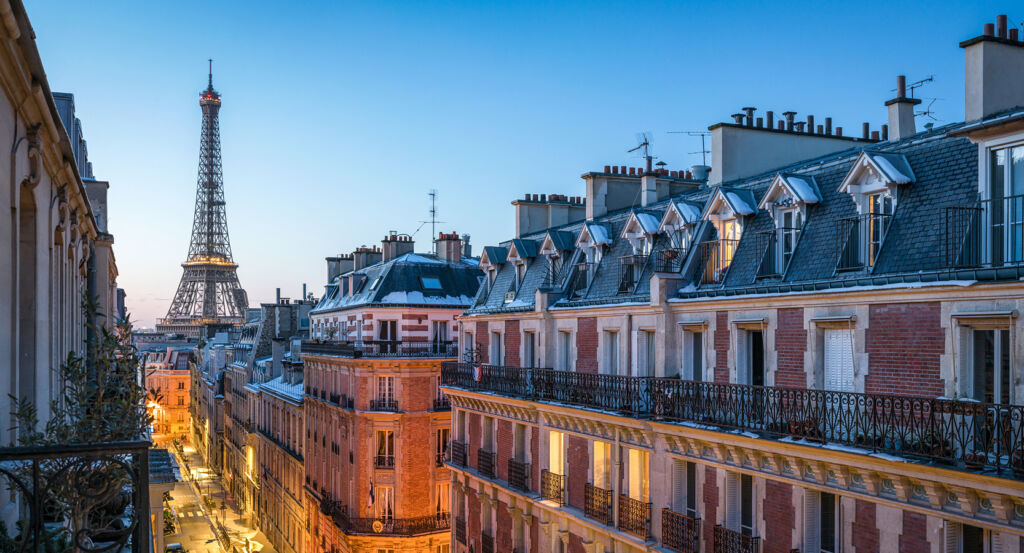
Why Épinettes matters.
Épinettes is a textured enclave where the northern edge of Batignolles meets Paris's former industrial belt through long residential streets, secluded passages and a working-class urban fabric created as fields gave way to railways, factories and dense nineteenth-century housing.
Positioned between Batignolles, Grandes-Carrières, and Saint-Ouen, the neighborhood occupies a northern Paris pocket where Avenue de Clichy, Avenue de Saint-Ouen and Boulevard Bessières frame a dense interior crossed by Rue de la Jonquière and Rue Guy Môquet. Apartment buildings rise directly from narrow pavements across much of the southern quarter, then give way toward the north to broader railway ground, planted spaces and blocks carrying the larger dimensions of Paris's outer edge. Rue de la Jonquière establishes the primary encounter through a long internal spine where shops, residential facades and side streets reveal the neighborhood at a slower scale than the avenues enclosing it. Smaller streets branching toward Rue des Épinettes deepen the physical character through courtyards, passages and irregular blocks inherited from successive phases of subdivision. The northern reaches change the rhythm again as the Petite Ceinture corridor and territory around Porte de Clichy introduce the infrastructural breadth that accompanied industrial expansion beyond nineteenth-century Central Paris. The result is a neighborhood whose close residential grain remains inseparable from the railways and manufacturing that accelerated its growth, preparing a history rooted in the conversion of agricultural ground into one of the seventeenth Arrondissement's densest urban districts.
What defines Épinettes.
Épinettes is best known for emerging from the rapid nineteenth-century transformation of agricultural territory belonging principally to Batignolles-Monceau into an industrial and working-class district absorbed by Paris in 1860. Batignolles and Monceau had separated from Clichy to form their own commune in 1830, when their combined population stood near 3,500 and speculative construction was already replacing open ground with houses intended for residents drawn beyond the expensive central city. Industrialization accelerated the change as railway engineering concentrated along the northwestern approaches to Paris. Ernest Goüin established his construction enterprise in Batignolles in 1846, developing a company whose work expanded through locomotives, metal engineering, bridges and railway construction before becoming the Société de Construction des Batignolles. Industrial employment drew workers into adjoining Épinettes as the expanding railway economy converted peripheral land into tightly built streets. Annexation in 1860 incorporated most of Batignolles-Monceau into Paris and created the modern seventeenth Arrondissement, with the Épinettes quarter assembled principally from the former commune and an additional portion of Saint-Ouen. Subdivision after annexation intensified residential construction until Épinettes became the Arrondissement's most densely built quarter, fixing a social and architectural character distinct from the more affluent development spreading across Plaine Monceau.
Public landscape supplied another mechanism for changing Épinettes as the dense district acquired spaces dedicated to recreation, commemoration and social reform. Square des Épinettes emerged on the former municipal paving-stone depot during a development campaign beginning in the late 1870s, with Jean-Camille Formigé shaping a one-hectare garden around tree-lined paths and a central music kiosk. A purple beech planted in 1879 survives from that early landscape, joining mature horse chestnuts, ginkgos, evergreen oaks and other species introduced across the garden. Sculpture subsequently turned the square into a site of civic memory. Aimé-Jules Dalou created the monument to Jean Leclaire, the building-painting entrepreneur who established a mutual-aid society for his employees and introduced worker participation in company profits; subscriptions initiated by his workers helped finance the bronze, inaugurated in 1896 with Formigé contributing its architectural component. The occupation of Paris brought the sculpture's destruction in 1943, followed by its restoration in 1971. A second monument honors Maria Deraismes, the writer and campaigner who co-founded the international mixed Masonic order Le Droit Humain, linking the garden to another current of nineteenth-century social reform.
How Épinettes fits.
Épinettes works as the anchor for a daytime exploration connecting a private residential experiment born during industrial expansion, a twentieth-century church completed across two decades and a cemetery whose growth traces the former commune into metropolitan Paris.
Begin at Cité des Fleurs, created in 1847 as a 320-meter private street linking the present Rue Guy Môquet with Rue de la Jonquière during the period when industrial growth was transforming the agricultural ground of Épinettes. Its founding convention imposed an unusually coordinated residential scheme: facades followed prescribed alignment, opposing entrance gates faced one another, garden owners planted three flowering trees and individual pilasters carried Medici vases assigned distinct floral varieties. The enclave later entered wartime history at number 25, headquarters of Plutus, a major clandestine false-document network raided by the Gestapo on May 18, 1944, connecting a nineteenth-century residential project with the Resistance during the occupation. Continue to Église Saint-Michel des Batignolles, where Bernard Haubold began a brick-and-reinforced-concrete church in 1913 after two provisional predecessors had served the surrounding population since 1858 and 1903. The First World War interrupted construction, and the campanile reached completion in 1934 with a gilded repoussé-copper replica of Emmanuel Frémiet's archangel from Mont-Saint-Michel; Haubold combined a basilical plan with Romano-Byzantine forms, even though substantial portions of his proposed polychrome brick and mosaic decoration remained unrealized. An organ acquired in 1937 from the former Hôtel Majestic added another layer to a building whose extended construction history spans the upheavals of early twentieth-century Paris. Conclude at Cimetière des Batignolles, founded in 1833 for the newly independent commune of Batignolles-Monceau and expanded in 1841 and 1883 as the surrounding population grew. Annexation brought the cemetery inside Paris in 1860 after the Thiers fortifications divided the former commune, and its successive enlargements remain visible in the changing organization of its grounds; 15,000 graves now occupy eleven hectares, including the burial places of Paul Verlaine, André Breton and Blaise Cendrars, before a 440-meter section of the Boulevard Périphérique was carried above the cemetery in 1969. The progression moves from a regulated residential enclave created amid nineteenth-century expansion through Haubold's prolonged experiment in brick, concrete and religious architecture into a communal burial ground absorbed beneath the infrastructure of metropolitan Paris, tracing the extraordinary physical changes that accompanied Épinettes from peripheral settlement to capital.
Where your story begins.
Foresyte Travel reveals places that feel extraordinary long before you arrive.
Enjoy editorial crafted for luxury travelers.
Foresyte may earn a commission when you book.














































































































