
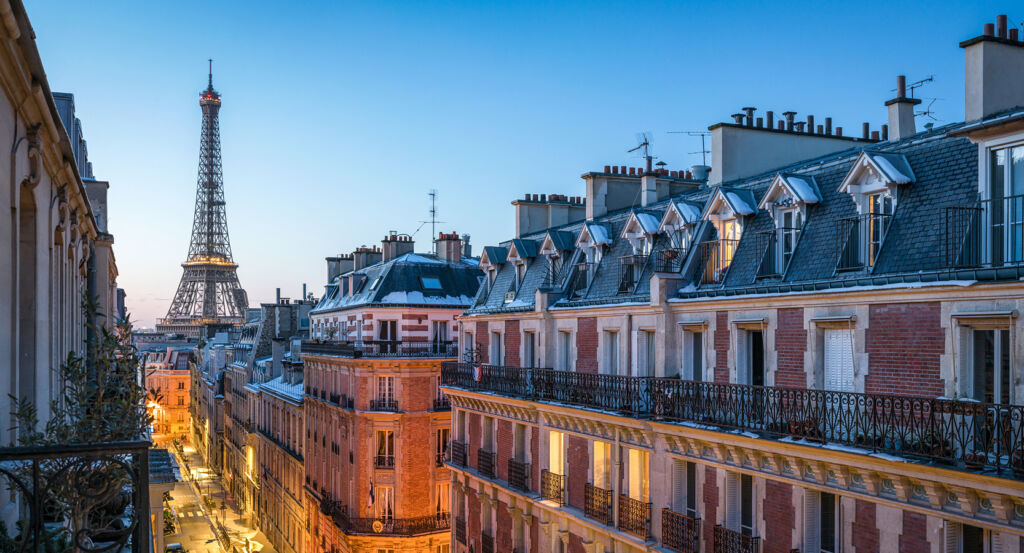
Why Plaine-Monceau matters.
Plaine-Monceau is an elegant enclave where the broad geometry of Second Empire Paris meets a late nineteenth-century residential quarter through tree-lined avenues, ornate apartment houses, private mansions and artist studios built across what had remained open countryside into the 1850s.
Positioned between Batignolles, Ternes, and Monceau, the neighborhood occupies a northwestern Parisian plateau where Avenue de Villiers, Boulevard Malesherbes and Avenue de Wagram cut through an unusually coherent network of broad streets extending from Boulevard de Courcelles toward the city limits. Stone apartment houses establish long architectural sequences, yet private mansions, garden walls and recessed entrances repeatedly interrupt those alignments, preserving the lower density favored during the district's first decades of construction. Avenue de Villiers establishes the primary encounter through an extended residential axis where elaborate facades and former studios capture the competition among architects working for affluent clients during the Third Republic. Streets around Place du Général Catroux deepen the physical character through freestanding residences, planted setbacks and radiating approaches that give individual buildings greater visual independence than the tighter blocks of Central Paris. Boulevard Pereire adds another spatial register through its elongated planted median and railway-derived course, carrying the district's planned geometry toward Porte de Champerret. The result is a neighborhood whose unusual architectural consistency grew from the rapid conversion of agricultural ground into one of nineteenth-century Paris's most ambitious residential districts.
What defines Plaine-Monceau.
Plaine-Monceau is best known for its rapid nineteenth-century conversion from agricultural land into a planned bourgeois district shaped by the railway investments and property operations of Émile and Isaac Pereire. The territory had belonged to the parish of Clichy, with the old Monceau hamlet clustered around present-day Rue de Lévis and a plateau stretching across cultivated ground toward the Seine. Hunting occupied substantial tracts under the Ancien Régime, and residents destroyed game preserves in 1791 after animals damaged surrounding crops; only 450 people inhabited the settlement during the Revolutionary period. Batignolles-Monceau became an independent commune in 1830, yet an ambitious 1837 subdivision scheme failed, leaving most of the plain agricultural into the following decade. A decisive change arrived with the Pereire brothers' Ligne d'Auteuil, whose development brought Boulevard Pereire across the territory in 1854 and established the first major new artery through the open plain. Haussmann simultaneously directed a broader street scheme whose principal axes incorporated present-day Boulevard Malesherbes, Avenue de Villiers and Avenue de Wagram. Annexation brought Batignolles-Monceau into Paris in 1860, placing the new district inside the enlarged capital just as land development accelerated. Construction intensified during the 1870s and 1880s, when architects filled the new streets with private mansions and artist residences before apartment buildings became more prevalent during the 1890s and early twentieth century. A short development window and a street system largely created independently of older rural routes gave Plaine-Monceau an architectural coherence unusual among Parisian districts assembled through centuries of incremental change.
Artistic society supplied a separate mechanism for the district's rise after its street network had been established. The abundance of undeveloped plots and affluent patrons encouraged architects to treat private residences as individual commissions, producing houses that ranged across Greek and Roman references, Renaissance revival, Louis XVI forms and eclectic combinations drawn from several periods. Artist studios became another conspicuous building type, joining large windows and specialized working rooms to residences created for painters, sculptors and performers. Sarah Bernhardt established herself in the quarter, as did Alexandre Dumas fils, Edmond Rostand, Tristan Bernard, Charles Gounod and Gabriel Fauré, creating a concentration of cultural figures across the new residential streets. Guillaume Dubufe belonged to the same artistic geography, occupying a purpose-built residence and studio on Avenue de Villiers during a period when the avenue became closely associated with successful painters. Private salons connected these households with the broader artistic society of the Third Republic, allowing domestic architecture to support performance, collecting and professional exchange alongside family residence. The district matured through a close relationship between speculative urban development and a cultural class able to commission individualized architecture on newly created streets.
How Plaine-Monceau fits.
Plaine-Monceau works as the anchor for an afternoon tracing Swedish religious life in Paris, the architectural ambitions of an international Asian art dealer and the conversion of a painter's residence into a national museum.
Begin at Église Suédoise de Paris, whose congregation reaches back to 1626, when pastor Jonas Hambraeus and Scandinavian and German nobles celebrated Lutheran communion during a diplomatic mission to Paris. A first dedicated Sophia Church opened on Boulevard Ornano in 1878, but its distance from the Swedish community prompted another search for permanent premises; the cornerstone of the present Rue Médéric church was laid by the Duchess of Södermanland on June 26, 1911, and the building opened on April 16, 1913 with a larger complex supporting religious, educational and social activity. Its assembly hall subsequently became a British Red Cross field hospital during the First World War and later accommodated Swedes facing hardship during the Second World War. Continue to Maison Loo, where Chinese art dealer Ching Tsai Loo commissioned architect François Bloch in 1925 to transform a conventional nineteenth-century hôtel particulier into a red, Chinese-inspired building created for the presentation and sale of Asian art. Loo had arrived in Paris in 1902 and developed an international art business before remaking the Rue de Courcelles property with upturned roofs, a Chinese gateway and interiors incorporating lacquer panels, turning the building itself into an architectural statement for the objects circulating through his gallery. Conclude at Musée national Jean-Jacques Henner, housed in the Avenue de Villiers residence Nicolas-Félix Escalier designed in 1878 for painter Roger Jourdain before Guillaume Dubufe made the house his residence and studio. Marie Henner acquired the property from Dubufe's heirs in 1921 to establish a museum devoted to Jean-Jacques Henner, whose paintings, drawings and preparatory work entered a domestic environment associated with the artistic society of the same period; the museum opened in 1924 and became a national institution in 1943. The progression moves from a seventeenth-century expatriate congregation acquiring a permanent twentieth-century home through C. T. Loo reshaping Parisian residential architecture around the international circulation of Asian art into a painter's house becoming the institutional home of another artist's work, revealing how Plaine-Monceau's residential fabric absorbed religious, commercial and artistic ambitions from far beyond its streets.
Where your story begins.
Foresyte Travel reveals places that feel extraordinary long before you arrive.
Enjoy editorial crafted for luxury travelers.
Foresyte may earn a commission when you book.














































































































