
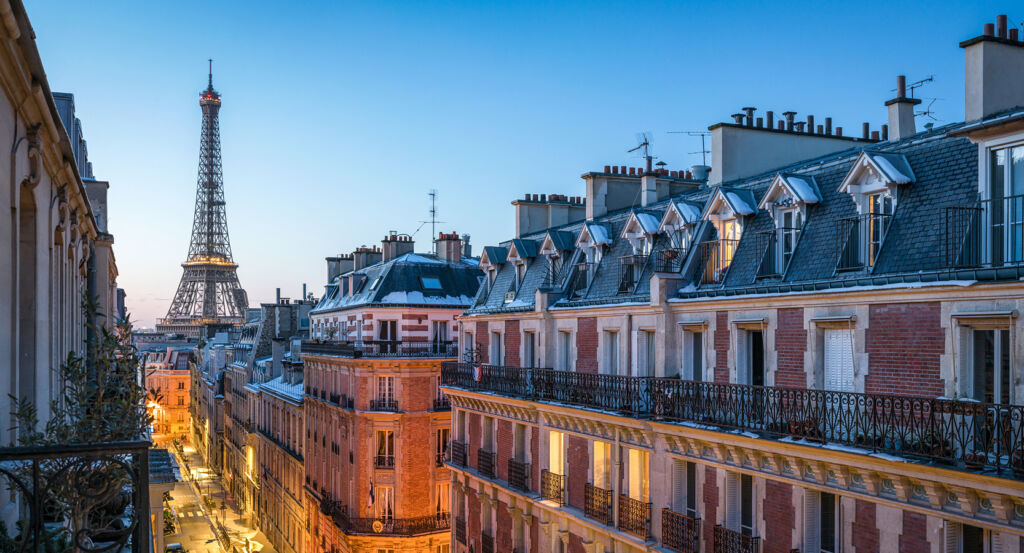
Why Boulevard Richard-Lenoir matters.
Boulevard Richard-Lenoir is a spirited Enfants-Rouges corridor where Haussmannian urban planning, entrepreneurial innovation, neighborhood markets, and contemporary Parisian life converge along one of the capital's most distinctive boulevards.
Running through Enfants-Rouges between Place de la Bastille and Place de la République, this expansive boulevard unfolds through tree-lined promenades, celebrated open-air markets, elegant Haussmann architecture, neighborhood cafés, landscaped medians, and lively public spaces that embody the character of eastern Paris. Broad pedestrian walkways, mature plane trees, thriving terraces, and generous green spaces create an atmosphere where residents, shoppers, and visitors experience one of the city's most inviting urban landscapes. Every section of the boulevard reveals another chapter in the remarkable transformation of nineteenth-century Paris into a modern metropolis. The result is a corridor defined by architectural elegance, civic vitality, and one of Paris' most beloved neighborhood avenues.
What defines Boulevard Richard-Lenoir.
Boulevard Richard-Lenoir is best known for covering the Canal Saint-Martin, whose waters continue flowing beneath its broad landscaped medians after engineer Pierre-Simon Girard completed the canal in 1825 under Napoleon Bonaparte's ambitious program to improve Paris' drinking water supply, commercial transport, and sanitation. Originally named Boulevard du Prince-Eugène before being renamed in 1870, the avenue honors industrial pioneers François Richard and Joseph Lenoir-Dufresne, whose innovations in textile manufacturing helped transform French industry during the late eighteenth and early nineteenth centuries. Baron Haussmann later incorporated the boulevard into his sweeping reconstruction of Paris, concealing much of the canal beneath elegant promenades while preserving strategically placed basins and locks that remain visible farther north along Canal Saint-Martin. The boulevard also hosts the renowned Marché Richard-Lenoir, among Paris' largest and most celebrated open-air markets, where hundreds of vendors continue a longstanding tradition of neighborhood commerce beneath the boulevard's double rows of plane trees. Beyond its engineering and commercial significance, Boulevard Richard-Lenoir has achieved lasting literary fame as the longtime fictional home of Georges Simenon's Inspector Jules Maigret, whose police headquarters at nearby Quai des Orfèvres and investigations around the boulevard introduced generations of readers to the everyday rhythms of Parisian life. Together, these achievements establish the avenue as a remarkable intersection of engineering, urban planning, commerce, literature, and civic design.
Historic canal infrastructure, expansive landscaped promenades, energetic market traditions, and carefully preserved Haussmannian streetscapes continue demonstrating how nineteenth-century engineering successfully merged transportation, public health, and urban beauty within a single boulevard. The enduring relationship between the concealed Canal Saint-Martin, thriving neighborhood commerce, and one of French literature's most enduring fictional detectives demonstrates why Boulevard Richard-Lenoir remains one of the capital's most distinctive civic corridors. Few Parisian boulevards combine hydraulic engineering, industrial history, literary heritage, and everyday neighborhood life with such remarkable continuity.
How Boulevard Richard-Lenoir fits.
Boulevard Richard-Lenoir works as an exploration through Enfants-Rouges' celebrated markets, historic boulevards, and neighborhood landmarks.
Begin at Place de la Bastille, where one of France's most significant revolutionary sites introduces the historical importance of the district before strolling beneath Boulevard Richard-Lenoir's tree-lined promenades. Continue through the Marché Richard-Lenoir, where one of Paris' finest open-air markets showcases the city's celebrated culinary traditions and neighborhood character. Conclude at Place de la République, where France's great republican monument provides a memorable finale celebrating the remarkable relationship between civic history, urban planning, and contemporary Parisian life. The progression moves naturally from revolutionary heritage to energetic local culture before culminating in one of the nation's defining public squares, revealing why Boulevard Richard-Lenoir remains one of Paris' most rewarding urban avenues.
Where your story begins.
Foresyte Travel reveals places that feel extraordinary long before you arrive.
Experience premium editorial crafted for luxury travelers.
Foresyte Travel may earn a commission when you book through the link on this page.














































































































