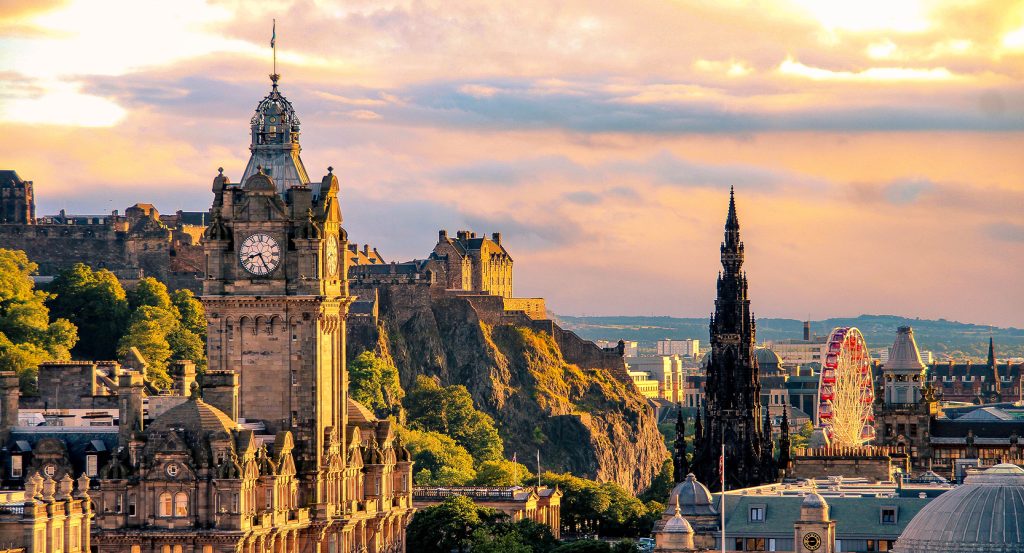
Why Calton Hill matters.
Calton Hill is a commanding volcanic summit where Edinburgh's Georgian civic ambition meets the classical architecture of the Scottish Enlightenment, the scientific achievements of nineteenth-century astronomy and the national commemorations that shaped the capital's eastern skyline.
Rising above the eastern end of Princes Street between the New Town and Abbeyhill, the historic hill occupies an elevated volcanic outcrop overlooking Edinburgh's central valley, with its western slopes descending toward the city's principal shopping district and its eastern approaches extending toward the Palace of Holyroodhouse. Grassy terraces, exposed rock and winding paths connect a collection of freestanding stone monuments across the summit. Classical columns and temple-inspired structures stand against an open skyline, their pale sandstone contrasting with the surrounding vegetation. The southern slopes overlook the railway corridor and the tightly arranged buildings of the Old Town. The result is a distinctive civic landscape whose geological prominence, neoclassical architecture and expansive views preserve Edinburgh's ambitions as an intellectual and cultural capital.
What defines Calton Hill.
Calton Hill is best known for its concentration of neoclassical monuments, developed during Edinburgh's nineteenth-century expansion as a center of scholarship, government and national commemoration. The hill originated from volcanic activity associated with the geological formation of the Edinburgh area during the Carboniferous period. Its exposed rock and elevated position subsequently influenced the development of surrounding settlements and transportation routes. Medieval Edinburgh expanded along the ridge connecting its castle with the royal precinct at Holyrood, leaving Calton Hill beyond the principal fortified urban center. The hill's name became associated with the surrounding Calton district, whose development accelerated as Edinburgh expanded eastward during the eighteenth century. The construction of the North Bridge, completed in 1772, strengthened connections between the Old Town and the emerging New Town, encouraging further urban growth around the eastern approaches. Edinburgh's intellectual prominence during the Scottish Enlightenment supported increasing interest in classical architecture, scientific institutions and civic improvement. The city's architectural ambitions acquired particular force during the early nineteenth century, when public monuments became prominent expressions of national achievement. The Nelson Monument was constructed between 1807 and 1816 to commemorate Admiral Horatio Nelson's victory and death at the Battle of Trafalgar in 1805. Architect Robert Burn designed the tower, whose castellated form introduced a distinctive vertical feature to the summit. The City Observatory developed through successive building campaigns, including William Henry Playfair's neoclassical observatory building completed in 1818. Its construction established Calton Hill as an important location for astronomical observation and scientific activity. The National Monument of Scotland was conceived as a memorial to Scottish soldiers and sailors who died during the Napoleonic Wars. Construction began in 1826 under the architectural direction of Charles Robert Cockerell and William Henry Playfair, drawing inspiration from the Parthenon in Athens. Financial difficulties halted the project in 1829, leaving the surviving columns and entablature as an unfinished classical structure. The Dugald Stewart Monument followed in 1831, commemorating the philosopher whose teaching contributed to Edinburgh's Enlightenment reputation. Playfair designed the circular monument using the Choragic Monument of Lysicrates in Athens as an architectural precedent. During the nineteenth and twentieth centuries, Calton Hill became increasingly associated with public ceremonies, political gatherings and panoramic views of the capital. Its architectural ensemble subsequently formed part of the Old and New Towns of Edinburgh World Heritage Site, inscribed by UNESCO in 1995.
William Henry Playfair's architectural contributions established a coherent classical character across several of the hill's most prominent structures. His designs employed Greek architectural precedents to express the intellectual ambitions of a city increasingly associated with European scholarship and scientific achievement. The Dugald Stewart Monument incorporates a circular arrangement of Corinthian columns supporting a decorative entablature and elevated roof. Its carefully proportioned composition creates a compact architectural counterpoint to the more substantial unfinished columns nearby. The City Observatory occupies a walled compound on the summit, incorporating buildings designed for astronomical observation and the accommodation of scientific instruments. The observatory's classical entrance and restrained masonry reflect the architectural conventions of early nineteenth-century institutional construction. Astronomical work on the hill developed through the efforts of scholars and instrument makers associated with Edinburgh's scientific community. The Royal Observatory's operations eventually transferred to Blackford Hill during the late nineteenth century, reflecting the changing requirements of astronomical research and the effects of urban expansion. The former City Observatory subsequently acquired new cultural functions, including its redevelopment as Collective, a center for contemporary art. The Nelson Monument incorporates a time ball installed in 1853, providing a visible signal used by ships in the Firth of Forth to regulate maritime chronometers. The ball's operation became associated with Edinburgh's One O'Clock Gun, introduced at the castle in 1861 to provide an audible time signal. This relationship connected the hill's scientific infrastructure with the practical requirements of maritime navigation. The surrounding summit preserves substantial areas of open ground, allowing the monuments to be viewed individually and in relation to the wider city. Its western terraces overlook the geometric street pattern of the New Town, and the southern slopes provide views toward the medieval skyline of the Old Town. The eastern panorama extends toward the volcanic landscape surrounding Holyrood Park and the waters of the Firth of Forth. The hill's surviving structures demonstrate the convergence of commemorative architecture, scientific development and urban planning during Edinburgh's period of nineteenth-century expansion.
How Calton Hill fits.
Calton Hill works as the architectural anchor for an Edinburgh outing connecting the capital's Georgian urban planning, its royal ceremonial history and the volcanic landscape that shaped the city's settlement and defensive geography.
Begin at the Scottish National Portrait Gallery, the distinctive red sandstone museum situated on Queen Street in Edinburgh's New Town. Designed by Robert Rowand Anderson and opened in 1889, the building was conceived as a purpose-built institution dedicated to Scotland's historical figures and cultural achievements. Its Gothic Revival exterior incorporates sculptural decoration associated with Scottish history, and the interior features an elaborate entrance hall decorated with murals by William Hole. The collections include portraits of monarchs, writers, scientists and political figures whose contributions shaped Scotland's development. The museum establishes a connection between the city's intellectual heritage and the individuals commemorated through its public institutions. Continue to the Palace of Holyroodhouse, the royal residence situated at the eastern end of the Royal Mile. The palace developed around the site of Holyrood Abbey, founded by David I in 1128, and acquired its principal surviving architectural form during the seventeenth century. Its state apartments preserve elaborate decorative interiors associated with Scottish and British royal history. The palace is particularly connected with Mary, Queen of Scots, whose sixteenth-century residence witnessed major political events, including the murder of David Rizzio in 1566. The adjoining abbey ruins preserve substantial medieval masonry, establishing the site's earlier religious importance. Conclude at Arthur's Seat, the prominent volcanic summit rising above Holyrood Park. Reaching 251 meters above sea level, the hill forms part of an extinct volcanic complex whose exposed rock reveals the geological processes that shaped Edinburgh's surrounding terrain. Walking routes ascend through grassland, rocky slopes and former quarry areas, providing extensive views across the capital and the Firth of Forth. The surrounding landscape includes Salisbury Crags, whose geological formations attracted the attention of eighteenth-century scientists investigating the origins of the Earth's rock structures. The progression moves from the Scottish National Portrait Gallery's national collections through the Palace of Holyroodhouse's royal history and culminates at Arthur's Seat's volcanic summit, connecting Calton Hill with the intellectual, political and geological foundations of Edinburgh.
Where your story begins.
Foresyte Travel reveals places that feel extraordinary long before you arrive.
Enjoy editorial crafted for luxury travelers.
Foresyte may earn a commission when you book.