
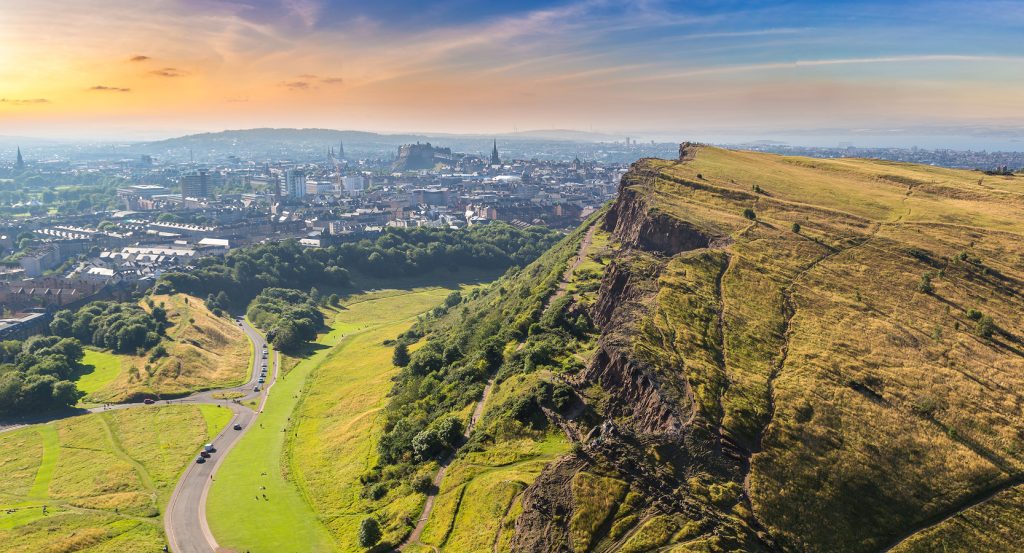
Why Arthur's Seat matters.
Arthur's Seat is an ancient volcanic summit where Holyrood's royal parkland, geological drama, Scottish legend, and Edinburgh's wild skyline rise into one of Britain's most unforgettable urban climbs.
Set along Queen's Drive near Holyrood Park Road and just steps from Palace of Holyroodhouse, this rugged ascent carries visitors through crags, grassland, glacial valleys, lochs, and exposed ridgelines before revealing a vast panorama across Edinburgh, the Firth of Forth, the Pentland Hills, and the surrounding Lowlands. Wind, stone, heather, and open sky shape every step as the city gradually falls away beneath a landscape formed by fire, ice, and centuries of human imagination. The climb feels both elemental and historic, transforming a walk above the capital into a direct encounter with Scotland's deep geological past. The experience ultimately combines natural power, mythic atmosphere, and commanding perspective into one of Edinburgh's defining outdoor experiences.
What defines Arthur's Seat.
Arthur's Seat is best known for rising 251 meters above Edinburgh as the highest point in Holyrood Park, preserving the eroded remains of an extinct Carboniferous volcano formed 340 million years ago and later sculpted by glacial movement into one of the most dramatic natural formations within any European capital city. The summit forms part of the Arthur's Seat Volcano site of special scientific interest, where basalt lava flows, volcanic vents, intrusive rocks, Salisbury Crags, and glacial landforms provide exceptional evidence of Scotland's deep geological history. Holyrood Park itself covers 650 acres and has served as royal hunting ground, military training landscape, public recreation space, and protected natural environment across centuries of Edinburgh history. The hill's name has long been associated with Arthurian legend, although its exact origin remains uncertain, while archaeological evidence across the park includes prehistoric hillfort remains, ancient cultivation terraces, medieval routes, and traces of human activity extending back thousands of years. The surrounding landscape also preserves Duddingston Loch, St. Margaret's Loch, Haggis Knowe, Hunter's Bog, and the dramatic Salisbury Crags, whose exposed rock faces helped shape early geological thinking during the Scottish Enlightenment through the work of James Hutton, whose observations around Edinburgh contributed to modern concepts of deep time. Today Arthur's Seat remains managed within Holyrood Park by Historic Environment Scotland, combining geological conservation, ecological protection, cultural heritage, and public access within one of the most extraordinary urban landscapes in Europe.
Ascending the summit reveals how volcanic eruption, erosion, glaciation, royal history, scientific discovery, and civic recreation have shaped a single landscape over immense spans of time. Steep paths, grassy shoulders, rocky outcrops, and exposed viewpoints allow visitors to read Edinburgh's geography directly from the terrain, with the medieval Old Town, Georgian New Town, Holyrood Palace, Calton Hill, and the Forth estuary arranged below in a single sweeping view. Protected habitats support grassland plants, birds, insects, and wetland ecosystems, while continuing conservation balances heavy public use with the preservation of fragile archaeological and geological features. Natural history, national memory, and physical exertion combine to create one of Scotland's most powerful city experiences.
How Arthur's Seat fits.
Arthur's Seat works as the centerpiece of an exploration through Holyrood's royal, natural, and historic landscapes.
Begin at Palace of Holyroodhouse, where Scotland's royal history establishes the cultural weight of the surrounding park before climbing Arthur's Seat for the city's most expansive natural viewpoint. Continue to Salisbury Crags, whose dramatic cliffs and geological significance deepen appreciation for the volcanic forces that shaped Holyrood Park. Conclude at Scottish Parliament Building, where Enric Miralles' bold contemporary architecture provides a compelling finale beside the historic slopes. The progression moves naturally from royal history to ancient geology before concluding through modern civic design, revealing why Holyrood remains one of Edinburgh's most powerful intersections of landscape, history, and national identity.
Where your story begins.
Foresyte Travel reveals places that feel extraordinary long before you arrive.
Enjoy editorial crafted for luxury travelers.
Foresyte may earn a commission when you book.














































































































