
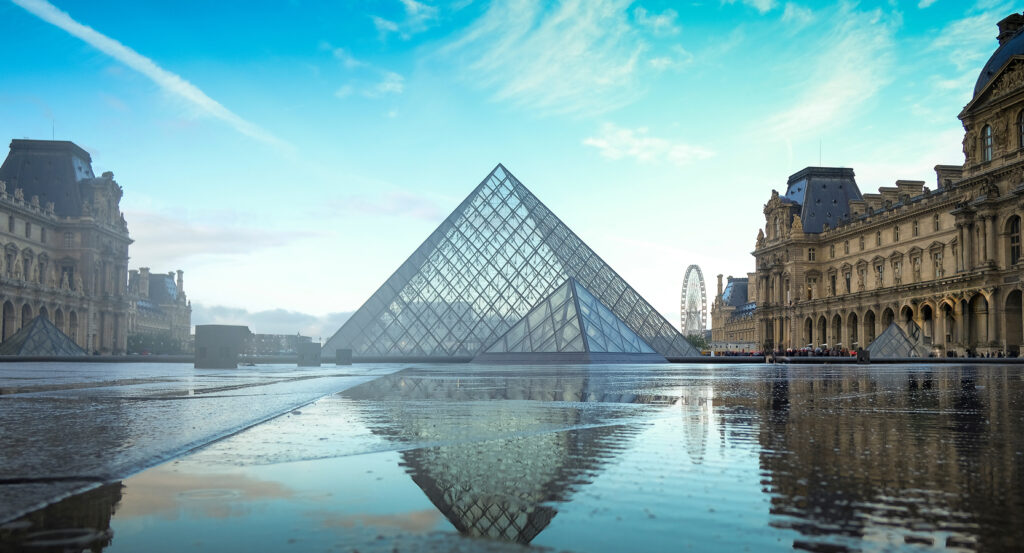
Why you should experience The Carrousel Garden in Paris, France.
Just beyond the Louvre's grandeur, the Carrousel Garden offers a rare exhale, a place where the city's intensity softens into elegance. It's a transitional space, suspended between art and air, where manicured lawns stretch toward the Tuileries and sculptures punctuate the paths like punctuation marks in a poem.
Walking through the Carrousel Garden feels like drifting through Paris's living heartbeat, the hush of fountains, the rhythm of footsteps on gravel, the distant hum of violins from the street performers. The garden's serenity is deceptive; it's surrounded by the pulse of the city, yet remains untouched by its haste. Sunlight filters through linden trees, scattering dappled patterns onto the grass, and for a fleeting moment, you understand the Parisian devotion to leisure as an art form. It's where the soul of the city reclines, unguarded and luminous.
What you should know about The Carrousel Garden.
The Carrousel Garden holds more secrets than its tranquil air would suggest. Its name hails from the 1662 “Grand Carrousel,” a lavish equestrian pageant ordered by Louis XIV to celebrate French military might, a performance of armor, music, and choreography that dazzled the court.
Long after the fanfare faded, the space was reborn as a public garden during Napoleon's reign, linking the Louvre to the Tuileries in a graceful axis of empire and elegance. Hidden among the hedges and statues are quiet symbols of that layered past: a sphinx here, a marble muse there, each telling its own story of conquest and creation. The Arc de Triomphe du Carrousel, with its pink marble columns and gilded horses, presides over the garden's entrance, not as a monument to war, but to the art of continuity. The garden has survived revolutions and restorations alike, its geometry unchanged, its purpose eternal, to remind Parisians that grandeur and stillness can coexist.
How to fold The Carrousel Garden into your trip.
To fold the Carrousel Garden into your Paris journey, treat it as more than a shortcut between landmarks, make it your interlude.
Enter from the Louvre's Cour Napoléon and let the symmetry guide you toward the Tuileries. Visit in the late afternoon, when the light turns honeyed and the garden hums with quiet conversation. Sit near the reflecting pool and watch the city unfurl around you, tourists posing, locals sketching, lovers reading under the same tree that might have shaded a duchess centuries ago. If you're exploring the Louvre, pause here afterward to reset your senses; the Carrousel Garden acts as a bridge between the intellectual and the resonant, between history and the now. And if you return at night, you'll find it nearly empty, a moonlit corridor where Paris whispers to itself, elegantly, endlessly.
Where your story begins.
Foresyte Travel reveals places that feel extraordinary long before you arrive.
Experience premium editorial crafted for luxury travelers.














































































































