
Why Arc de Triomphe du Carrousel matters.
Arc de Triomphe du Carrousel is an imperial ceremonial gateway where the Louvre quarter's palatial character meets Napoleonic military commemoration, Roman architectural precedent and the immense east-west perspective extending through the Tuileries.
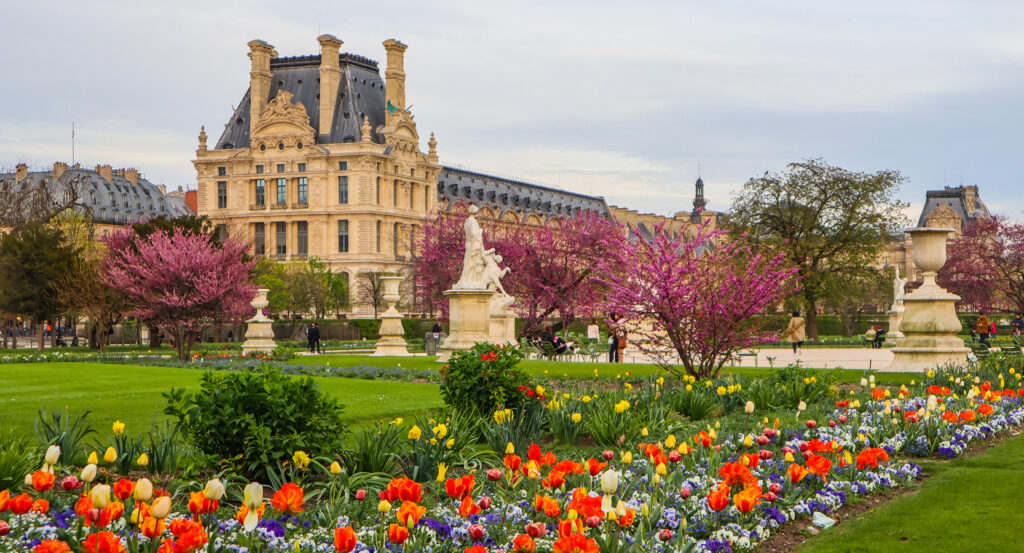
Set along Place du Carrousel near Rue de Rivoli and just steps from Jardin des Tuileries, the arch occupies the center of a vast open esplanade where the Louvre's long northern and southern wings frame lawns, sculpture and broad pedestrian approaches before the formal garden begins. Three arcades divide its compact marble mass as eight Corinthian columns, sculpted soldiers and the crowning quadriga give the structure a dense vertical profile against the open ground. The disappearance of the Palais des Tuileries left the arch standing independently between the Louvre and the garden, exposing sightlines that its original architects never experienced in their present form. Jardin du Carrousel extends around the monument before André Le Nôtre's Grande Allée carries the axis west toward Place de la Concorde, the Champs-Élysées and distant Arc de Triomphe. The result is a precisely scaled imperial monument whose architecture now anchors one of Paris's longest ceremonial perspectives.
What defines Arc de Triomphe du Carrousel .
Arc de Triomphe du Carrousel is best known for commemorating Napoleon I's Grande Armée after the 1805 campaign, translating the emperor's victories at Ulm and Austerlitz into an architectural entrance for the Palais des Tuileries. Napoleon entrusted Charles Percier and Pierre-François-Léonard Fontaine with the project after his return from Austerlitz, placing two architects already responsible for work at the Louvre and Tuileries in charge of the new imperial gateway. Construction began in 1806, drawing upon the ancient arches of Septimius Severus and Constantine in Rome for a three-bay composition articulated by Corinthian columns of pink marble. Dominique Vivant Denon, first director of the Louvre, conceived the sculptural program devoted to the 1805 campaigns in Germany and Austria. Painter Charles Meynier supplied designs from which different sculptors developed reliefs devoted to specific military episodes, integrating contemporary history across the monument's principal faces. Eight statues positioned above the columns represent a cuirassier, dragoon, horse grenadier, mounted chasseur, foot grenadier, gunner, carabinier and sapper, turning individual branches of the Grande Armée into permanent architectural figures. Long inscriptions across the attic recount events of the German campaign in the manner of dedications on ancient triumphal arches. The completed structure functioned as the principal ceremonial entrance to the imperial residence, standing within a grille that separated the palace courtyard from Place du Carrousel. Its name carried an older royal association: Louis XIV had staged the Grand Carrousel, an elaborate equestrian pageant, on the same ground in 1662 to mark the birth of the Dauphin. The arch joined that Bourbon ceremonial territory to Napoleon's new imperial imagery, embedding the regime's military victories within a site already associated with royal performance.
The sculpture crowning the arch underwent a politically charged transformation after Napoleon's fall. Four ancient bronze horses from the facade of Saint Mark's Basilica in Venice had been seized by French forces during the Italian campaigns and brought to Paris in 1798. Installed above the Carrousel arch during the Empire, the Venetian horses connected Napoleon's new monument with trophies carrying their own centuries-long history. The Bourbon Restoration reversed that appropriation in 1815, when the bronzes were returned to Venice and the summit temporarily lost the group that had dominated its silhouette. François-Joseph Bosio created the replacement quadriga installed during the Restoration period, with a chariot drawn by four horses and accompanied by gilded figures of Victory and Peace. Political change consequently altered the monument without dismantling the Napoleonic architecture beneath it. Another rupture arrived in 1871 when the Paris Commune burned the Palais des Tuileries, leaving the arch before a ruined imperial residence. Demolition of the palace remains in 1883 transformed the monument from a gateway into a freestanding object and opened the uninterrupted perspective now extending between the Louvre and Jardin des Tuileries. Conservation undertaken from 2022 through 2024 reinforced the structure, treated its stone and marble and addressed its extensive sculptural program, preserving a monument whose physical history has survived imperial collapse, Bourbon restoration, revolution and the disappearance of the palace it was built to enter.
How Arc de Triomphe du Carrousel fits.
Arc de Triomphe du Carrousel works as the anchor for a daytime exploration through the 1st Arrondissement using three nearby sites that move from Catherine de Médicis and André Le Nôtre's royal landscape through Richelieu's seventeenth-century palace into a church assembled through successive commissions by major architects and artists.
Begin at Jardin des Tuileries, created in 1564 when Catherine de Médicis commissioned a palace and garden on ground occupied by tile makers beyond the contemporary city walls. André Le Nôtre completely redesigned the garden from 1664 for Louis XIV, organizing its central axis, parterres and basins through calculated geometry whose optical effects remain visible along the Grande Allée. The palace burned during the Commune in 1871 and disappeared, yet the garden survived; a 1990 competition later selected landscape architects Pascal Cribier and Louis Benech for another major intervention. The Louvre has administered the Tuileries since 2005, preserving a landscape whose sculpture collection now ranges from historic works by Antoine Coysevox to pieces by Jean Dubuffet, Giuseppe Penone and Louise Bourgeois. Continue to Domaine national du Palais-Royal, where Cardinal Richelieu purchased the Hôtel de Rambouillet in 1624 and entrusted Jacques Lemercier with the residence that became the Palais-Cardinal. Richelieu installed painting galleries and a theater before bequeathing the property to Louis XIII; Anne of Austria subsequently occupied it with the young Louis XIV and Philippe d'Orléans. Louis-Philippe Joseph d'Orléans later commissioned Victor Louis to build the arcaded wings around the garden during the 1780s, turning their ground floors into commercial premises that helped make the complex a center of Parisian political and social activity before the Revolution. François-Léonard Fontaine reshaped portions of the palace for the future Louis-Philippe during the nineteenth century, and Daniel Buren's Deux Plateaux introduced its black-and-white columns into the Cour d'Honneur in the twentieth. Conclude at Église Saint-Roch, whose main body rose between 1653 and 1690 from plans by Jacques Lemercier before Robert de Cotte supplied its facade in 1736 to 1738. Jules Hardouin-Mansart constructed the Chapelle de la Vierge between 1706 and 1710, and parish priest Jean-Baptiste Marduel later assembled a major decorative campaign involving Étienne-Maurice Falconet, Jean-Baptiste Marie Pierre, Joseph-Marie Vien and Gabriel-François Doyen. Étienne-Louis Boullée extended the sequence with the Chapelle du Calvaire in 1754, creating a chain of architectural and artistic commissions spanning a century. Revolutionary damage altered Marduel's program, after which the church received paintings and sculpture transferred from other destroyed religious buildings, giving Saint-Roch an exceptional concentration of seventeenth and eighteenth-century French art. The progression moves from Catherine de Médicis and Le Nôtre's royal landscape through Richelieu, Lemercier and Victor Louis's evolving palace into Saint-Roch's century-long sequence of architecture, painting and sculpture, extending the Carrousel through three institutions that concentrate the artistic patronage of royal and pre-Revolutionary Paris.
Where your story begins.
Foresyte Travel reveals places that feel extraordinary long before you arrive.
Experience premium editorial crafted for luxury travelers.
Foresyte Travel may earn a commission when you book through the link on this page.














































































































