
Why Louvre Museum matters.
Louvre Museum is a commanding cultural institution where the 1st Arrondissement's royal character meets an immense former palace, a transparent glass pyramid and collections spanning civilizations across several millennia.
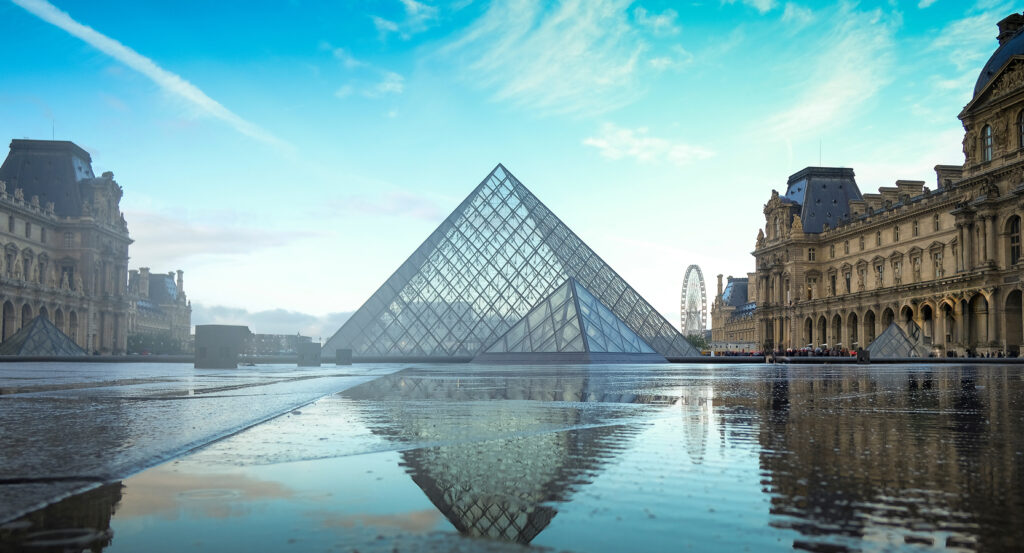
Set along Rue de Rivoli near Rue de l'Amiral de Coligny and just steps from the Seine, the museum occupies a vast palace precinct where long classical facades, the Cour Carrée, the Cour Napoléon and the Tuileries axis open a succession of grand spaces between dense Right Bank streets and the river. The Sully, Richelieu and Denon wings enclose courtyards whose stone elevations shift from Renaissance sculpture to seventeenth-century classicism and Second Empire ornament. I. M. Pei's glass pyramid creates the principal contemporary intervention within the Cour Napoléon, its transparent geometry exposing the older palace fronts across the surrounding pools. Passage through the complex moves between expansive galleries, surviving royal rooms, underground medieval fortifications and courtyards that reveal the institution as both museum and accumulated architectural site. The result is a vast encounter with art and French history in which the collections and the palace carrying them operate at an exceptional physical and chronological scale.
What defines Louvre Museum.
Louvre Museum is best known for transforming a royal complex whose history began with Philippe Auguste's fortress into a universal museum assembled through more than eight centuries of architectural, political and collecting history. Philippe Auguste began the fortress 1190 as part of Paris's western defenses, creating a moated quadrilateral dominated by the Grosse Tour, a keep thirty meters high and fifteen meters across. Expansion of Paris under Charles V brought the fortress inside a new defensive circuit during the fourteenth century, ending its original strategic purpose and allowing the king to convert it into a royal residence with apartments, gardens and a library. François I returned royal attention to the site during the Renaissance and initiated replacement of the medieval castle, with Pierre Lescot developing the palace architecture continued under Henri II and sculptor Jean Goujon supplying decoration for the new wing. Henri IV later pursued the Grand Dessein to connect the Louvre with the Tuileries, constructing the Grande Galerie between 1595 and 1610 along the Seine. Jacques Lemercier extended the Lescot wing under Louis XIII and created the Pavillon de l'Horloge, followed under Louis XIV by Louis Le Vau's enlargement of the Cour Carrée, Charles Le Brun's Galerie d'Apollon and the eastern Colonnade developed by a group including Le Vau, Le Brun and Claude Perrault. Louis XIV's move toward Versailles left substantial palace space available to artists and learned institutions, strengthening associations between the Louvre and artistic production before the Revolution. A 1791 decree assigned the palace to a museum of the arts, and the Muséum central des arts opened on August 10, 1793. Napoleon expanded its holdings and renamed it Musée Napoléon, and the nineteenth century brought further construction before Napoleon III's Nouveau Louvre under Louis Visconti and Hector Lefuel finally joined the Louvre and Tuileries palace complexes. The Louvre's institutional significance rests on this extraordinary sequence, in which fortress, royal residence, artists' precinct, revolutionary museum and imperial palace successively enlarged the same site.
The collections acquired their present global stature through a succession of royal acquisitions, revolutionary transfers, archaeological discoveries and major gifts that repeatedly changed what the museum placed before the public. François I brought Leonardo da Vinci to France and acquired the Mona Lisa in 1518, placing the painting within the royal collection centuries before that collection entered the Louvre as public property. Revolutionary seizures and works transferred during Napoleon's military campaigns expanded the museum after 1793, though the settlement following Waterloo required the restitution of thousands of objects taken during those conquests. The Venus de Milo arrived during that changed political climate after its discovery on Melos in 1820, passing through the Marquis de Rivière and Louis XVIII before the king gave it to the Louvre in March 1821. Archaeological missions and diplomatic gifts subsequently brought Greek sculpture from Olympia, Assos and Magnesia into the antiquities department during the nineteenth century. Charles Champoiseau discovered the Winged Victory of Samothrace in 1863 and sent its fragments to Paris, with later archaeological work establishing the relationship between the goddess and the gray-marble ship base that transformed its presentation. The museum's painting holdings expanded through purchases, state commissions and private donations, then changed substantially in 1986 when works centered on the period after 1848 moved to the newly opened Musée d'Orsay. These successive acquisitions and redistributions turned inherited royal holdings into collections continually reshaped by revolution, diplomacy, archaeology, state policy and private collecting.
How Louvre Museum fits.
Louvre Museum works as the anchor for a daytime exploration of the adjoining royal center using three nearby sites that move from the medieval parish of the Louvre through Richelieu's seventeenth-century palace into an imperial triumphal arch created for Napoleon.
Begin at Saint-Germain-l'Auxerrois, the historic church facing the Louvre across Place du Louvre and a surviving religious counterpart to centuries of royal residence across the street. The present building preserves construction from several periods beginning in the Middle Ages, with Gothic additions producing its porch, rose window, buttresses and tower. Political upheaval repeatedly altered its fate: the church was sacked during a memorial service for the Duc de Berry on February 13, 1831, before an 1837 law authorized restoration and reopening under Jean-Baptiste Lassus and Victor Baltard. Second Empire redevelopment then recast the surrounding Place du Louvre, with Jacques Hittorff designing the neighboring mairie and Théodore Ballu creating the Neo-Gothic belfry between the church and municipal building. Continue to Palais-Royal, where Cardinal Richelieu acquired the Hôtel de Rambouillet and adjoining parcels beginning in 1624 and commissioned Jacques Lemercier to create the Palais-Cardinal. Richelieu left the residence to Louis XIII, after which Anne of Austria and the young Louis XIV occupied it and the name shifted to Palais-Royal; the Orléans family received the complex from 1661. Victor Louis reshaped the garden precinct during the late eighteenth century for the duc de Chartres, constructing the Valois, Beaujolais and Montpensier wings and introducing 180 commercial arcades that helped make the complex a major Parisian center for shops, cafés, restaurants and political gathering. Conclude at Arc de Triomphe du Carrousel, commissioned by Napoleon from Charles Percier and Pierre Fontaine after Austerlitz and built between 1806 and 1810 as the ceremonial entrance to the Tuileries palace. Dominique Vivant Denon devised a sculptural program celebrating the Grande Armée and coordinated eighteen sculptors, with reliefs based on Charles Meynier's designs depicting episodes from the 1805 campaigns. Eight soldier statues rise above Corinthian columns of pink marble, and François-Joseph Bosio's quadriga has crowned the structure since 1827 after the horses taken from Saint Mark's in Venice were returned in 1815. The progression moves from a medieval royal parish reshaped by nineteenth-century restoration through Richelieu and the Orléans family's successive creation of Palais-Royal into Percier, Fontaine and Denon's imperial monument, extending the Louvre into three nearby sites shaped by monarchy, revolution and empire.
Where your story begins.
Foresyte Travel reveals places that feel extraordinary long before you arrive.
Enjoy editorial crafted for luxury travelers.
Foresyte may earn a commission when you book.














































































































