
Why Communards' Wall matters.
Communards' Wall is a solemn historic memorial where Père-Lachaise's funerary character meets the final violence of the Paris Commune, the mass execution of captured fédérés and a political commemoration sustained across more than a century.
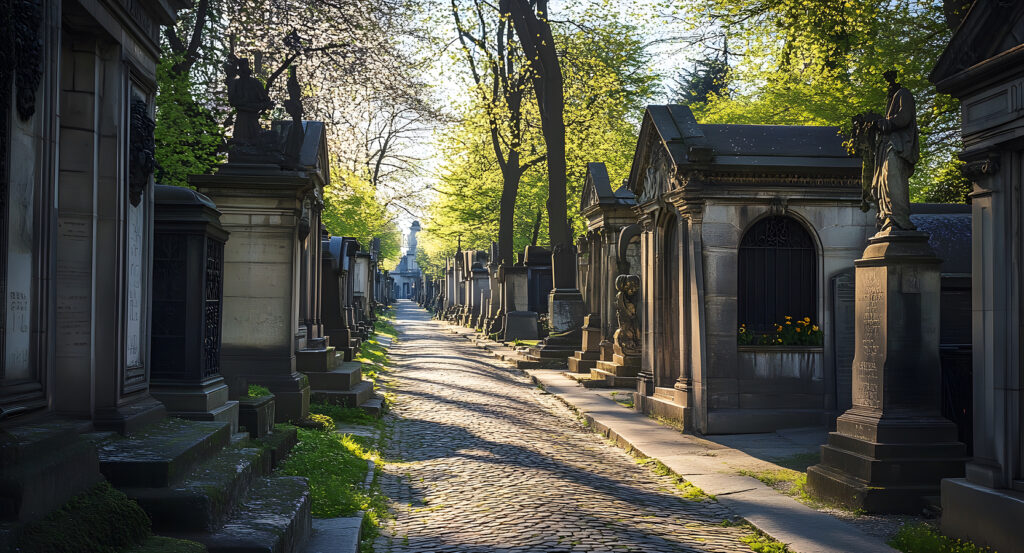
Set along the eastern perimeter of Cimetière du Père-Lachaise near Avenue Transversale No. 3 and just steps from Division 76, the memorial occupies a secluded cemetery edge where a long stone enclosure, closely spaced graves, mature trees and narrow paths create an austere pocket within the vast wooded necropolis. The commemorative plaque sits directly against the masonry, with graves associated with Communard and socialist figures extending across the ground before it. Dense vegetation and irregular rows of funerary monuments narrow the approach, separating this eastern corner from the cemetery's grand central avenues and expansive entrances. The surrounding divisions preserve the layered stonework, trees and sloping terrain that characterize Père-Lachaise after two centuries of burials. The result is a restrained memorial whose physical simplicity concentrates attention on the historical event that turned an ordinary cemetery wall into one of the enduring sites associated with the Commune of 1871.
What defines Communards' Wall.
Communards' Wall is best known for marking the place where captured Communards were executed during the closing hours of the Semaine sanglante, the military suppression that ended the Paris Commune in May 1871. Versailles forces entered Paris on May 21 and advanced east through a week of barricade fighting as territory held by the Commune contracted toward Belleville and Ménilmontant. Père-Lachaise became one of the final fortified positions, with Communards using the cemetery's walls, tombs and elevated ground during combat on May 27. Versailles troops penetrated the cemetery that day, and fighting continued among the graves at close quarters. Historical accounts associated with the site state that 147 captured fédérés were subsequently shot against the eastern enclosure and buried nearby in a mass grave, though City of Paris material also uses a broader figure of close to 200 for executions connected with this section of Père-Lachaise. The Commune itself ended on May 28 as the remaining barricades in eastern Paris fell to government forces. Bodies of other fédérés killed during the fighting were buried in mass graves around the cemetery, deepening the association between this corner of Père-Lachaise and the repression that followed the insurrection. The site soon acquired the name Mur des Fédérés, fixing the execution ground within the political memory of the Commune. Former Communards, relatives and political organizations subsequently turned the wall into a recurring commemorative destination, transforming a place created through military defeat into a persistent gathering point for remembrance.
Commemoration at the wall developed into a political tradition whose history extended far beyond the events of 1871. Flowers appeared at the burial ground by Toussaint that year, and socialist newspapers called the first organized montée au Mur on May 23, 1880, shortly before the full amnesty for Communards enacted that July. Former participants in the Commune subsequently helped sustain annual processions, and political parties and trade unions incorporated the site into their own commemorative practices. A marble plaque dedicated to the dead of the Commune was installed in the opening decade of the twentieth century, formalizing an association already sustained through decades of gatherings. The 1936 commemoration occurred immediately after the electoral victory of the Popular Front and drew a vast procession to Père-Lachaise amid the labor mobilization of that spring. Communards and later political figures associated with the Commune were also buried near the wall, strengthening the connection between the execution site and subsequent generations of socialist and labor history. The annual montée continues on the Saturday closest to May 28 under the auspices of the Amies et Amis de la Commune de Paris 1871, preserving a commemorative practice whose origins reach the first decade after the uprising.
How Communards' Wall fits.
Communards' Wall works as the anchor for a historical exploration through Père-Lachaise using three nearby sites that move from a nineteenth-century universal funerary sculpture through an early modernist literary tomb into a postwar memorial corridor devoted to victims of Nazi deportation.
Begin at Monument aux morts de Bartholomé, the immense sculptural composition developed by Albert Bartholomé after he shifted from painting toward sculpture following the death of his wife. Work began in 1889, and the finished monument was unveiled on November 1, 1899 after Bartholomé had presented the definitive plaster model at the Salon de la Société nationale des Beaux-Arts in 1895. Its two registers organize life, death and mourning around a central opening derived from ancient funerary architecture, with paired groups of human figures approaching the threshold. The unveiling drew 98,000 people on its first day, demonstrating the extraordinary public attention commanded by the work at the end of the nineteenth century. Continue to Tombe d'Oscar Wilde, whose occupant first entered Père-Lachaise through transfer from Bagneux in 1909. Jacob Epstein received the commission from Wilde's literary executor Robert Ross and carved the enormous winged figure associated with the tomb from a block of stone, developing a work whose modernist treatment generated controversy before its installation. The monument later became one of the cemetery's protected funerary works, joining the graves of Frédéric Chopin, Molière, Jean de La Fontaine and other figures singled out within Père-Lachaise's classified heritage. Conclude at Monuments de la Déportation, where remembrance expanded after the Second World War into a series of memorials devoted to victims of Nazi concentration and extermination camps. Fifteen monuments were erected along the cemetery's circular avenue between 1946 and 2017, including memorials associated with Auschwitz III-Buna-Monowitz, Natzweiler-Struthof, Buchenwald-Dora, Dachau, Bergen-Belsen and Sachsenhausen. Their concentration near older sites associated with the Commune, antifascism and the Resistance created a distinctive commemorative district within Père-Lachaise. The progression moves from Bartholomé's universal treatment of mortality through Epstein's individualized memorial to Wilde into the postwar concentration of monuments devoted to deportation and extermination, carrying a walk through Père-Lachaise across three successive approaches to public remembrance.
Where your story begins.
Foresyte Travel reveals places that feel extraordinary long before you arrive.
Enjoy editorial crafted for luxury travelers.
Foresyte may earn a commission when you book.














































































































