
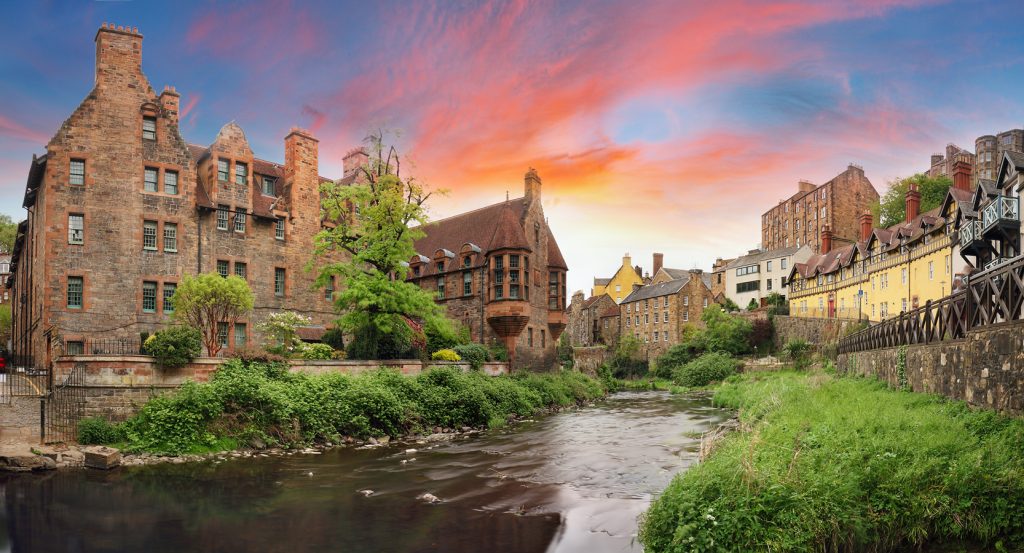
Why Bells Brae matters.
Bells Brae is the moment Dean Village reveals its soul, a narrow, vintage lane in Edinburgh where river-scented air, honeyed sandstone, and the hush of the Water of Leith gather into one spell.
Slip down from Queensferry Road and the city noise falls away; the bridge arches high above while Bells Brae curls beside the water like a ribbon of cobbles. Cottages lean close, lintels carved with relics of the old milling guilds, ivy threading their walls as if stitching past to present. Footsteps sound softer here. You catch fragments of birdsong, the whisper of current against stone, the clink of a window latch, small, human notes that make the street feel inhabited. At golden hour the façades glow apricot; after rain they deepen to copper and peat, reflecting the sky in scattered puddles. Bell's Brae isn't a grand vista; it's an intimate one, the kind that slows your breathing and makes you notice textures, angles, and light. In a city famous for drama, this is its gentlest scene change.
What defines Bells Brae.
The name carries centuries of work and water.
For more than eight hundred years, this bend in the river was the approach to Edinburgh's milling quarter; grain wagons rattled over these stones toward waterwheels that fed the city. Brae” marks the slope; “Bell” points to a proprietor's yard or a guild house whose bell once kept shift-time, a practical music for practical lives. Look closely and the street still murmurs its function: thresholds worn into shallow crescents by boots and barrows; anchor rings set low in masonry for tethering carts; millstones worked into garden edges like fossils. In the 19th century, philanthropic renewal reshaped the valley and Bells Brae became the front row of a social experiment in dignified housing and public beauty. The lane's tight curve isn't accidental, it frames the river and slows traffic to a human pace, a piece of style urbanism long before the term existed. Even the sightlines are deliberate: stand midway and Well Court rises like a stage set; turn back and the Dean Bridge crowns the view, a stone proscenium arching over everyday life. What reads as scenic is, in truth, deeply intentional, a choreography of gradient, light, and craft.
How Bells Brae fits.
Treat this lane as a threshold, not a shortcut.
Start at the Dean Bridge and descend slowly, pausing where the parapet first opens to the valley, that's your wide establishing shot. As you reach the curve of Bells Brae, walk the inside edge where the cobbles tilt subtly toward the river; the soundscape gathers there, richer and rounder. Stop by the cottages with crest stones and bread-motif carvings, then continue to the river wall for your most cinematic composition: water, stone, and the red gables of Well Court aligned in a single frame. Come early morning for dew-dark cobbles and chimney smoke, or at late afternoon when the lane turns to molten amber and reflections pool like glass. If rain finds you, stay, Bells Brae is at its most tender in soft weather, when the river swells and the street exhales petrichor. From here, drift onto the Water of Leith Walkway toward St. Bernard's Well and Stockbridge, or loop back uphill to re-emerge on Queensferry Road with the pleasant shock of city bustle returning. Bring nothing more than good shoes and a few unhurried minutes. Bells Brae rewards presence: the slower you move, the more the lane gives, a windowbox geranium, a cat in a sill, a faint bell of memory carried on the river's breath.
Where your story begins.
Foresyte Travel reveals places that feel extraordinary long before you arrive.
Enjoy editorial crafted for luxury travelers.
Foresyte may earn a commission when you book.














































































































